The Latest Trump Assassination Attempt, How Media Narratives Fuel Violence

The Latest Trump Assassination Attempt, How Media Narratives Fuel Violence

The Latest Trump Assassination Attempt, How Media Narratives Fuel Violence
April 28, 2026

Donald Trump is surrounded by security personnel during a public event, emphasizing the heightened security measures in place.
There have been at least five assassination attempts on the life of President Trump since his 2016 campaign. Media framing him as a Nazi and a threat to democracy has emboldened the left to call for and engage in political violence. Photo courtesy of James Skoufis.

The April 25, 2026 attack at the White House Correspondents’ Dinner was the fifth documented attempt against President Donald Trump in less than a decade. The first, largely forgotten by the media, came in 2016, when Michael Steven Sandford attempted to seize an officer’s weapon at a Trump rally in Las Vegas.

The most widely remembered was Thomas Matthew Crooks opening fire at the Butler, Pennsylvania rally on July 13, 2024, killing one rallygoer and grazing Trump’s ear, producing the iconic photograph of Trump raising his fist and shouting “Fight, fight, fight.” Between the fourth and fifth attempts on the president’s life, conservative Christian commentator Charlie Kirk was assassinated while engaging students in open dialogue on a university campus.

The media enabled violence against both men through sustained false framing. Trump was portrayed for years as a Russian asset and a threat to democracy. Using out-of-context quotes and selective framing, the media painted Kirk as a racist and a homophobe. Some on the left called for the deaths of both men and celebrated when Kirk was killed.

The media campaign against Trump began before his first election. On September 23, 2016, reports surfaced that U.S. authorities were investigating Trump campaign figure Carter Page for possible ties to Russian influence operations. This was the first public story directly linking a Trump associate to Russia. Fusion GPS, the opposition-research firm hired by the Clinton campaign, had directed Christopher Steele to share his findings with the media as early as mid-September 2016, weeks before the election.

On October 7, 2016, DHS and Director of National Intelligence James Clapper issued a public statement attributing the hacking of Democratic officials and the WikiLeaks releases to Russian intelligence acting to benefit Trump. On January 10, 2017, BuzzFeed published the Steele dossier in full, the same day Jeff Sessions’s confirmation hearing began, triggering wall-to-wall media saturation of the Russia narrative. The FBI’s own investigation, Crossfire Hurricane, had been formally opened on July 31, 2016, though the Durham Report later concluded it lacked an adequate factual basis.

The Russia narrative, the claim that Trump was a foreign-installed puppet being blackmailed by Vladimir Putin, ran for Trump’s entire first term and shaped two impeachment proceedings. The Mueller Report found no evidence of criminal conspiracy. The Durham Report concluded the FBI launched its investigation without an adequate factual basis and applied a double standard not applied to the Clinton campaign. The narrative collapsed only after nearly three years of continuous coverage built on material that, as Durham confirmed, lacked a factual foundation from the start.

Despite Russiagate collapsing, the media still runs with it from time to time, ostensibly on slow news days. However, Trump’s second term has been more acutely shaped by media framing him as a tyrant and a threat to democracy. The Intercept ran a 2024 piece arguing Trump “represents an existential threat to democracy” and that the warning “must be repeated, over and over again.” NPR aired a segment in which a political scientist argued the press had an “obligation” to cover Trump as a threat to democracy in the same way it covers climate change, with no opposing view presented.

The April 25, 2026 Correspondents’ Dinner shooter, Cole Allen, left social media posts comparing Trump to Adolf Hitler and encouraging others to buy guns. Press Secretary Karoline Leavitt’s statement after the shooting was precise: “Those who constantly, falsely label and slander the president as a fascist and a threat to democracy and compare him to Hitler to score political points are fueling this kind of violence.”

A documented series of celebrity statements explicitly invoked Trump’s assassination or injury, with minimal institutional consequence. In May 2017, Kathy Griffin posed holding a bloodied, severed head styled to resemble Trump; CNN fired her, but she reposted the image after his 2023 indictment. At the January 2017 Women’s March, Madonna said she had “thought an awful lot about blowing up the White House.” At the 2017 Glastonbury Festival, Johnny Depp asked the crowd, “When was the last time an actor assassinated a president?” and added, “Maybe it’s time.”

In March 2017, Snoop Dogg released a music video depicting him shooting a prop gun at a Trump-lookalike clown called “Ronald Klump.” In June 2017, the New York Public Theater staged Julius Caesar with the lead dressed as Trump, stabbed to death onstage nightly. Days before the April 25, 2026 attack, Jimmy Kimmel joked that Melania had “a glow like an expectant widow.” Trump called for his firing; Melania called it “hateful and violent rhetoric.” When conservatives made comparable statements about Obama-era figures, prosecutions and firings followed. Most of these incidents produced only brief apologies.

The media framing of January 6 as a violent coup attempt orchestrated by Trump became foundational to the “existential threat” narrative. The White House has noted that the House Select Committee’s report “violated House rules, deleted documents in the final days of the 117th Congress, and had a predetermined, partisan outcome.” Trump was acquitted in his second Senate impeachment trial, and no court found him criminally liable for the events.

The claim that he “incited an insurrection,” repeated as a settled fact across countless news cycles, was legally contested and never proven in court, yet it was used continuously to brand him as someone who had already attempted to overthrow the U.S. government, making further violence easier to rationalize.

Democratic politicians contributed directly to the incitement environment. Joe Biden said in 2016, “If we were in high school, I could take him behind the gym,” a remark he later repeated more explicitly, saying, “I’d take him behind the gym and beat the hell out of him.” Nancy Pelosi said in June 2018, “I just don’t even know why there aren’t uprisings all over the country. And maybe there will be,” and on another occasion, “You’ve got to be ready to take a punch. You’ve got to be ready to throw a punch.”

Hakeem Jeffries called on people to “fight” the Trump administration “in the streets.” In 2018, Rep. Maxine Waters told supporters to confront Trump cabinet members in restaurants, gas stations, and department stores and “tell them they’re not welcome anymore, anywhere.”

The sustained characterization of Trump as a white supremacist by mainstream outlets, academics, and politicians altered the moral permission structure for violence against him. The Charlottesville “both sides” misquote is the clearest example: Trump’s full statement condemned neo-Nazis explicitly, but the selective clip, “very fine people on both sides,” was presented for years as evidence of white supremacy by major outlets and repeated by Biden as a cornerstone of his 2020 campaign, even after multiple fact-checkers noted the misrepresentation. The same pattern of selective framing applied to Kirk.

When a political figure is credibly labeled a white supremacist or a racist by mainstream institutions, the framework that inhibits violence against him erodes.

The post The Latest Trump Assassination Attempt, How Media Narratives Fuel Violence appeared first on The Gateway Pundit.

Go to Source
Author: Antonio Graceffo

MUST WATCH: Abortion Advocate Refuses to Name Preferred BARBARIC Abortion Method After Rep. Brandon Gill Grills Her in House Hearing – Exposes the Barbaric Reality Democrats Desperately Want to Hide

MUST WATCH: Abortion Advocate Refuses to Name Preferred BARBARIC Abortion Method After Rep. Brandon Gill Grills Her in House Hearing – Exposes the Barbaric Reality Democrats Desperately Want to Hide

MUST WATCH: Abortion Advocate Refuses to Name Preferred BARBARIC Abortion Method After Rep. Brandon Gill Grills Her in House Hearing – Exposes the Barbaric Reality Democrats Desperately Want to Hide
April 28, 2026

Congressional hearing featuring Mr. Gill and Ms. Waters discussing key issues, highlighting their engagement and the importance of the dialogue.

Republicans took a bold stand against the radical left’s sacred cow: the so-called Freedom of Access to Clinic Entrances (FACE) Act. The hearing exposed how the Biden DOJ weaponized this law as a club to smash pro-life Americans while turning a blind eye to violent attacks on pregnancy resource centers and churches.

Freshman Rep. Brandon Gill (R-TX) delivered one of the most uncomfortable moments for the abortion lobby in recent memory.

Gill directly confronted Jessica Waters, Assistant Professor of Justice, Law & Criminology and a vocal advocate for abortion access, asking which BARBARIC abortion method she preferred.

When she declined to answer directly, Gill proceeded to list and describe several procedures, including suction abortion, dilation and curettage, dilation and evacuation, and saline injection, pressing her to explain which method she considered acceptable.

Instead of addressing the barbarism, Waters pivoted to tired talking points about the “FACE Act” and “reproductive health care access.”

Here is the devastating back-and-forth:

Brandon Gill:
You’re an advocate for abortion policy. What’s your favorite type of abortion?

Jessica Waters:
I am an advocate for patients having access to the full realm of reproductive health care.

Brandon Gill:
But do you have a preferred method of abortion that you like?

Jessica Waters:
I do not.

Brandon Gill:
Let me read through a couple different methods, and I want to get your take on how much you like these. The first type is called a suction abortion. This is when the cervix is dilated, and a strong suction, 29 times the power of a household vacuum cleaner, tears the baby’s body apart and sucks it through the hose into a container. Do you prefer that method?

Jessica Waters:
I stand by my former testimony.

Brandon Gill:
That sounds kind of gross, doesn’t it? Sounds pretty gruesome. Do you agree? It does to me.

Jessica Waters:
I stand by how I answered your question fully and accurately.

Brandon Gill:
Okay, what about this one? This one is called dilation and curettage. After dilation of the cervix, a sharp looped knife is inserted into the uterus. The baby’s body is cut into pieces and extracted, often by suction. Do you prefer that method?

Jessica Waters:What I believe we are here to talk about today is the FACE Act. We are not here to talk about—

Brandon Gill:
I’m asking you. You’re a pro-abortion advocate. I’m asking if you prefer the dilation and curettage method.

Jessica Waters:
I am an access to reproductive health care advocate.

Brandon Gill:
You don’t want to talk about abortion itself. Why is that?

Jessica Waters:
I would prefer to talk about the reason that the committee called the hearing.

Brandon Gill:
Is it because it’s uncomfortable to talk about?

Jessica Waters:
I would prefer—

Brandon Gill:
It should be uncomfortable.

Jessica Waters:
I would prefer, if you would let me finish my statement, to talk about the Freedom of Access to Clinic Entrances Act, which is what I was asked to come here and talk about.

Brandon Gill:
How about this one? It’s called dilation and evacuation. Forceps are inserted into the uterus, grabbing and twisting the baby’s body to dismember him or her. If the head is too large, it must be crushed in order to remove it. Do you prefer that method?

Jessica Waters:
I would prefer to talk about the reason the hearing was called and the basis of my expert testimony.

Brandon Gill:
It’s uncomfortable to hear this, isn’t it? It is. I think it is because it’s barbaric and evil. How about this one? It’s called the saline injection. It’s when a 20% salt solution is injected through the mother’s abdomen into the baby’s amniotic fluid. The baby’s skin is burned off. The baby ingests the solution and dies of salt poisoning, dehydration, and hemorrhaging of the brain. Do you prefer that method?

Jessica Waters:
I would prefer to talk about the subject of the hearing.

Brandon Gill:
This is the subject of the hearing. This is about protests outside of abortion clinics. I’m asking you about abortion.

Jessica Waters:
I stand by my prior testimony.

Brandon Gill:
Okay. I wouldn’t want to talk about this either if I were you, because it is barbaric and evil.

WATCH:

The post MUST WATCH: Abortion Advocate Refuses to Name Preferred BARBARIC Abortion Method After Rep. Brandon Gill Grills Her in House Hearing – Exposes the Barbaric Reality Democrats Desperately Want to Hide appeared first on The Gateway Pundit.

Go to Source
Author: Guest Contributor

“I’m Innocent!” – A Smug Comey Responds to Second Indictment and Arrest Warrant (VIDEO)

“I’m Innocent!” – A Smug Comey Responds to Second Indictment and Arrest Warrant (VIDEO)

“I’m Innocent!” – A Smug Comey Responds to Second Indictment and Arrest Warrant (VIDEO)
April 28, 2026

James Comey lashed out at the Trump Administration after a grand jury indicted him on charges related to the Trump assassination Instagram post.

“Cool shell formation on my beach walk,” Comey said in his caption in May 2025.

Comey Trump assassination social media post (Screenshot via @Comey on X)

The US Marshals were asked to provide Comey with the indictment, and they issued an arrest warrant.

Comey is facing up to 20 years in prison.

Read the indictment here.

James Comey was indicted on two felony counts:

COUNT ONE: Knowingly and willfully make a threat to take the life of, and to inflict bodily harm upon, the President of the United States;

COUNT TWO: knowingly and willfully did transmit in interstate and foreign commerce a communication that contained a threat to kill the President, Donald J. Trump

Acting Attorney General Todd Blanche, FBI Director Kash Patel and US Attorney Ellis Boyle delivered remarks on the two-count indictment returned by the grand jury in the Eastern District of North Carolina.

Blanche made it clear: “You are not allowed to threaten the President of the United States of America.”
Comey lashed out at the Trump Administration in a video message posted to his Substack.

“Well.. they’re back,” Comey said.

“This time about a picture of seashells on a North Carolina beach a year ago. And this won’t be the end of it. Nothing has changed with me. I’m still innocent,” he said.

WATCH:

The post “I’m Innocent!” – A Smug Comey Responds to Second Indictment and Arrest Warrant (VIDEO) appeared first on The Gateway Pundit.

Go to Source
Author: Cristina Laila

Hijacking the Special Session: Virginia Supreme Court Oral Arguments Yesterday

Hijacking the Special Session: Virginia Supreme Court Oral Arguments Yesterday

Hijacking the Special Session: Virginia Supreme Court Oral Arguments Yesterday
April 28, 2026

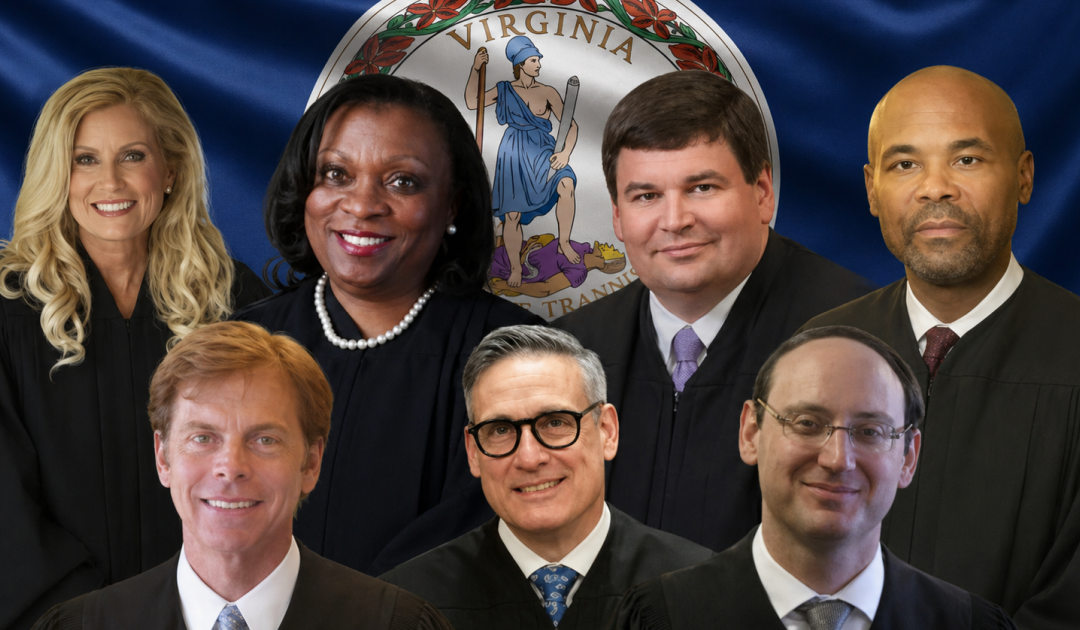
Group portrait of Virginia judges in judicial robes, featuring a backdrop of the Virginia state flag, highlighting diversity in the judiciary.

Yesterday, the Virginia Supreme Court heard oral arguments pertaining to cases previously brought prior to the April 21st referendum election throughout the commonwealth.

Initially, the justices had lifted the temporary restraining order issued by Tazewell County judge Jack Hurley, Jr., without considering the merits of the case.  The Gateway Pundit reported on the issues that were facing the Va. Supreme Court ahead of the referendum vote.

However, the justices determined that they could only rule on the merits of the case if the election succeeded in passing the amendment, allowing the redrawing of districts to favor a new map giving Democrats a 10-to-1 congressional majority in an essentially evenly divided state.  The previous map was 6 to 5 in favor of Democrats.

Virginia requires an amendment to be proposed and agreed upon by a majority of the General Assembly.  Then, in the “first regular session held after the next general election,” members of the General Assembly must agree upon the amendment a second time in the new General Assembly.  Several legal experts have previously suggested that the ruling should favor the nullification of the election on the grounds that numerous procedural requirements were not followed in the process to propose and pass the amendment.

Yesterday, the seven justices heard oral arguments, days after the election.

Appellants Argue the Definition of the Term “Election”

During the oral arguments, a Justice asked, “Do you agree that the word ‘next’ in modifying ‘next general election for the House of Delegates,’ means that if the election has started, that’s not the one, you have to go to the next one?  Your disagreement with the other side is when the election starts?”

Appellant’s counsel responded that he disagreed with the definition of the word ‘election’ used by challengers on “the other side.”  He noted that the Constitution, in five separate provisions, defines the election as “a single day” that “takes place in November, not over a three month period that begins in September.”

“So your position requires us to interpret “election” in such a manner that literally every single vote that is cast for whatever the office is is cast before the election even begins?” the Justice asked.

“Yes, your Honor,” he replied, explaining that it’s consistent with the interpretation of the federal government and “sister states.”

The Justice then noted that constitutional provisions, if not specifically defined, are meant to be interpreted the way the people who ratified them would have.

“Do you think it is at all anomalous to tell somebody that when they went and voted…irrevocably cast their vote, that they were not actively participating in the election when they cast their ballot?” he asked.

Counsel tried to argue that the word “election” is defined; however, the Justice pointed out it was not defined in Article XII Section I that outlines the amendment process, and while the term “elected” appears in other provisions, it is not the word “election,” noting that one is a verb and the other a noun.

Shockingly, to justify the proposed amendment coming during the election but after someone had already cast their ballot, counsel argued that is a risk they are taking in utilizing the option to cast their ballot early.

Watch the exchange in the thread below:


In the clip below, the Justice noted that in the General Assembly debates over Virginia’s 1971 Constitution, “at least a few of the members” said the reason for the intervening election requirement was to ensure people knew how their delegates voted on a proposal before they cast their ballots for or against their incumbent delegate and to allow their opponent to say they would have voted differently.

Counsel argued, and the Justice agrees, that the legislators’ statements do not supersede the plain text of the Constitution.  But that still does not help define the term “the next general election”.  It does, however, offer context of the legislators’ intent in the requirement and whether the proposal can be made in the middle of an ongoing election.


Anecdotal of Disenfranchised Democrat Voter Unchallenged

Counsel for the appellees in their response referenced a sworn affidavit from Camilla Simon, a Democrat voter and plaintiff in the case who voted early during the 2025 general election for her delegate, Rodney Willett.  Willett went on to be the chief patron of the resolution that proposed the constitutional amendment introduced late in the 2025 general election.

Counsel notes that Simon had already voted and was “very unhappy” about the proposal and wished she could change her vote for Willett.  A Justice interrupted to inquire whether the trial court had accepted that as a fact.  Counsel stated it was accepted and was unchallenged by the appellants.

Counsel continued, “In any event, she, like a million or more other people, voted before this amendment was ever even proposed.  None of these voters had any idea this was coming.  And that’s not how the process is supposed to work because, as I mentioned before, it’s the People of the commonwealth, the voters, who possess the power to amend or modify the constitution.  And denying them the knowledge that this proposed amendment was coming through undermines the whole process.”


The Special Session Was Hi-Jacked to Propose the Amendment

In Virginia, a Special Session of the General Assembly may be called by the Governor or by a two-thirds vote in each chamber of the General Assembly.  House Joint Resolution 428 called for a Special Session to address “budget bills.”  HJR 428 reads in part:

“…the General Assembly does hereby apply to the Governor to convene the General Assembly in a special session on Monday, May 13, 2024, for the purpose of considering Budget Bills; and be it”

Appellee’s counsel argued that if a proposal for the amendment had been included in the purpose of the bill for the special session, the General Assembly would not have been able to muster the two-thirds vote calling for the session.

But calling for a special session to consider budgetary bills was a sneaky way to assemble the legislature, introduce the proposed amendment, and then pass it with a simple majority, which Democrats hold in the General Assembly.  The makeup is 64 to 36 in the House of Delegates and 21 to 19 in the Senate.  Neither would have met the two-thirds requirement for a special session had the bill included a proposal to amend the constitution to allow for the redrawing of congressional districts.

Counsel notes that there is no known precedent for the Assembly taking on additional business during a special session outside the bounds of the agreed-upon issues.

Watch this shocking exchange here:


General Assembly Says ‘We Do What We Want’

In one of the most shocking exchanges during the hearing, counsel for the appellants argued that once in the special session, the General Assembly can ultimately ignore the bounds set forth in the bill and conduct any business they see fit with a simple majority.

Counsel stated:

“I want to reiterate the fact that the challengers’ sole argument with respect to the scope of business of the special session…is that they purportedly exercised a power not found in the text of the constitution to limit the scope of that special session.  I just want to point out that HJR 428…says ‘the business shall be to consider such matters as are provided for by the procedural resolution adopted to govern the conduct of business coming before the special session.’”

“So the General Assembly is the master of its own operations?  And if they wanted to close the door more tightly, it could, if it wants to leave it ajar, it can?” a Justice asked.

“Yes, that’s correct, and they can change that by majority vote at any time,” counsel responded.

“But in other words, if they had a pretty airtight resolution saying ‘we’re only gonna look at this one thing and absolutely nothing else,’ then you might agree…”, the Justice asked before being interrupted.

“No, your Honor,” counsel responded.

Shockingly, the use of the term “restore fairness” in the question proposed on the ballot did not come up once during the entirety of the arguments.

The Virginia Supreme Court today denied a request to pause the order blocking the referendum.

BIG NEWS: Virginia Supreme Court Denies Request From AG to Pause Order Blocking Democrat Gerrymander Referendum


The post Hijacking the Special Session: Virginia Supreme Court Oral Arguments Yesterday appeared first on The Gateway Pundit.

Go to Source
Author: Brian Lupo

89-Year-Old Man Arrested for Opening Fire With a Shotgun Inside an Athens Courthouse

89-Year-Old Man Arrested for Opening Fire With a Shotgun Inside an Athens Courthouse

89-Year-Old Man Arrested for Opening Fire With a Shotgun Inside an Athens Courthouse
April 28, 2026

Athens courthouse targeted by shooting – Screengrab Social Media/X

At least five people were wounded by an ‘experienced’ Greek shooter.

It’s a dangerous world, and mass shootings in places like schools, churches, and markets (not to mention hotels) are becoming ever more normalized.

But today (28), in Greece, a tragic incident occurred with a distinct feature: police arrested an 89-year-old man who allegedly opened fire with a shotgun in a social security office and a courthouse in central Athens.

The attack reportedly wounded five people.

Associated Press reported:

“Law enforcement authorities said the suspect was arrested near the city of Patra, some 210 kilometers (130 miles) west of the Greek capital.

The gunman initially opened fire at the social security office, wounding an employee, police said. Police officers who arrived at the scene treated the man, but the gunman fled the scene.”

CCTV footage apparently showed the man carrying a short-barreled shotgun in his right hand.

“The same man was suspected of later opening fire on the ground floor of a court building in another part of central Athens, with several people wounded there, police said, adding that authorities had found the shotgun.

[…] The head of the Athens Judicial Employees Union, Stratis Dounias, said that initial information indicated that the man had shot at the floor inside one of the offices in the court building.

At least three female court employees were slightly wounded by ricocheting shotgun pellets, while media reports said that a fourth female employee was transported to a hospital without physical injuries.”

Read more:

Greece Announces Massive Closure Operation of 60 Illegal Mosques in Athens Operated by Bangladeshis and Pakistanis

The post 89-Year-Old Man Arrested for Opening Fire With a Shotgun Inside an Athens Courthouse appeared first on The Gateway Pundit.

Go to Source
Author: Paul Serran