
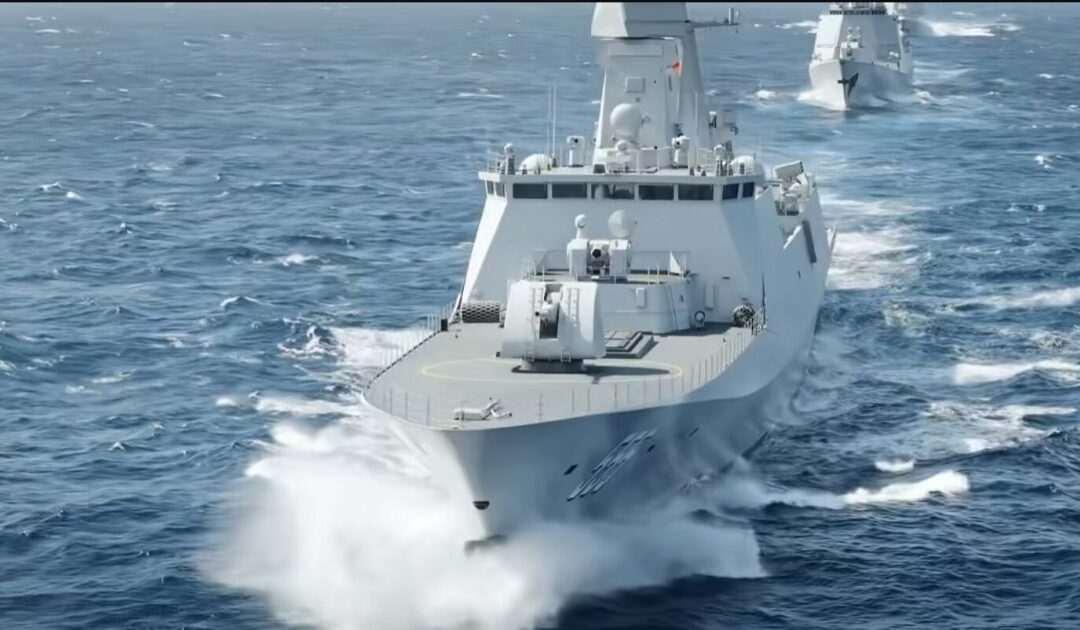
China’s New Navy Frigate Is Impressive but Not a Game Changer — The U.S. Remains the World’s Dominant Naval Power
May 20, 2026

Beijing is heralding its new Type 054B guided-missile frigate as a generational leap that brings the People’s Liberation Army (PLA) Navy closer to parity with the United States. The evidence does not support that claim.
The 054B is a genuine and incremental improvement over its predecessor, relevant within China’s near-seas operational envelope, but it does little to close the overall naval gap with the United States and does not alter the strategic balance. Global Firepower ranks the United States first among 145 nations in overall military power for 2026, a position it has held since the index began in 2005.
Development of the 054B began around 2016 as an evolutionary upgrade to the Type 054A. Hull modules were first spotted at builder Hudong-Zhonghua Shipyard in Shanghai around December 2022. The lead hull was launched in August 2023 and began sea trials in January 2024. The first ship, Luohe (hull 545), was commissioned January 22, 2025 at Qingdao and assigned to the North Sea Fleet. The second ship, Qinzhou (hull 555), built at Huangpu Wenchong Shipyard in Guangzhou, was commissioned in May 2025 and assigned to the South Sea Fleet.
Luohe reached operational capability in January 2026, one year after commissioning. As of April 2026, satellite imagery from March 21 shows both a third and fourth hull at an advanced stage of assembly at Hudong.
The 054B is physically larger than its predecessor, approximately 15 meters longer at around 150 meters overall length, with a beam of approximately 17 meters and a displacement estimated between 5,500 and 6,000 tons. Its armament includes a 32-cell vertical launch system, a new 100mm main gun, dual AESA radars, and aviation facilities for the Z-20 anti-submarine helicopter, replacing the older and lighter Z-9.
Chinese state media describe an AI-assisted architecture designed to reduce blind spots in air defense, integrated sensor and antenna systems to lower radar cross-section, and improved combat command systems. Independent analysts at Janes confirm enhanced ASW sensors, a reduced-signature hull profile, and upgraded command architecture. These are real improvements. The question is what they actually change.
A frigate with better acoustic sensors and a stronger command system becomes a more capable escort for task forces, and the 054B does improve the quality of the PLAN’s screen around carrier groups and amphibious forces. That matters tactically in a South China Sea or Taiwan contingency, where the 054B would operate as the final line of defense within a layered formation alongside Type 055 destroyers and Type 052D multirole destroyers. Within that near-seas envelope, the 054B makes PLAN task forces marginally harder to attrit. That is the accurate and limited scope of its significance.
The Chinese Communist Party’s (CCP) claims that the 054B extends China’s reach into the Western Pacific are completely false. Operational reach is a function of basing infrastructure, replenishment-at-sea capability, and allied port access, not of how capable a frigate is relative to the adversary’s.
China has only one acknowledged overseas military logistics facility, in Djibouti in the Indian Ocean, and potential dual-use access at Ream Naval Base in Cambodia. It has no overseas naval bases in the Western Pacific. Its forward presence in that theater consists of artificial island installations at Fiery Cross Reef, Mischief Reef, and Subi Reef in the South China Sea, which lack the repair infrastructure of established naval bases and sit well within range of US and allied strike assets.
A 054B with improved fuel efficiency still has to return to a Chinese home port when it needs repairs, resupply, or crew rotation. The limiting factor on PLAN reach was never the fuel tank; it is the absence of basing infrastructure, which no frigate improvement resolves.
The United States, by contrast, operates from Yokosuka, Guam, Pearl Harbor, and a network of allied port access across Japan, South Korea, Australia, and the Philippines. This basing network is combined with the Burke-class DDG-51 destroyer fleet, armed with Aegis Baseline 10 and SPY-6 radar. The destroyers carry 96-cell VLS systems, compared to the Type 054B’s 32.
The U.S. also fields Virginia-class submarines that are quieter, deeper-diving, and more lethal than anything currently operated by the PLAN. Additional advantages include P-8 Poseidon maritime patrol aircraft, carrier air wings, and allied interoperability across the Indo-Pacific.Together, these capabilities constitute a set of counters that the Type 054B does not meaningfully degrade.
Global Firepower places the US Navy at 7.168 million tonnes of aggregate fleet displacement, far ahead of the PLAN. Better sensors and AI-assisted air defense on a Chinese frigate do not make Virginia-class submarines easier to find, do not reduce P-8 coverage, and do not alter Aegis performance. US doctrine under Distributed Maritime Operations deliberately distributes combat power across multiple hull classes and platform types, so the absence of a US frigate in the current inventory does not create a vulnerability the 054B exploits.
At present, the PLA Navy has a larger number of vessels than the U.S. Navy, but the U.S. remains the most powerful navy ever to exist. China has demonstrated an ability to produce ships quickly, and the CCP is constantly upgrading ship capabilities. That is a fleet-architecture development worth monitoring.
It does not, however, constitute parity with or a challenge to U.S. maritime superiority, which rests on a global basing network, submarine dominance, carrier aviation, and decades of blue-water operational experience that no single frigate class can close.
The post China’s New Navy Frigate Is Impressive but Not a Game Changer — The U.S. Remains the World’s Dominant Naval Power appeared first on The Gateway Pundit.
Go to Source
Author: Antonio Graceffo