
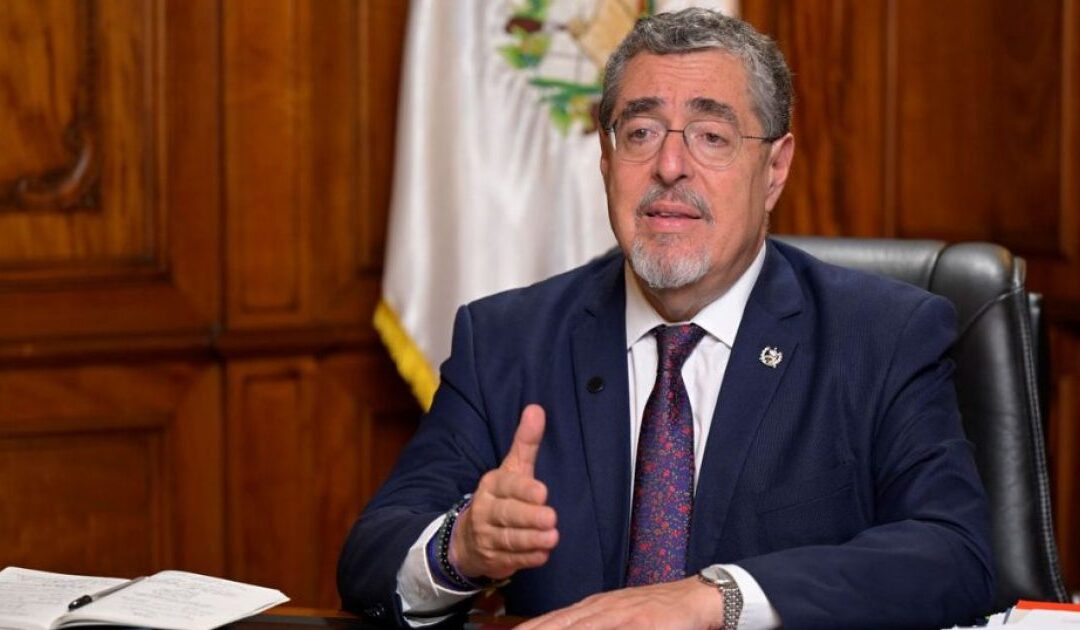
The Open Letter from President Bernardo Arévalo to Guatemalans: The Usual Left-Wing Rhetoric to Consolidate Power
May 21, 2026

Guatemalan President Bernardo Arévalo —a self-described progressive sociologist and leader of the left-wing Semilla movement— published an open letter and a video message addressed to the nation celebrating the departure of Attorney General Consuelo Porras and the appointment of Gabriel Estuardo García Luna as the new head of the Public Prosecutor’s Office (MP).
Porras, a veteran prosecutor with eight years in office, had long been a thorn in the side of Arévalo’s administration.
In his letter, Arévalo portrayed her departure as the end of the alleged “capture” of the MP by “political-criminal networks,” accusing her of protecting corruption while persecuting so-called “reformers.”
This narrative reflects a classic strategy of the Hispanic American left: portraying justice institutions as enemies of change in order to justify placing political allies in power and advancing an ideological agenda under the discourse of “institutional recovery.”
Arévalo’s letter
Arévalo invoked the legacy of his father’s public letters and attributed the 2023 electoral victory and the protests led by indigenous sectors to an alleged citizen resistance against sabotage by traditional elites.
He harshly criticized Porras’ administration, which was accused of facilitating organized crime, drug trafficking, and abuses of power, citing cases against figures such as prosecutor Virginia Laparra, journalist José Rubén Zamora, and his own indigenous allies Luis Pacheco and Héctor Chaclán.
He also recalled his failed attempts to remove her —including public calls for her resignation and political maneuvers blocked in Congress— and presented García Luna’s selection as a “new dawn” achieved through legal and institutional means.
However, Arévalo, whose party holds limited influence in Congress, appears to devote more energy to justifying this political confrontation than to delivering concrete results in response to growing concerns over economic growth, security, and employment.
Nor should it be ignored that the letter omits a fundamental element: Porras operated within a constitutional framework specifically designed to protect the justice system from Executive interference. That institutional independence exists as a safeguard against the kind of state politicization that has historically characterized numerous ideological governments across Hispanic America.
The narrative of the “Pact of the Corrupt”
What happened is not new. Arévalo and his allies have repeatedly used the concept of the so-called “Pact of the Corrupt”: an alleged network of politicians, business leaders, and judicial operators protecting impunity within the State.
That framework served as a campaign slogan and now functions as a tool of political legitimization. However, conservative sectors believe the term has become a useful label to discredit traditional institutions, business actors, and center or center-right figures who defend stability, legal certainty, and anti-communist values.
Porras was the target of international sanctions promoted by various Western governments and international organizations. Even so, she consistently maintained that the prosecutor’s office was investigating legitimate cases of fraud and irregularities, including proceedings related to the Semilla party, such as allegations concerning anomalies in signature collection.
Her defenders argue that Porras’ true “political sin” was resisting the model promoted by the now-defunct International Commission against Impunity in Guatemala, an international structure that many conservative sectors viewed as a form of foreign interference with selective application of justice.
During her administration, the MP was accused of weakening specialized prosecution offices and anti-corruption structures. Her supporters respond that several of those units had become deeply politicized and operated with ideological bias.
Meanwhile, conviction rates for serious crimes —such as extortion, homicide, and organized crime— remained low, a structural problem that existed before Porras and continues to affect the country under the current administration.
The Arévalo administration filed hundreds of corruption complaints, but many did not move forward under the MP’s leadership, fueling accusations of institutional obstruction.
The question remains valid: were these genuine accountability efforts, or the use of state institutions to harass political adversaries and consolidate power?
The new era: reform or revenge?
Gabriel Estuardo García Luna, a career judge and academic, now assumes office promising to restore institutional credibility and strengthen the fight against crime.
Arévalo presents his arrival as a victory for the popular will and the democratic process. However, for critical sectors, the appointment also raises legitimate concerns about the future independence of the MP.
There are fears that the MP could prioritize investigations against conservative actors, business leaders, or former officials, while minimizing politically sensitive matters for the ruling party.
Although some see a possible shift toward “high-impact” cases, Hispanic America’s experience shows that many judicial reforms promoted by left-wing governments ultimately lead to selective enforcement of the law, weakening of institutional checks and balances, and pressure on independent economic sectors.
Porras’ departure closes a period marked by strong tensions between the MP and the Executive branch. Conservatives fear that this new scenario will further reduce checks on presidential power, especially considering Arévalo’s limited legislative strength and his dependence on fragile political alliances.
Corruption, ideology, and institutional risks
Corruption problems in Guatemala are real, deep, and structural. Their roots include institutional weakness, poverty, drug trafficking, political capture, and limited state capacity. Reducing that crisis exclusively to the figure of one attorney general oversimplifies a far more complex reality.
Guatemala continues to rank poorly in international transparency and governance indexes, reflecting the accumulated failure of multiple administrations and political elites.
Conservative sectors maintain that a sustainable fight against corruption requires truly independent justice institutions, legal certainty, economic freedom, strengthening of the rule of law, and individual responsibility —not merely ideological discourse or identity-based political mobilization.
For many critics, the risk is that Arévalo’s project will end up replacing one form of institutional capture with another: an MP more aligned with the Executive’s priorities.
Questions remain open. Will the so-called “new dawn” produce real results in security, justice, and transparency? Or will it simply consolidate a new political elite under a reformist discourse?
Recent experience across Hispanic America —including cases such as Venezuela, Bolivia, and Nicaragua— shows that many leaders who promised to dismantle “corrupt pacts” ultimately weakened institutional checks and concentrated power.
Although Porras’ administration was surrounded by controversy, portraying her departure exclusively as the country’s liberation from “evil networks” reduces a complex national problem to a simplified political narrative.
The true fight against corruption requires strengthening institutions against any factional capture, defending the rule of law, and guaranteeing opportunities and security for all citizens, not only for those who share the political vision of the government in power.
The post The Open Letter from President Bernardo Arévalo to Guatemalans: The Usual Left-Wing Rhetoric to Consolidate Power appeared first on The Gateway Pundit.
Go to Source
Author: Gateway Hispanic