Watch CNN Forced to Report That Gas Prices Have Hit a Four-Year Low (VIDEO)
June 30, 2025
CNN was just forced to report that gas prices have hit a four year low on Trump’s watch. It was a thing of beauty.
They note that lots of people are going to be traveling by car for the July 4th weekend, many more than in recent years.
This comes after months of Democrats and media outlets complaining that Trump has not lowered prices fast enough. Now it’s happening and all the recent criticism gets memory holed.
Gas prices: Fuel costs continue to fall, hitting lowest June price point since 2021
The national average price for regular gas decreased on Monday to $3.185 per gallon, according to AAA, the least expensive average cost for regular gas in the month of June in the last four years.
The latest drop in gas prices comes after several consecutive days of gradual decreases in fuel costs. Monday’s national average price point is less expensive than a week ago when the average price of regular gas was $3.22 per gallon. It is also significantly cheaper than in 2024, when the national average price for regular gas was nearly thirty cents per gallon higher at $3.491.
Furthermore, Monday’s price point for gas means that June will finish with the lowest national average price in June for regular gas since 2021, when it was $3.157 per gallon, according to the U.S. Energy Information Administration. It was also a stark contrast to costs under Joe Biden in June 2022, when the national average price for regular gas was $5.032 per gallon, the most expensive in the country’s history.
Additionally, the fuel costs on Monday were also less expensive than the average price for May, when a gallon of gas was $3.278, according to the U.S. Energy Information Administration.
Now watch CNN reporting on this. It must have pained them to have to cover this:
THE TRUMP EFFECT
Gas prices are at a 4-year low record as Americans go into the 4th of July weekend, all thanks to President Trump’s policies. pic.twitter.com/6VktFWjeXG
ELIE MYSTAL: Imagine Donald Trump wants to do something illegal to you. Ali Velshi, imagine that he wants to murder you. Imagine that he and Stephen Miller released an entire policy explaining how they can murder Canadian journalists who are working in America because they’re taking the jobs from real American journalists. Right? So he’s going to murder you.
So you, Ali Velshi, you go to court. You go to court in the Southern District of New York, and you say, like, “I don’t—I don’t—I don’t think this murder thing is constitutional. It’s clearly illegal. It’s clearly unconstitutional. Donald Trump and Pam Bondi and Stephen Miller shouldn’t be able to have a plan to murder me.”
And the court says, “You’re right, Ali Velshi. There’s no way Donald Trump is allowed to murder you. We’re going to have an injunction. We’re going to stay the executive order saying that he’s going to murder Canadian journalists.”
And so you’re like, great. Awesome. And you go home.
And then Pat Kiernan shows up, and he’s like, “What about me? I’m also a Canadian.” Ashleigh Banfield shows up: “I’m also Canadian. What about me?”
And the courts say, “Well, I can’t help you because Ali Velshi is the one who sued. So, Pat Kiernan, if you don’t want to be murdered, you have to launch your entire own lawsuit in the Southern District of New York—again—to make sure that Donald Trump doesn’t murder you.”
Here’s the video:
Deranged Elie Mystal explains SCOTUS nationwide injunction ruling by describing how Trump could hatch a plot to m*rder people.
“Imagine Donald Trump wants to m*rder you…”
Totally sane, normal stuff going on over there at MSNBC.
A Florida man who was shot in the chest credits a cross necklace for saving his life.
Aidan Perry, 20, told NBC affiliate WESH his friend was showing off a gun and accidentally fired it.
The bullet ricocheted off the golden necklace and became lodged in the fatty tissue of his chest. Doctors said the necklace saved his life, as it took most of the force of the bullet and slowed it down enough that it didn’t enter his chest.
If he hadn’t been wearing the necklace, doctors said the bullet could have pierced his lungs or heart.
LOOK:
“HE’S THE REASON I’M STILL HERE”: A Florida man credits God with saving his life after his cross necklace blocked a bullet from piercing his chest. https://t.co/hwfLGX3DHPpic.twitter.com/u6ZfxahxKW
Europe’s Defense Reality Check: The Mathematics of Military Inadequacy
June 30, 2025
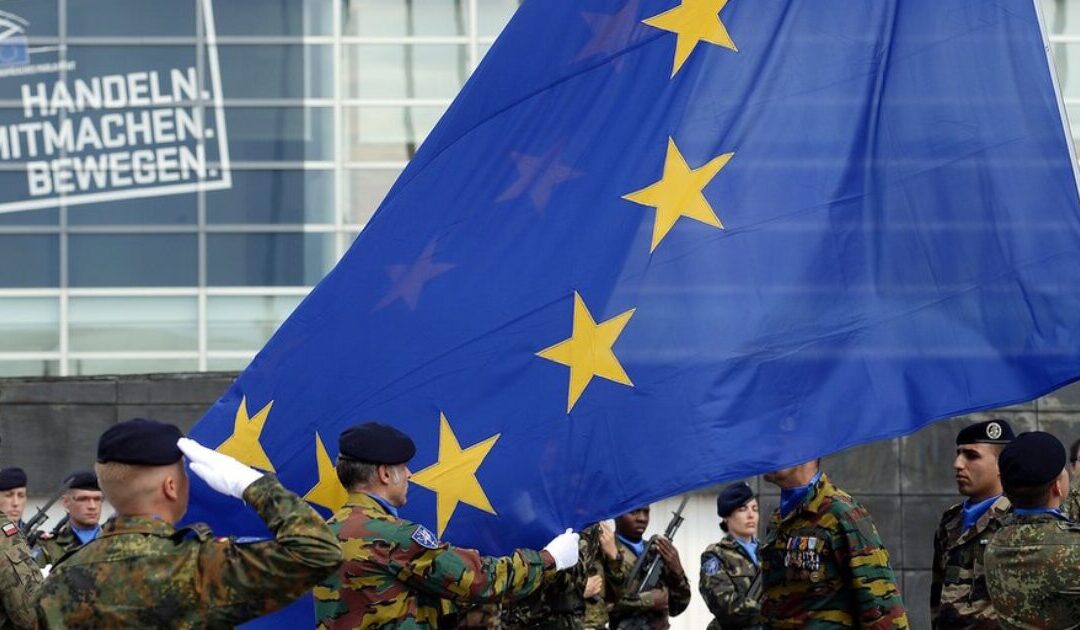
Military personnel from European countries with the EU flag. Photo from open sources
Following President Trump’s successful push for NATO allies to commit to spending 5% of GDP on defense by 2035, Europe now faces the potentially insurmountable challenge of reversing decades of military neglect. Building a force capable of defending the continent against Russia or China will be a massive undertaking, made even more difficult by declining birthrates, a shrinking workforce, and the political cost of maintaining generous welfare states and pacifist norms.
NATO allies agreed on June 25, 2025, to more than double their defense spending target from 2% of GDP to 5% by 2035, with the commitment structured as 3.5% for “core defense” and 1.5% for broader security measures including infrastructure and cyber defense. This achievement was widely praised, with NATO Secretary General Mark Rutte stating: “Would you ever think that this would be the result of this summit if he would not have been re-elected president? … I think he deserves all the praise”. However, the magnitude of this commitment becomes clear when examining current spending levels and capability gaps.
In 2024, European NATO members spent a combined $454 billion on defense, just 30% of total NATO spending, while the United States spent $997 billion, or 66%. Reports claim European military spending rose by 17% to $693 billion in 2024, but that figure misleadingly includes Russia’s estimated $149 billion. Given that NATO exists primarily to deter Russian aggression, it is absurd to include Russia’s defense budget in Europe’s total.
Even in terms of GDP percentage, Russia continues to outpace the European Union in defense spending. The EU’s total defense spending is projected to reach around 2.04% of GDP in 2025, while Russia is expected to spend 7.5% of its GDP on the military. But the gap in spending is just one part of Europe’s broader capabilities deficit.
Unlike Russia or the United States, Europe’s $454 billion in defense expenditures is fragmented across more than 30 countries, each with its own command structure, procurement system, administrative overhead, and military bureaucracy. In contrast, the United States achieves far greater efficiency and combat power through its unified $997 billion defense budget, which supports a single military structure with global reach.
Because the United States has invested in defense every single year since World War II, American military spending builds upon a solid, established foundation of infrastructure, technology, and institutional knowledge. In contrast, many European countries have militaries that are only 30 years old, particularly those that emerged from Soviet control, while even longstanding NATO members spent so little on defense for decades that their current spending represents desperate catch-up efforts.
Meanwhile, Europe remains fundamentally dependent on the United States for essential military functions including satellite intelligence services, threat assessments, air-to-air refueling, ballistic missile defense, airborne electromagnetic warfare, and advanced surveillance capabilities. These sophisticated systems cannot be quickly replicated regardless of increased spending, as they represent decades of technological development and operational expertise.
By some estimates, Europe would have to increase its annual spending by an additional $270 billion just to approach parity with Russia. More critically, Russia benefits from decades of accumulated military stockpiles inherited from the Soviet-era assets that took generations to build and cannot be quickly replicated. Its defense industry employs 4.5 million people and produces weapons at nearly three times the rate of the U.S. and Europe combined, while European nations are still operating largely peacetime defense industries.
Matching Russia’s military spending, which equals 32% of its government budget, would devastate Europe’s social welfare systems. European countries currently devote an average of 19.5% of GDP to social benefits, including healthcare, pensions, unemployment, and education, with France spending as much as 31.3%. Raising defense budgets to Russian levels would require deep cuts to the very programs that define European societies: universal healthcare, generous unemployment benefits, extensive parental leave, free higher education, and comprehensive pensions.
Beyond spending, Europe would face serious manpower challenges in expanding its armies. All European countries have fallen below the population replacement rate of 2.1 births per woman. Some of the lowest fertility rates include Malta (1.06), Spain (1.12), Lithuania (1.18), and Italy (1.21). Since World War II, most have reduced or eliminated conscription, France ended it in 1996, Spain in 2001, Germany in 2011, Belgium in 1994, and the UK as early as 1963.
Today, only a few countries, such as Finland, Norway, Cyprus, Austria, Lithuania, Estonia, and Switzerland, retain some form of conscription, typically with short terms and limited enforcement. In contrast, Russia maintains mandatory conscription for men up to age 30.
Falling birthrates and an aging population leave Europe with a shrinking workforce, rising pension costs, and limited fiscal space for defense or modernization. Sustaining expansive welfare systems while building credible military power is likely mathematically unworkable. With constrained tax capacity, demographic decline, and growing threats from Russia and China, Europe faces a narrowing set of options.
Conscription alone won’t solve the manpower shortage. Defense spending would also need to rise significantly, requiring major restructuring and politically painful cuts to entrenched social programs. Europe can either maintain generous welfare and remain militarily dependent on the U.S., or redirect resources toward serious defense investment at the expense of its social model.
JUST IN: Authorities Identify the Two Firefighters Killed in Idaho Ambush
June 30, 2025
Idaho firefighters killed identified as Battalion Chief Frank Harwood, 42, of Northern Lakes Fire Dept., and Coeur d’Alene Battalion Chief John Morrison
Kootenai County authorities identified the two Idaho firefighters tragically killed by a gunman on Sunday.
On Sunday, a 20-year-old suspect intentionally started a fire on Canfield Mountain in Coeur d’Alene, Idaho, to lure firefighters to the location and opened fire on the first responders.
The Gateway Pundit reported earlier that the suspect has been identified as 20‑year‑old Wess Roley.
Roley fatally shot two firefighters identified as Battalion Chief Frank Harwood, 42, of Northern Lakes Fire Department, and Coeur d’Alene Battalion Chief John Morrison.
Authorities in Idaho have identified the firefighters killed in a shooting at Canfield Mountain Sunday.
Kootenai County Fire and Rescue Chief Frank Harwood, 42, and Coeur d’Alene Fire Department Battalion Chief John Morrison were identified as the fallen firefighters.
During a press conference Monday, Kootenai County Fire and Rescue Chief Christopher Way said Harwood was a member of the agency for 17 years. He was married, had two children and was a former Army National Guard combat engineer.
Way said that Harwood was a leader who “did an amazing job” and was well respected.
Morrison served Coeur d’Alene for more than 28 and moved up the ranks in his department from firefighter to battalion chief, Coeur d’Alene Fire Chief Tom Greif said.
Roley was later found dead near his weapon after law enforcement. Officials say he acted alone, but whether he died by suicide or police action remains unclear.
Photos of the suspect are now circulating online, as reported by the New York Post.
JUST IN – Alleged Idaho sniper ID’d as 20-year-old Wess Roley, per local authorities. pic.twitter.com/FByGm81Quc
We use technologies like cookies to store and/or access device information. We do this to improve browsing experience and to show (non-) personalized ads. Consenting to these technologies will allow us to process data such as browsing behavior or unique IDs on this site. Not consenting or withdrawing consent, may adversely affect certain features and functions.
Functional
Always active
The technical storage or access is strictly necessary for the legitimate purpose of enabling the use of a specific service explicitly requested by the subscriber or user, or for the sole purpose of carrying out the transmission of a communication over an electronic communications network.
Preferences
The technical storage or access is necessary for the legitimate purpose of storing preferences that are not requested by the subscriber or user.
Statistics
The technical storage or access that is used exclusively for statistical purposes.The technical storage or access that is used exclusively for anonymous statistical purposes. Without a subpoena, voluntary compliance on the part of your Internet Service Provider, or additional records from a third party, information stored or retrieved for this purpose alone cannot usually be used to identify you.
Marketing
The technical storage or access is required to create user profiles to send advertising, or to track the user on a website or across several websites for similar marketing purposes.