As U.S. and EU Strike Deal, Canada Is Left Behind

As U.S. and EU Strike Deal, Canada Is Left Behind

As U.S. and EU Strike Deal, Canada Is Left Behind
July 30, 2025

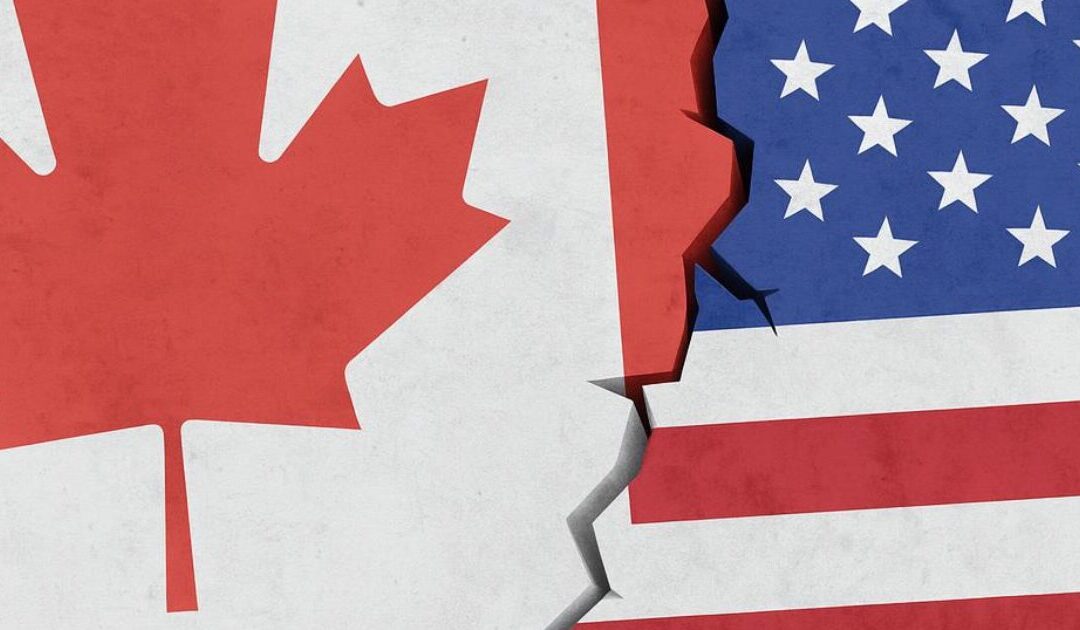
Canada Loses Trade War with U.S. Digital illustration created by ChatGPT based on user request. This image is an original AI-generated work and is free to use without copyright restrictions.


After President Trump imposed steep tariffs on Canada over trade imbalances, subsidies, and national security concerns, Ottawa refused to negotiate. Instead, it bet on forming a trade and security pact with Europe that excluded the U.S. But after Trump closed “the biggest deal in history” with the EU, Canada now finds itself isolated as Europe moves forward, this time, with America, not Canada.

In March 2025, newly appointed Canadian Prime Minister Mark Carney made Europe, not the U.S., his first foreign stop, meeting with leaders in France and the U.K. and declaring Canada “the most European of non-European countries.” Carney emphasized the need to “diversify” Canada’s trade and security ties, arguing the country had grown too reliant on the U.S.

In June, Canada and the EU signed a defense and trade partnership and launched talks on digital trade. Ottawa hoped this new alliance would offset U.S. pressure. But after President Trump secured a massive trade deal with the EU on July 27, leaving Canada out, those hopes collapsed.

Despite enjoying some exemptions under USMCA, Canada still faces steep U.S. tariffs, with more threatened in August. Isolated and sidelined, Canada now finds itself with neither Europe nor the U.S. firmly in its corner.

It is mathematically puzzling that Canada, China, or the EU could believe they can maintain export levels after losing access to the U.S. market. With a population of 340 million and an average annual income around $80,000, Americans are among the world’s most eager consumers.

There is no other market with comparable scale, purchasing power, or appetite for imported goods. Since these economies are already trading extensively with one another and the rest of the world, reshuffling trade between them cannot compensate for the loss of access to the U.S.

Canada is particularly vulnerable. Over three-quarters of its goods exports go to the U.S., and nearly half of its imports come from the U.S., revealing the asymmetric nature of the relationship. Provincial economies are deeply tied to this trade: U.S. exports account for 34% of Alberta’s GDP, 33% of New Brunswick’s, and 25% of Saskatchewan’s. Additionally, about 70% of Canadian goods exported to the U.S. are used in American manufacturing, reflecting tightly woven supply chains vulnerable to disruption.

Import dependency is also uneven across provinces. Saskatchewan imports 80% of its goods from the U.S., followed by Manitoba at 76% and Alberta at 63%. Jobs linked to U.S. trade are heavily concentrated in Ontario (42%), Quebec (21%), Alberta (15%), and British Columbia (11%), meaning that any shock to U.S.-Canada trade disproportionately harms key provinces and sectors.Bottom of Form


The trade war has already inflicted significant damage on Canada’s economy. According to Statistics Canada, Canada’s share of goods exports to the U.S. dropped to 68.3% in May, down from the 2024 monthly average of 75.9%. Exports to non-U.S. countries hit a record high in May, rising 5.7%, but this wasn’t enough to offset the overall decline. TradeImeX data shows that Canadian exports to the U.S. fell 15.7% in April alone.

Currency markets reacted sharply. The Canadian dollar, already weakened by 7.7% in 2024, fell below 70 U.S. cents by December and continued to hover around 69.5 cents through early 2025, according to Bank of Canada data.

Employment also suffered. Statistics Canada reported 1.6 million unemployed people in May 2025, a 13.8% year-on-year increase. The average job search duration rose to 21.8 weeks, up from 18.4 weeks the previous May. While the unemployment rate dipped slightly to 6.9% in June, broader labor conditions deteriorated.

Manufacturing was hit hard. Output declined by 1.3% year-on-year in February, and sales dropped 1.4% in March. TD Economics reported a 0.1% GDP contraction in April, falling short of Statistics Canada’s projections.

The EU has come to its senses and agreed to grant Americans a fair deal—something we’ve never had before. China is still in negotiations, and while the likely outcome is a tariff reduction, they will almost certainly violate the agreement again, just as they did with the Phase One deal during Trump’s first term. Canada, facing no viable alternatives and an overwhelmingly asymmetric dependence on the U.S., will have no choice but to negotiate—and ultimately accept U.S. terms. The past seven months of economic instability and rising prices in America are simply the short-term cost of securing better trade deals and higher incomes for years to come.

The post As U.S. and EU Strike Deal, Canada Is Left Behind appeared first on The Gateway Pundit.

Go to Source
Author: Antonio Graceffo

JUST OUT: Roseanne Barr to Screen Her New Film “Rosanne Barr Is America” at The Gateway Pundit Vindicated Conference in Las Vegas, Aug. 9-10

JUST OUT: Roseanne Barr to Screen Her New Film “Rosanne Barr Is America” at The Gateway Pundit Vindicated Conference in Las Vegas, Aug. 9-10

JUST OUT: Roseanne Barr to Screen Her New Film “Rosanne Barr Is America” at The Gateway Pundit Vindicated Conference in Las Vegas, Aug. 9-10
July 30, 2025

Roseanne Barr Is Back!

And, Roseanne and documentary film maker, author and political commentator, Joel Gilbert, will screen their new film “Roseanne Is America” at The Gateway Pundit sponsored

“Vindicated: Heroes who stood up to the Deep State” conference in Las Vegas August 9-10 at the Ahearn Hotel.

You can purchase your tickets here.

For years, the legendary Roseanne Barr was America’s most popular and beloved comedian. Her groundbreaking TV show, Roseanne, revived working class humor and earned legions of fans for America’s “domestic goddess.” Often political, Roseanne fearlessly addressed the issues of family, class, race, gender, and gay rights. In 2012, Roseanne Barr even ran for president. The Roseanne Show was number one in the 1990s, and revived in 2018 with excellent ratings. However, when Roseanne posted a tweet about the Iran nuclear deal and Obama ally Valerie Jarrett, the lifelong civil rights activist was promptly accused of racism over the misunderstood post. Roseanne and her show were abruptly “cancelled.”

In Roseanne Barr is America, the still hilarious and highly opinionated Roseanne recounts the untold story of her unusual upbringing and her extraordinarily successful career in comedy and television. A master storyteller, Roseanne exposes the sinister political forces and the twisted “cancel culture” that must be overcome for America to survive as a free nation. An impassioned lover of America, Roseanne explains in her uniquely entertaining way her views on today’s pressing issues and the path forward. As viewers will quickly come to understand, Roseanne Barr is America!

** Following the film Roseanne Barr will answer questions virtually with producer Joel Gilbert about the film.

Comedian Roseanne Barr and producer Joel Gilbert.

When The Gateway Pundit started organizing our Las Vegas Conference on August 9-10, we had NO IDEA what was about to transpire in Washington, DC.

The Gateway Pundit has always supported those American heroes who were unjustly persecuted by the Washington, DC Deep State.

We frequently reported on the horrific persecution of American heroes like General Michael FlynnRudy GiulianiRoger StonePresident Donald Trump and others.

We ALWAYS knew they were innocent men and American patriots.

In August we are bringing several of these courageous men and women together under the same roof.

Purchase your tickets today! Come witness history!

The post JUST OUT: Roseanne Barr to Screen Her New Film “Rosanne Barr Is America” at The Gateway Pundit Vindicated Conference in Las Vegas, Aug. 9-10 appeared first on The Gateway Pundit.

Go to Source
Author: Jim Hoft

Climate Alarmists Wrong: Increased Economic Damage Doesn’t Prove Storms Are Getting Worse

Climate Alarmists Wrong: Increased Economic Damage Doesn’t Prove Storms Are Getting Worse

Climate Alarmists Wrong: Increased Economic Damage Doesn’t Prove Storms Are Getting Worse
July 30, 2025

Photograph showing the damage to houses and trees in Washington following the 11/17/2013 tornado. Photo courtesy of Mrluckypants via Wikimedia Commons

One of the indicators that climate alarmists use to push the climate crisis narrative is the increasing cost of storms.

The logic appears straightforward: a storm that did $10 million in damage must be more severe than one that did $1 million in damage, and since storms cost less money in the past, they claim this proves that storms are getting more severe.

They also set dollar thresholds for severe storms, and since more storms exceed this dollar threshold, they claim that severe storms are occurring more frequently.

However, this reasoning fundamentally misunderstands the economic factors driving storm damage costs.

According to data from the National Oceanic and Atmospheric Administration (NOAA), since 1980, there have been 403 billion-dollar weather disasters in the United States, with tropical cyclones causing over $1.5 trillion in total damage.

In 2024 alone, the U.S. experienced 27 billion-dollar disasters resulting in $182.7 billion in damages. Climate activists point to these numbers as evidence of worsening storms, but this analysis reveals a critical flaw in their methodology.

The $1 billion threshold used to classify “severe” storms is fixed and not adjusted for inflation beyond the basic Consumer Price Index.

According to NOAA’s Climate.gov, this flawed approach has resulted in 57 events since 1980 that were originally below the billion-dollar threshold but are now classified as billion-dollar disasters simply due to inflation.

This artificial inflation of severe storm counts creates the false impression that dangerous storms are becoming more frequent when, in reality, the monetary threshold has simply lost its meaning over time.

Inflation has turned million-dollar storms into billion-dollar ones. The effect is clear in historical comparisons. Hurricane Katrina caused $125 billion in damage in 2005—equivalent to $200 billion today, according to WCNC.

Hurricane Harvey’s $125 billion in 2017 would equal about $159 billion in 2024, a $33 billion jump in just seven years. Most striking is the 1926 Great Miami Hurricane, which cost $105 million at the time but would have caused $236 billion in 2018, per the Washington Post.

These examples show how inflation alone can make storms seem far more “severe” over time.

Apart from inflation, another driver behind escalating storm costs is the massive increase in population and development in hurricane-prone areas.

According to research published by The Washington Post, the combined population of the 15 counties hit by Hurricane Milton’s hurricane-force winds grew from 3.7 million people in 1980 to 9.1 million in 2023, more than doubling, while the area’s economic activity quadrupled over the same period.

Data from the Center for Climate and Energy Solutions shows that there are nearly 50 million homes and at least $1.4 trillion in assets within an eighth of a mile of the coast, with U.S. coastal populations growing by roughly 35 million people between 1970 and 2010.

When hurricanes strike these increasingly populated and developed areas, the damage costs naturally skyrocket regardless of the storm’s actual intensity.

When researchers account for population growth, development, and inflation, the apparent trend in storm severity vanishes.

A study in Nature Sustainability, cited by The Washington Post, found that once hurricane damage is adjusted for increases in people and property, the rising destruction trend disappears.

Similarly, research in the Bulletin of the American Meteorological Society shows no significant trend in normalized U.S. hurricane losses since 1900. As the researchers noted, this is expected, landfalling hurricanes have not increased in frequency or intensity from 1900 to 2017.

Contrary to climate activist claims, actual storm frequency data reveals no significant increase in severe weather events.

According to the Environmental Protection Agency’s Climate Change Indicators, since 1878, approximately six to seven hurricanes have formed in the North Atlantic every year, with roughly two per year making landfall in the United States.

The total number of hurricanes and the number reaching the United States show no clear overall trend since 1878.

This finding is supported by peer-reviewed research published in Nature Communications, which found that “recorded century-scale increases in Atlantic hurricane and major hurricane frequency are consistent with changes in observing practices and not likely a true climate trend.”

The study concluded that apparent increases in storm frequency are better explained by improved detection and reporting methods rather than actual changes in storm patterns.

When they claim severe storms are becoming more frequent, what they mean is that more storms now exceed an arbitrary damage threshold, resulting from more people with more expensive homes and more possessions living in storm-prone areas.

Rather than a climate crisis, it seems more like a matter of personal choice, and perhaps questionable judgment.

The post Climate Alarmists Wrong: Increased Economic Damage Doesn’t Prove Storms Are Getting Worse appeared first on The Gateway Pundit.

Go to Source
Author: Antonio Graceffo

Top FDA Official Resigns in Disgrace After Exposé by Investigative Journalist Laura Loomer

Top FDA Official Resigns in Disgrace After Exposé by Investigative Journalist Laura Loomer

Top FDA Official Resigns in Disgrace After Exposé by Investigative Journalist Laura Loomer
July 30, 2025

Dr. Vinay Prasad (Source: FDA)

Dr. Vinay Prasad — a radical left-wing ideologue who wormed his way into one of the most powerful regulatory roles in the federal government — has officially resigned from the Food and Drug Administration following a explosive exposé led by investigative journalist Laura Loomer.

For weeks, Loomer publicly exposed Prasad’s shocking anti-Trump rhetoric, far-left allegiances, and dangerous abuse of regulatory power.

“We have a crisis at the FDA! A wolf in sheep’s clothing is sabotaging President Trump’s bold “Make America Healthy Again” (MAHA) agenda!” Loomer wrote on X.

Loomer continued, “This is no mere bureaucratic misstep. It’s a catastrophic vetting failure that threatens to derail the America First healthcare revolution. Prasad’s anti-Trump rhetoric, radical left-wing ideology, and deliberate actions to obstruct our President’s deregulatory mission prove he’s a dangerous misfit. The time to act is NOW—Prasad must be REMOVED before he destroys Trump’s vision for a healthier America!”

According to Loomer:

In 2021, Prasad described himself as a “political liberal, closest to Elizabeth Warren” and a “Sanders/Warren liberal,” proudly embracing a progressive identity. He voted for Bernie Sanders in the 2016 Democratic primary, and FEC records reveal he donated to Sanders’ campaign, signaling his support for radical left-wing policies.

In 2020, Prasad declared on X that he wanted “Biden to win more than anything” and confirmed he voted against Trump, solidifying his opposition to the President.

Prasad’s policy positions are a direct affront to the conservative principles underpinning Trump’s agenda. He advocates for universal basic income, student loan forgiveness, open borders, and Roe v. Wade abortion standards. He supports a 50% marginal tax rate for high earners, a wealth taxsingle-payer healthcareuniversally funded pre-K and community college, and expansive parental leave policies.

[..]

Prasad’s disdain for Trump is personal and vitriolic. He has called the President “perhaps the worst president in the history of the Republic.” Prasad has claimed that Trump disagreed with him “on probably 90% of issues.” He compared Trump’s family separation immigration policy to a “human rights violation” worthy of the International Criminal Court. Prasad mocked his election fraud claims as “laughable and pathetic,” and called January 6 “a terrible day.” Further, he even attacked Trump University as a “scam.” Prasad consistently refers to the President as “orange man.” This is a derogatory jab used by the radical Left to attack Trump over his tan skin. Prasad has a strong admiration for Dr. Anthony Fauci, whom he dubbed “St. Anthony of Fauci” with “profound reverence.” Thisfurther highlights his alignment with figures Trump has criticized, particularly over the COVID-19 response.

Since assuming control of CBER at the FDA, Prasad has amassed unprecedented power. He holds three key FDA roles: Chief Medical Officer, Chief Scientific Officer, and Director of CBER. Reports suggest he is under consideration to lead the Center for Drug Evaluation and Research (CDER). This could make him more influential than FDA Commissioner Marty Makary. Moreover, this consolidation of authority in the hands of a Trump antagonist and avowed Leftist is a recipe for disaster. Prasad’s actions further demonstrate a clear intent to undermine President Trump’s vision.

Read more here.

On Tuesday, the pressure became too much, and Prasad quietly stepped down from his roles as Chief Medical Officer, Chief Scientific Officer, and Director of the Center for Biologics Evaluation and Research (CBER).

More from the far-left New York Times:

The Food and Drug Administration’s top vaccine and gene therapy official resigned on Tuesday after a public campaign against him led by the right-wing influencer Laura Loomer, according to people familiar with the matter.

[…]

Andrew Nixon, a Department of Health and Human Services spokesman, confirmed the resignation Tuesday evening.

“Dr. Prasad did not want to be a distraction to the great work of the F.D.A. in the Trump administration and has decided to return to California and spend more time with his family,” Mr. Nixon said in a statement. “We thank him for his service and the many important reforms he was able to achieve in his time at F.D.A.”

[…]

Dr. Prasad also faced heat for cracking down on the company Sarepta Therapeutics, which came under heightened scrutiny after two teenagers and a 51-year-old man died of liver complications after using the company’s gene therapy drugs. Though Dr. Prasad pressured the company to stop shipping its drug Elevidys for Duchenne muscular dystrophy, he reversed the decision days later for young boys who can still walk and who are believed to be at lower risk for complications.

Dr. Prasad’s critics argued that his actions with Elevidys amounted to a crusade against Sarepta. Mr. Santorum, who has ties to Sarepta, also reposted an editorial lambasting Dr. Prasad on social media and called top officials at the White House to relay his concerns, according to a person familiar with the matter.

The post Top FDA Official Resigns in Disgrace After Exposé by Investigative Journalist Laura Loomer appeared first on The Gateway Pundit.

Go to Source
Author: Jim Hᴏft

Scott Bessent Reaffirms U.S. Economic Strength Under Trump

Scott Bessent Reaffirms U.S. Economic Strength Under Trump

Scott Bessent Reaffirms U.S. Economic Strength Under Trump
July 30, 2025

At a time of global uncertainty, where international markets face inflationary pressures, energy crises, and geopolitical conflicts, a bold and clear statement has captured the attention of analysts, entrepreneurs, and investors alike. In a recent interview, Republican Representative and renowned financial strategist Scott Bessent was asked directly by a reporter:
“Where would you invest your money if you were still running a hedge fund?”
His answer was short, firm, and patriotic: “In the United States.”

Though brief, the statement reflects a deep understanding of the current

The post Scott Bessent Reaffirms U.S. Economic Strength Under Trump appeared first on The Gateway Pundit.

Go to Source
Author: Gateway Hispanic