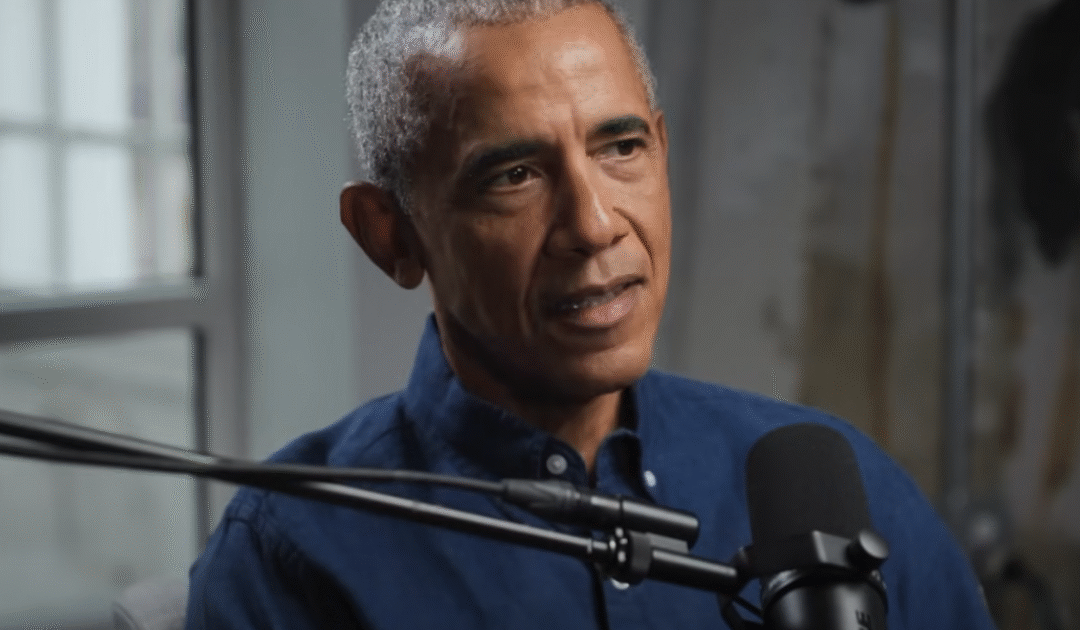
Wait, What? This is Barack Obama’s Independence Day Message?
July 4, 2025
Barack Obama got blasted for his anti-American Independence Day message on Friday.
“Independence Day is a reminder that America is not the project of any one person. The single most powerful word in our democracy is the word ‘We.’ ‘We The People.’ ‘We Shall Overcome.’ ‘Yes We Can.’ America is owned by no one. It belongs to all citizens. And at this moment in history—when core democratic principles seem to be continuously under attack, when too many people around the world have become cynical and disengaged—now is precisely the time to ask ourselves tough questions about how we can build our democracies and make them work in meaningful and practical ways for ordinary people,” Obama said.
Independence Day is a reminder that America is not the project of any one person. The single most powerful word in our democracy is the word ‘We.’ ‘We The People.’ ‘We Shall Overcome.’ ‘Yes We Can.’ America is owned by no one. It belongs to all citizens. And at this moment in…
A “core democratic principle” Barack Obama and his Administration consistently violated was the freedom of the press and free speech, which is why George Washington, Thomas Jefferson, James Madison, and theFounding Fathers enshrined that as the very First Amendment, “Whoever… https://t.co/sYCdatrhEX
— Elizabeth MacDonald (@LizMacDonaldFOX) July 4, 2025
America was not founded as a “democracy”.
It was founded as a “republic” and the most powerful word was “liberty”, not “we”. https://t.co/ezckiXFkiN
— Rich Baris The People’s Pundit (@Peoples_Pundit) July 4, 2025
— Margot Cleveland (@ProfMJCleveland) July 4, 2025
Nope. Independence Day is a celebration of the Americans who declared independence from Great Britain. Universalizing alleged lessons is a left-wing revolutionary project. https://t.co/vvj9qc31FZ
French Police Now Punctures Rubber Boats With Illegal Migrants Trying to Cross the Channel to Britain (VIDEO)
July 4, 2025
French police punctures rubber boat near the coast in Boulogne-Sur-Mer, keeping illegal migrants from trying to cross the channel into the British Isles.
Despite the UK having paid the French almost half a billion Sterling Pounds to keep the migrant boats from departing Callais and other beaches to cross the channel into Britain, so far, the numbers of the illegal invasion just kept rising.
Is it any surprise we’re seeing record numbers of illegal immigrants when Starmer’s virtue-signalling Labour Party have removed nearly all the deterrents?
But today (4), French police have punctured Channel migrants’ boats at sea for the first time, in a considerable change of tactics backed by the British.
“Officers entered the sea on a beach near Boulogne-Sur-Mer on Friday armed with knives to puncture the dinghies in water that was shallow enough for the migrants to wade back to shore.
Dozens of migrants, including some women and children, had to give up their attempt to reach the UK as the boat started to deflate and sink. It is understood the knife puncturing is part of initial trials by the French to establish which tactics are most effective in stopping migrants leaving.”
Starmer’s UK has fad to repeatedly demand that Macron’s France do the job they are being paid to do.
In the new strategy, police and gendarmes will start ‘intervening’ in shallow waters – within 300 meters of the shore – to stop the illegals in boats leaving for Britain.
“The new strategy is expected to be unveiled at next week’s Anglo-French summit when Emmanuel Macron comes to the UK for a three-day state visit.
It comes as a record 20,422 migrants have reached the UK so far this year, up nearly 50 per cent on last year and the highest number in the first six months of any year since the Channel crossings started in 2018. Some 5,170 arrived in June alone.”
The Prime Minister’s office welcomed the new, tougher French tactics.
“A No 10 spokesman said: ‘No government has been able to get this level of co-operation with the French. That is important. We are looking to see France change its maritime tactics, and that is down to the Prime Minister’s efforts to reset our relationships across Europe’.”
Watch: French Police slashing the boats as they are about to take off.
French Police slashing the boats as they are about to take off
China’s Nuclear Deception: The Treaty That Would Handcuff America’s Military
July 4, 2025
Chinese leader Xi Jinping. Photo courtesy of State Council of the People’s Republic of China
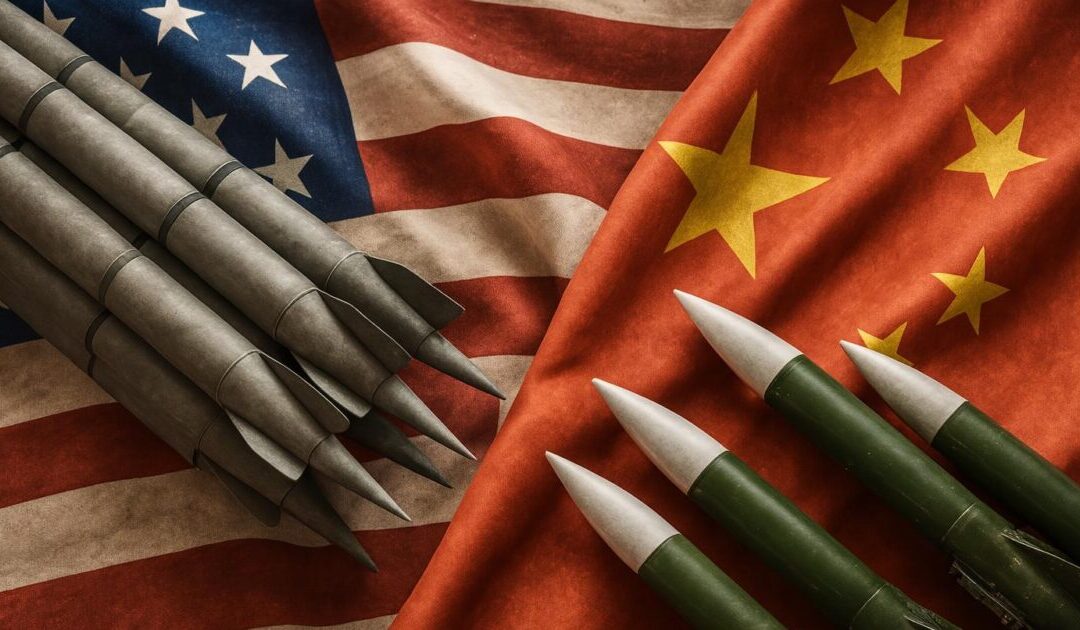
China announced this week its willingness to “take the lead” in signing the Southeast Asia Nuclear Weapon-Free Zone Treaty, a move that comes while Beijing rapidly expands its nuclear arsenal.
The announcement, made by Chinese Foreign Ministry spokesperson Mao Ning, followed news that both China and Russia have agreed to become signatories to the decades-old Bangkok Treaty. The Bangkok Treaty, formally known as the Southeast Asia Nuclear Weapon-Free Zone Treaty (SEANWFZ), is a comprehensive nuclear disarmament agreement that creates one of the world’s most extensive nuclear-free zones.
America has not signed the Bangkok Treaty due to two primary objections, both rooted in concerns over limiting U.S. military operations and strategic flexibility in Southeast Asia. The treaty protocol requires nuclear-armed states to give unequivocal “negative security assurances”, a binding promise never to use or threaten to use nuclear weapons against treaty members. The U.S. opposes this requirement because it seeks to preserve strategic ambiguity in its nuclear doctrine.
Officials argue that such absolute assurances could conflict with alliance commitments, including defense treaties with the Philippines and Thailand, where the U.S. may need to retain the option of nuclear retaliation in response to chemical or biological attacks.
Additionally, U.S. nuclear strategy depends on the threat of nuclear use to deter not only nuclear but also large-scale conventional attacks. The treaty’s rigid language allows no exceptions, even in extreme scenarios, which Washington sees as a serious constraint on deterrence.
Past agreements have shown how security assurances can lead to unintended entanglements. A good example is the 1994 Budapest Memorandum, in which the U.S., UK, and Russia pledged security assurances to Ukraine, Belarus, and Kazakhstan in exchange for giving up their nuclear arsenals. These included commitments to respect sovereignty, avoid economic coercion, and respond to nuclear threats. When Russia invaded Ukraine in 2014 and again in 2022, those assurances triggered pressure for U.S. involvement.
If the United States signs the Bangkok Treaty protocol, comparable dynamics could unfold in Southeast Asia. For example, if China were to use military force against treaty parties such as the Philippines, Vietnam, or Malaysia, the U.S. could face strong pressure to intervene due to formal commitments made under the treaty. Similarly, in scenarios involving nuclear coercion, where China threatens to use nuclear weapons against ASEAN countries, the U.S. might feel obligated to respond, having extended security guarantees through the protocol.
Unlike the Budapest case, several ASEAN members are formal U.S. allies, meaning that treaty commitments under the Bangkok Treaty could overlap with existing alliance obligations, significantly increasing the risk of automatic entanglement.
The treaty also creates a deeper strategic contradiction that would weaken America’s ability to protect its strategic interests. For example, consider a scenario in which China threatens a nuclear strike against Vietnam. Under the treaty, the United States would be expected to defend Vietnam from Chinese nuclear coercion.
However, the treaty simultaneously imposes key restrictions: the U.S. would not be allowed to threaten nuclear retaliation within the treaty zone, could not use nuclear deterrence in the South China Sea, and would be forced to rely solely on conventional forces.
This produces what military strategists call an “umbrella without teeth.” ASEAN countries would receive American promises of protection, legal commitments to their nuclear security, and expectations of deterrence. But U.S. protection would lack credibility because it cannot include the threat of nuclear response precisely in the region where such threats are most likely. China, aware of these legal limitations, would understand that the U.S. is self-constrained.
This dynamic benefits China in several ways. It allows Beijing to threaten ASEAN countries with nuclear weapons from outside the treaty zone while knowing the U.S. cannot respond in kind. It forces Washington into expensive, high-risk conventional military responses and creates doubt among allies about America’s commitment once they realize U.S. nuclear deterrence is legally restricted.
In short, the Bangkok Treaty could create the same dynamic seen in the Budapest Memorandum: allies expect protection, but legal constraints prevent the U.S. from delivering credible deterrence. The result could be either failed commitments or costly wars fought without the full spectrum of American power. It’s a textbook example of a multilateral agreement that increases U.S. obligations while decreasing U.S. capabilities, exactly the type of strategic trap that foreign policy realists warn against.
Several factors make the Bangkok Treaty potentially more consequential than Budapest. Geographically, it covers ten countries and vast maritime zones in the South China Sea, a region central to global commerce and the U.S.-China strategic rivalry. In contrast, the Budapest Memorandum involved only three landlocked or inland nations.
Strategically, while Ukraine was important, it was not central to global trade; Southeast Asia, by contrast, controls critical shipping lanes. And finally, the adversary in the Bangkok case, China, is far stronger than Russia was in the 1990s, with rapidly growing military capabilities and status as a near-peer competitor. Any conflict in this region would be far more complex and dangerous.
This sets up a classic foreign policy dilemma: signing the Bangkok Treaty risks entangling the U.S. in regional conflicts with reduced military flexibility, while refusing to sign allows China to present itself as the peaceful power and portray America as hostile to nuclear disarmament. Yet from a national security perspective, declining to sign would make the U.S. safer. It would also reinforce America’s longstanding policy of strategic ambiguity, which helps deter conflict in flashpoints like Taiwan by complicating Beijing’s planning and avoiding automatic entanglement in foreign wars.
Far-Left Hack Elie Mystal Says America Should be ‘Sanctioned and Rebuked’ By Other Nations Because the U.S. is “THE Bad Guy”
July 4, 2025
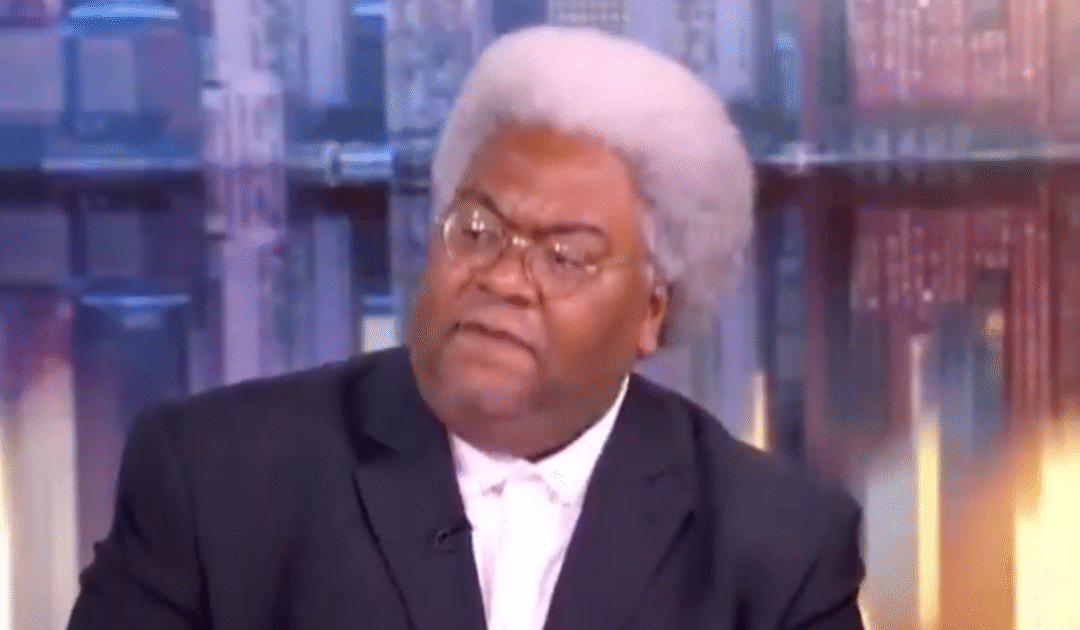
Elie Mystal/Image” Video screenshot ‘The View’
During an appearance on the Joy Reid Show, far-left pundit Elie Mystal displayed his hatred for America. During the discussion, he said he hopes the world will punish and ‘sanction’ America for being ‘THE’ bad guy on the world stage.
Mystal said, “And I don’t say this lightly, but our country needs to be sanctioned.”
“We are the bad guys on the world stage.”
“We are a menace to not only free people everywhere, but we are a menace to peaceful people everywhere at this point. And I’m not even going to say that we’ve only been a menace for the past three or four months.”
“When does the international community decide that enough is enough? I know we’re rich. I know we’ve got a lot of money. I know that people want to buy things from our country because we’re rich, or want to sell things to our country because we’re rich.”
“But at some point, the international community has to stand up to us because we are a bad guy on the world stage.”
“And so we should be sanctioned. We should be sanctioned, we should be sanctioned and rebuked.”
Watch:
Elie Mystal: “Our country is THE bad guy on the world stage. The world needs to stand against America. Sanction us.” pic.twitter.com/3OjPx52Ryn
Elon Musk Shares More Details About His Plan to Create New Political Party and Become ‘Deciding Vote on Contentious Laws’
July 4, 2025
Tech billionaire Elon Musk spent his Independence Day doubling down on his threat to form a new political party, dubbed the “America Party.”
The Tesla and SpaceX CEO, who picked a fight with President Donald Trump over the One Big Beautiful Bill, is claiming he wants to disrupt the two-party system by creating a party for the “80% in the middle” who feel abandoned by Democrats and Republicans.
In new posts about his plans, Musk wrote, “One way to execute on this would be to laser-focus on just 2 or 3 Senate seats and 8 to 10 House districts.”
“Given the razor-thin legislative margins, that would be enough to serve as the deciding vote on contentious laws, ensuring that they serve the true will of the people,” Musk continued.
One way to execute on this would be to laser-focus on just 2 or 3 Senate seats and 8 to 10 House districts.
Given the razor-thin legislative margins, that would be enough to serve as the deciding vote on contentious laws, ensuring that they serve the true will of the people.
Musk, who briefly led the Department of Government Efficiency (DOGE) until his departure in May, blasted Trump over the One Big Beautiful Bill, calling it an “insane spending” disaster, claiming it will balloon the national debt by a staggering $3–5 trillion. He vowed to form the America Party “the next day” if the legislation passed.
The tension between Trump and Musk boiled over in early June when the X owner publicly criticized the legislation on his social media platform, prompting the president to fire back by labeling Musk a “big-time drug addict” and hinting at his ketamine use for depression. Trump also threatened to slash billions in federal contracts and subsidies for Musk’s companies, including Tesla and SpaceX, a move that sent Tesla’s stock plunging 14% in a single day.
Musk retaliated by suggesting Trump’s impeachment, alleging without evidence that Trump’s name appears in unreleased Jeffrey Epstein files, and even threatening to decommission SpaceX’s Dragon spacecraft, though he later backed off.
Details on the America Party remain sparse, but Musk has hinted at a centrist platform aimed at representing the “silent majority” disillusioned with partisan politics.
Republicans have criticized the decision, believing that it will give the Democrat Party an edge in 2026 and beyond.
Third-party efforts, from Ross Perot’s Reform Party to the Libertarians, have struggled to overcome America’s winner-take-all electoral system and stringent ballot access laws.
We use technologies like cookies to store and/or access device information. We do this to improve browsing experience and to show (non-) personalized ads. Consenting to these technologies will allow us to process data such as browsing behavior or unique IDs on this site. Not consenting or withdrawing consent, may adversely affect certain features and functions.
Functional
Always active
The technical storage or access is strictly necessary for the legitimate purpose of enabling the use of a specific service explicitly requested by the subscriber or user, or for the sole purpose of carrying out the transmission of a communication over an electronic communications network.
Preferences
The technical storage or access is necessary for the legitimate purpose of storing preferences that are not requested by the subscriber or user.
Statistics
The technical storage or access that is used exclusively for statistical purposes.The technical storage or access that is used exclusively for anonymous statistical purposes. Without a subpoena, voluntary compliance on the part of your Internet Service Provider, or additional records from a third party, information stored or retrieved for this purpose alone cannot usually be used to identify you.
Marketing
The technical storage or access is required to create user profiles to send advertising, or to track the user on a website or across several websites for similar marketing purposes.