
Power Panic: Clinton’s Trump Tirade Reveals a Fading Clique

Power Panic: Clinton’s Trump Tirade Reveals a Fading Clique

Power Panic: Clinton’s Trump Tirade Reveals a Fading Clique
February 18, 2026

Panel discussion at the Munich Security Conference featuring Petr Macinka, Deputy PM of Czech Republic, alongside other prominent figures in international relations.

Guest post by Gina Tedesca

When Hillary Clinton — a former U.S. Secretary of State — reduced a high-stakes geopolitical debate in Munich to teenage-level sniping — “I don’t like him” about Donald Trump — it wasn’t just embarrassing. It was revealing.

What unfolded was not diplomatic gravitas. It was political resentment exported across the Atlantic. A former chief diplomat of the United States venting personal dislike on a European stage — that alone speaks volumes about the tone the event has sunk to.

Substance vs. Sputtering

Czech Deputy PM Petr Macinka stuck to arguments. Focused on policy. He made the case that America’s political earthquake was not an accident but a reaction — to ideological overreach, cultural radicalism, and elite detachment.

Clinton responded not with counterarguments, but with disdain.

Backing her was Radosław Sikorski — himself a former Polish Defense Minister — who chimed in with pointed interjections that escalated the combative tone. Two former high-ranking officials, once responsible for diplomacy and defense, now reduced to political sniping at a supposedly strategic forum.

The applause that followed was telling. Less a celebration of debate — more a reflection of a like-minded audience.

First learn how to talk – Czech Deputy PM Destroys Hillary Clinton In Dramatic Munich Faceoff:

The Munich Security Conference: From Strategy to Sanctuary

The Munich Security Conference was once synonymous with hard security realism. Today, it risks becoming something else: a sanctuary for former officeholders relitigating old battles.

Figures like Alex Soros and Clinton did not appear to narrow divides — but to harden them. The panel titled “West – West Divide” felt less like a bridge-building effort and more like a grievance session.

When former officials dominate the stage, the line between strategic dialogue and partisan nostalgia begins to blur.

Bystron: Platforming Former Officials to Attack the Current U.S. Leadership

The backlash wasn’t confined to social media. Petr Bystron, Munich’s only Member of the European Parliament and a member of its Foreign Affairs Committee, issued sharp criticism — published in the Bavarian State Newspaper, the Bayerische Staatszeitung.

Bystron accused former MSC chairman Wolfgang Ischinger of deliberately inviting prominent former officials such as Clinton and Sikorski in order to publicly criticize the current U.S. leadership.

In his view, the appearance of a former U.S. Secretary of State alongside a former Polish Defense Minister was no coincidence. It signaled a political message: bringing in yesterday’s power brokers to attack today’s elected government — and in doing so, widening the transatlantic rift rather than helping to close it.

Grenell Fires Back

From Washington-aligned circles came further pushback. Richard Grenell, former U.S. ambassador to Germany, blasted what he called “the biggest Merz misstep to date” after his public gestures of strong support for Gavin Newsom.

In another post, Grenell criticized parts of the German media, claiming they shield the government “as if it were their employer.”

A Forum at Risk

What was once Germany’s flagship strategic gathering now risks becoming a partisan echo chamber with global branding.

If Munich wants to remain relevant, it must decide:
Is it a platform for forward-looking strategy — or a reunion venue for former officials settling political scores?

Because if the latter prevails, the real damage will not be Clinton’s remark. It will be the conference’s credibility.

Sources:

The post Power Panic: Clinton’s Trump Tirade Reveals a Fading Clique appeared first on The Gateway Pundit.

Go to Source
Author: Jim Hᴏft

The New Approach to China in the US National Defense Strategy

The New Approach to China in the US National Defense Strategy

The New Approach to China in the US National Defense Strategy
February 18, 2026

Modern naval vessel 015 docked at a port, showcasing military personnel and a bustling waterfront with construction in the background.
Photo courtesy of the People’s Liberation Army.

The Trump administration has released two documents, the National Security Strategy and the National Defense Strategy, both of which address the major threats to the United States.

The strategy documents suggest the focus will be on countering China in the Western Hemisphere, near the U.S. homeland, first, and then countering China in the Indo-Pacific.

The “China” section of the 2026 National Defense Strategy (NDS) describes the People’s Republic of China as the second most powerful country in the world, behind the United States.

That characterization is accurate only when power is measured in aggregate terms rather than military capability alone. In strictly military rankings, China does not rank second.

By most credible assessments, including nuclear capability, force projection, and strategic depth, China ranks behind both the United States and Russia, placing it third in overall military power.

The claim that China is the world’s second most powerful country reflects a broader evaluation that combines military strength with economic scale, industrial capacity, technological development, diplomatic reach, and political influence.

Across those metrics, the United States remains the most powerful country economically, militarily, and politically, particularly in its ability to influence the foreign policies of other nations.

China’s economy is slowing as the country faces a demographic crisis.

The population is aging, and young people make up a shrinking share of society. In a country where most families have only one child, parents are often hesitant to allow that child to join the military.

In an effort to surpass the United States, Beijing has steadily increased defense spending, but at the expense of social programs for an aging population that will require greater care.

At the same time, the percentage of the population paying taxes is declining as workers retire and are not replaced by new births.

The NDS notes, however, that China could continue increasing defense spending if it chose to do so. History has shown that state priorities often supersede care for the population.

China has been developing high-priced, advanced-technology weapons focused largely on controlling the Western Pacific, as well as systems capable of reaching targets much farther away.

The Indo-Pacific is expected to account for more than half of the global economy in the near future.

This means China’s buildup threatens U.S. interests, as well as the security, freedom, and prosperity of the American people.

The PRC is positioning itself to interfere with U.S. commerce and shipping, potentially restricting America’s access to global markets.

This is why the NDS, the NSS, and the Department of War urge the United States to maintain a favorable balance of power against China, particularly in the Indo-Pacific.

This is crucial not only to America’s interests but also to protect regional allies whose militaries are too small to challenge China directly.

Supporting those allies increases U.S. military power by providing bases where the United States can resupply or launch patrols. It also serves as a force multiplier when allied militaries are combined with U.S. forces.

The U.S. shift in focus toward the homeland and nearshore regions still prioritizes countering China. Defense of the U.S. homeland and America’s backyard is less about troop placement and more about geoeconomic security.

By prioritizing the Western Hemisphere, the United States aims to secure supply chains by moving critical manufacturing from Asia to North and South America, reducing vulnerability.

It also seeks to exclude Chinese economic and technological influence from Latin America and the Caribbean.

By encouraging Europe and South Korea to take greater responsibility for their own defense, the United States frees resources to secure the rear in the Americas while advancing the front in the Indo-Pacific.

At the same time, the strategy supports expanded military-to-military communication with China’s People’s Liberation Army to promote strategic stability, deconfliction, and de-escalation.

Whereas previous approaches limited such engagement largely to crisis management or symbolic confidence-building measures, the 2026 NDS frames sustained military dialogue as a tool for preventing miscalculation while negotiating from a position of strength.

The overarching aim is to deter aggression, preserve freedom of action in the Indo-Pacific, and maintain peace through strength, giving President Trump leverage to secure favorable outcomes for the United States while safeguarding regional security, economic access, and long-term prosperity.

The post The New Approach to China in the US National Defense Strategy appeared first on The Gateway Pundit.

Go to Source
Author: Antonio Graceffo

Remembering Rush Limbaugh, Five Years to the Day After His Passing

Remembering Rush Limbaugh, Five Years to the Day After His Passing

Remembering Rush Limbaugh, Five Years to the Day After His Passing
February 18, 2026

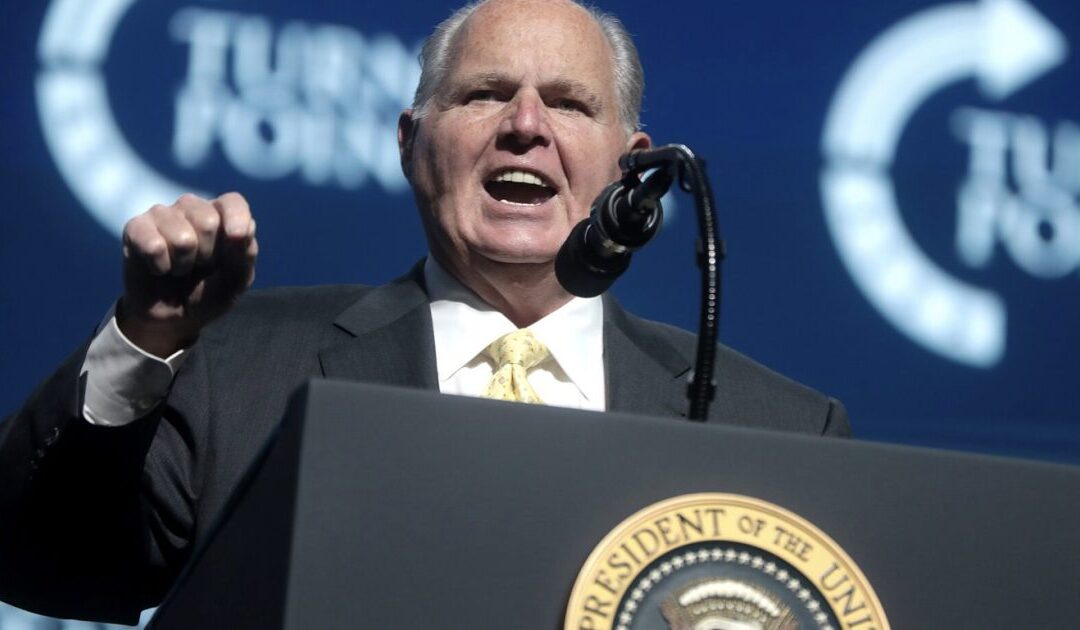
Rush Limbaugh speaking passionately at a Turnpoint USA event, gesturing emphatically while addressing the audience from a podium featuring the presidential seal.

Five years after his death from lung cancer, conservatives on Tuesday remembered the greatest influencer of them all.

Rush Limbaugh, the radio host and author who built a political movement and a media empire from behind his golden microphone died Feb. 17, 2021, at the age of 70.

And the reverberations of his life and career are still being felt.

“He broke wide open – the media ‘dam’ that suppressed the voices and values of almost half the country,” longtime Limbaugh producer James Golden, known professionally as “Bo Snerdley,” wrote in a tribute on Tuesday.

“The ‘silent majority’ through Rush Limbaugh, found its voice.”

That’s putting it mildly.

From the closing months of Ronald Reagan’s presidency, to the election of the first Republican House of Representatives in almost a half a century during the midterms of 1994, to the election of Donald Trump in 2016, Limbaugh was in the vanguard of conservative politics in the United States, leading a cultural revolution that continues to this day.

During his State of the Union address in 2020, President Donald Trump saluted Limbaugh as “the greatest fighter and winner that you will ever meet” before honoring Limbaugh with the Presidential Medal of Freedom.

It was a moment Limbaugh fans cheered and leftists loathed. Just note then-House Speaker Nancy Pelosi’s studied nonchalance in the video below. Beneath the hauteur, you can almost feel her skin is crawling.

Five years on, the American right views Limbaugh with reverence.

This isn’t the hero-worshipping hagiography of the left, who build dewy-eyed, do-no-wrong cults of personality around their favorites — JFK, Bill Clinton in his sexual-predator prime (if not so much lately), both wretched Obamas.

It’s the respect of adults who’ve seen and heard their worldviews explained and propagated in ways only an extraordinary intellect and equally extraordinary broadcasting talent can achieve.


Limbaugh’s was the bare-knuckled conservativism of educated common sense. It was combined with an unfailing sense of humor that could make even the most outrageous behaviors of ideological opponents laughably funny, without undermining in the least the idea of how dangerous those opponents really are.

(That danger just keeps getting more evident, as the September assassination of Turning Point USA founder Charlie Kirk proved. Limbaugh was a huge supporter of the much-younger Kirk. Here’s hoping they’ve had some good talks lately.)

What Limbaugh did with unflagging success for decades is exactly what a stable of late-night “comedians” have been trying to do to the right. But they fail for two reasons: Conservative ideas aren’t dangerous to sane people, and the “comedians” aren’t half as funny as they think they are.

There are countless social media posts published marking the anniversary of Limbaugh’s death (along with some predictably malevolent leftists publishing what they probably think are clever comments), but one sums it all up as well as any of them.

“There will never be another Rush Limbaugh,” the user wrote. “An American treasure.”

Perfectly put.

Rush Limbaugh, RIP.

This article appeared originally on The Western Journal.

The post Remembering Rush Limbaugh, Five Years to the Day After His Passing appeared first on The Gateway Pundit.

Go to Source
Author: Joe Saunders, The Western Journal

Mark Halperin Rags on AOC for Running to the NY Times to Complain About Coverage of Her Munich Disaster (VIDEO)

Mark Halperin Rags on AOC for Running to the NY Times to Complain About Coverage of Her Munich Disaster (VIDEO)

Mark Halperin Rags on AOC for Running to the NY Times to Complain About Coverage of Her Munich Disaster (VIDEO)
February 17, 2026

Screencap of Twitter/X video.

Alexandria Ocasio-Cortez ran to the New York Times to save her from the disaster she created for herself in Munich, where she was unable to answer basic questions.

Isn’t it fascinating that AOC knew that the NY Times would work with her to spin the whole thing in her favor somehow?

On his 2Way program today, journalist Mark Halperin tore into AOC, mocking her not only for the Munich disaster but for running to her protectors at the Times:

“AOC called the NY Times last night because she didn’t like the press she was getting over her appearance in Munich and she said something on one level very rational. She said, I wasn’t there as a presidential candidate, I wasn’t even there as a senate candidate.”

“Here’s the NY Times headline: After First Big Overseas Trip, Ocasio-Cortez Expresses Frustrations. The congresswoman argued in an interview that presidential speculation, which included scrutiny of her slip-ups, had overshadowed her anti-authoritarian message at the Munich Security Conference.”

“If you go to an international security conference filled with presidential candidates and have your team build up that you’re there to be on the world stage, and you think the press is going to cover your substantive and very interesting message about the threat of authoritarianism taking advantage of income inequality, over your prospects as a presidential candidate, as evinced by your debut on the world stage, you are so naive that you shouldn’t even be a member of the House.”

Conservative guest Larry O’Connor added:

“There’s also a ham-handed narcissism in calling the New York Times and trying to do some sort of damage control.”

Watch the whole thing below:

Isn’t it just amazing that the NY Times reporter came right out and admitted that AOC called him? Why was she so comfortable doing that? Why is he so comfortable admitting it? Because Democrats and the media are all part of the same party.

We are watching AOC’s future political prospects crumble in real time. It’s a real shame, isn’t it?

The post Mark Halperin Rags on AOC for Running to the NY Times to Complain About Coverage of Her Munich Disaster (VIDEO) appeared first on The Gateway Pundit.

Go to Source
Author: Mike LaChance

GENIUS: Vermont Spent Millions on Electric Buses That Turned Out to be ‘Unreliable’ in Cold Weather

GENIUS: Vermont Spent Millions on Electric Buses That Turned Out to be ‘Unreliable’ in Cold Weather

GENIUS: Vermont Spent Millions on Electric Buses That Turned Out to be ‘Unreliable’ in Cold Weather
February 17, 2026

Screencap of YouTube video.

Behold the genius of liberalism.

Like so many blue states, Vermont decided to ‘go green’ and spent millions on electric buses. There’s just one little problem. It turns out that they’re not reliable in cold weather.

It’s a good thing they never get cold weather in Vermont, right? Except for maybe just six months out of the year, of course.

The Vermont Daily Chronicle reports:

Vermont EV buses prove unreliable for transportation this winter

Electric buses are proving unreliable this winter for Vermont’s Green Mountain Transit, as it needs to be over 41 degrees for the buses to charge, but due to a battery recall the buses are a fire hazard and can’t be charged in a garage.

Spokesman for energy workers advocacy group Power the Future Larry Behrens told the Center Square: “Taxpayers were sold an $8 million ‘solution’ that can’t operate in cold weather when the home for these buses is in New England.”

“We’re beyond the point where this looks like incompetence and starts to smell like fraud,” Behrens said.

“When government rushes money out the door to satisfy green mandates, basic questions about performance, safety, and value for taxpayers are always pushed aside,” Behrens said. “Americans deserve to know who approved this purchase and why the red flags were ignored.”

General manager at Green Mountain Transit (GMT) Clayton Clark told The Center Square that “the federal government provides public transit agencies with new buses through a competitive grant application process, and success is not a given.”

Here’s a short video report:

Who could have predicted that this would not end well? Besides everyone.

Sure, the buses don’t work and millions of taxpayer dollars were wasted, but the important thing is that progressives felt better about themselves for a little while. That’s what’s really important here, isn’t it?

The post GENIUS: Vermont Spent Millions on Electric Buses That Turned Out to be ‘Unreliable’ in Cold Weather appeared first on The Gateway Pundit.

Go to Source
Author: Mike LaChance