UPDATE: One of the Passengers on U.S.-registered Speedboat Killed by Cuba’s Coast Guard Identified as American Citizen
February 26, 2026
Cuban vessel via Cuban Government
New details have emerged regarding one of the passengers aboard a Florida-registered speedboat who was killed by Cuba’s Coast Guard on Wednesday.
As The Gateway Pundit previously reported, Cuban authorities said their border guards killed four passengers and wounded six others aboard a U.S.-registered speedboat after the passengers allegedly opened fire on Cuban soldiers just one nautical mile off Cuba’s coast.
The New York Post reported that one of the passengers who was killed was identified as American citizen Michel Ortega Casanova, who has lived in the United States for over 20 years after fleeing Cuba.
Misael Casanova, the brother of Michel Casanova, shared with the Associated Press that his brother had become obsessed in recent days with the liberation of Cuba from its communist regime.
Misael Ortega Casanova, brother of Michel Ortega Casanova, told The Associated Press late Wednesday that he was mourning his brother’s death but lamented that he fell into what he called an “obsessive and diabolical” quest for Cuba’s freedom.
“Only us Cubans who have lived over there understand,” Misael Ortega Casanova said, referring to the “great suffering” that he and other Cubans on the island have faced.
He noted that his brother, who was a truck driver and an American citizen who lived for more than 20 years in the U.S., leaves behind his wife, his mother, two sisters — one of whom lives in Cuba — and a daughter who is pregnant.
“No one knew,” Misael said of his brother’s plans. “My mother is devastated.” He added: “They became so obsessed that they didn’t think about the consequences nor their own lives.”
Cuba’s government on Wednesday claimed the 10 passengers on board the U.S.-registered boat were attempting to “infiltrate Cuba” in order to “unleash terrorism.”
In response to the fatal shooting, Secretary of State Marco Rubio, whose parents fled Cuba in the 1950s during the dictatorship of Fulgencio Batista, stated, “We’re going to find out exactly what happened here, and then we’ll respond accordingly.”
WATCH:
SECRETARY RUBIO on CUBA: What I’m telling you is we’re going to find out exactly what happened and who was involved. We’re not going to just take what somebody else tells us.
BREAKING: Hillary Clinton’s Lawyers Abruptly Halt Epstein Deposition After Photos of Hillary Mid-Testimony Leak to Benny Johnson
February 26, 2026
Hillary Clinton’s lawyers abruptly halted the Epstein deposition on Thursday after a photo of Hillary was leaked to conservative podcast host Benny Johnson.
Bill and Hillary Clinton agreed to testify before the Oversight Committee after Chairman James Comer moved forward with holding them in criminal contempt of Congress.
Hillary is testifying at an office in Chappaqua, New York.
All hell broke loose after a photo of Hillary Clinton mid-testimony leaked to Benny Johnson.
Clinton left the room over the leaked photo and when she came back, she sparred with Chairman Comer, according to MSNOW.
The deposition eventually resumed.
“The first image of Hillary Clinton testifying under oath about Jeffery Epstein to the Republican Oversight Committee,” Benny Johnson said.
The photo was provided by Congresswoman Lauren Boebert.
BREAKING: The first image of Hillary Clinton testifying under oath about Jeffery Epstein to the Republican Oversight Committee.
This is the first time Hillary has had to answer real questions about Epstein. Clinton does not look happy.
Chaos has erupted inside Hillary Clinton’s Epstein deposition after a Republican lawmaker took a photograph of her during the private session.
Republican Rep. Lauren Boebert snapped a photo of Hillary Clinton and her attorneys as she addressed lawmakers about her relationship with Epstein. Boebert reportedly leaked the photo to MAGA influencer Benny Johnson.
Clinton’s lawyers asked for the Epstein proceedings to halt after the photo began leaking on social media. It is highly prohibited for lawmakers or witnesses to take photographs inside a closed-door congressional testimony.
‘It’s against chamber rules that were read at the top of the meeting. so the hearing has been paused briefly while they figure out where the photo came from and why, possibly members of congress are violating house rules. so we’ll keep you updated. we just wanted to share what’s happening inside,’ Clinton told the Daily Mail.
Benny Johnson argued that Hillary Clinton’s deposition is being filmed and will eventually be released.
I cannot believe this is happening.
Hillary Clinton just STORMED out of the Epstein Deposition because I posted a photo of her testifying.
Now the Clinton PR team is crying about me to the press. This is insane.
UPDATE: We’ve Completed 40 PERCENT Of Our Investigation Into Detroit’s 2020 Absentee Ballot Envelopes And We’re Beginning To See Why They Covered The Windows
February 26, 2026
After years of being gaslighted by some of the most dishonest people in election history, The Gateway Pundit, along with some of the most respected election investigators in the state, is working to blow the lid off the lies about Detroit’s “secure” 2020 election that helped to give Joe Biden an inexplicable victory in the must-win state of Michigan.
In September, the Gateway Pundit announced that we would be working with Independent Investigator Yehuda Miller, who had won a massive FOIA (Freedom of Information Act) lawsuit against the City of Detroit and was finally in possession of almost 1 million election documents from Detroit’s 2020 election.
Yehuda Miller’s request for the documents was originally rejected. Undeterred by their denial of public records, Miller hired a top FOIA attorney who successfully sued for the documents before the expiration of the 22-month federally mandated period, which requires election officials to retain all election records from all general, special, or primary elections.
Mr. Miller was able to secure copies of the actual absentee ballots, the signed envelopes that contained the absentee ballots, absentee ballot applications, QVF files, and total tapes from each (including the always OUT OF BALANCE) Detroit precincts, and picked them up in a U-Haul, where he drove them to a secure location. In addition to the hard copies, we also have the digital files from Detroit’s 2020 election.
We quickly assembled some of Michigan’s top election integrity experts. Together with Yehuda, our incredible team of volunteers has completed almost 40% of the investigation of over 155K absentee ballot envelopes from the 2020 election. It’s fair to say that after several weeks of uncovering issues and concerns flagged by volunteers, it’s becoming clearer every day why election workers and outside agitators covered the windows of the TCF Center after locking out the majority of the Republican poll challengers. On the other side of the covered windows, absentee ballots were being processed on the day after the 2020 election, with little to no oversight by Republican poll challengers and, in many cases, absolutely no oversight by anyone other than the almost exclusively Democratic Party election workers and supervisors.
Image – Kimberly P. Mitchell, Detroit Free Press
We are currently reviewing and entering the data from each individual absentee ballot envelope. Once this process is completed, we will begin entering the data from the absentee ballot applications. After both sets of data have been entered into a program designed exclusively for our team by the brilliant Check My Vote founder Phani Mantravadi, we can begin placing the absentee ballot applications side-by-side with the envelopes and comparing them, at which point, we believe we will really begin to put the puzzle pieces together.
PLEASE consider giving HERE to support this project and help offset the costs that individuals and MFEI are contributing to keep it going.
This is a costly project, and to date, it has been exclusively funded by Yehuda Miller: Massive FOIA costs incurred to obtain the documents from the City of Detroit and Wayne County, and costly storage fees to keep the almost 1 million documents in a secure facility. Check My Votefounder Phani Mantravadi: Hundreds of hours to develop and maintain the website used by volunteers to review documents and enter data in an easy-to-use format he created. Data storage and maintenance fees, as well as hundreds of more hours needed to train volunteers and to organize and make necessary updates/changes to the website. Michigan Fair Elections(MFEI): Sharing valuable resources by experts needed to help train and work with volunteers, as well as helping Phani to organize a massive number of documents.
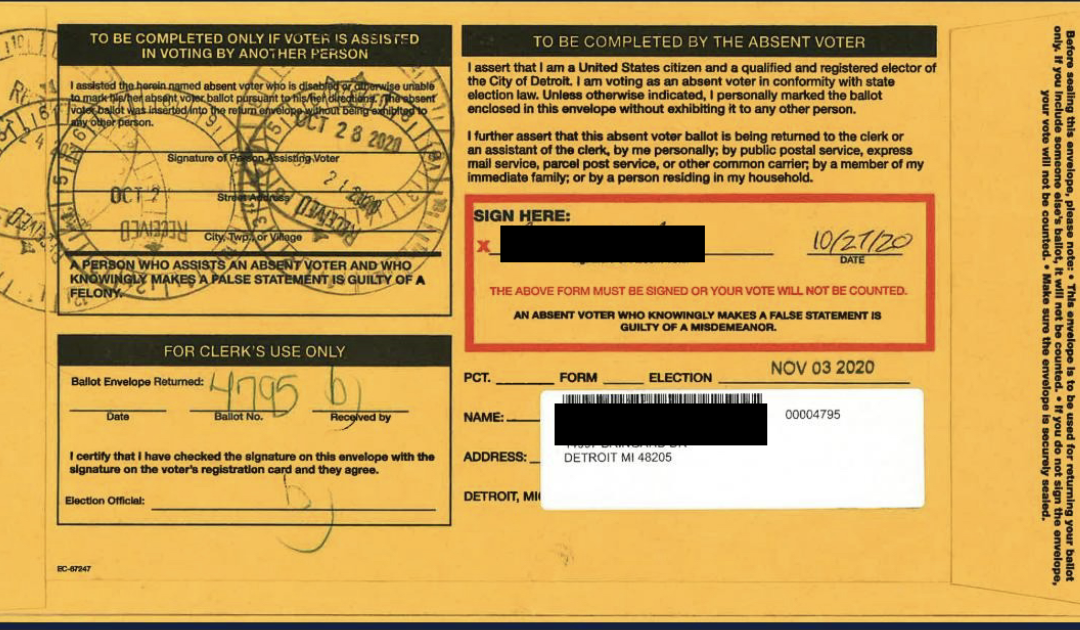
Here are a few of the absentee ballots our incredible team of volunteers has already flagged as having “issues.”
Let’s begin with this “voter,” who is registered to vote and voted from a NON-EXISTENT address in Detroit. We have confirmed that 8286 Auburn St., Detroit, MI, is a fake address. This “voter” successfully registered to vote from this address and received an absentee ballot in the 2020 election. According to the official City of Detroit “Received” date stamp, his absentee ballot envelope was received on the day before the election. The “Clerks Only” section of the envelope reveals that this “voter” from a fraudulent address was given ballot #8574. Curiously, this voter has now been wiped clean from the Michigan voter rolls.
The absentee ballot envelope below shows a German address on the envelope label. The white label is what is used by the USPS to deliver the ballot. According to the date next to the voter’s signature, the envelope was signed on Oct. 30, 2020, and received (according to the official City of Detroit stamp) on October 30. We’ve been hearing for decades that our USPS service is inefficient. Apparently, when it comes to absentee ballots in Detroit, they defy all odds and deliver overseas mail on the same day.
Curiously, this voter did not use the UOCAVA (Uniformed Overseas Civilian Absentee Voter Act) form of voting which allows them to skip the requirement to prove that they are a US citizen, they can never have lived in the US, and they can literally choose any address in Michigan and say that some member of their family once lived there to register to vote. Contrast their ballot to the ballots below, which show two UOCAVA voters (red envelopes). Both voters’ ballots were mailed to an address in Detroit, despite their official registration listing a forwarding address in Israel. Both UOCAVA voters cast absentee ballots in the November 2020 election.
Remember, UOCAVA voters don’t have to prove that they live at a particular address in Michigan or that they ever did to vote in Michigan’s elections. The rules for overseas voters are much more lax than they are for US citizens living in the USA.
This absentee ballot envelope was not signed or dated. There is a handwritten note stating that the ballot was “rejected” because there is “no sig.” The person was, nevertheless, issued ballot number 0387, and according to the official voter rolls, despite the “rejected” ballot, voted absentee in the Nov. 2020 election. The line below the signature clearly states: THE ABOVE FORM MUST BE SIGNED OR YOUR VOTE WILL NOT BE COUNTED.”
The absentee ballot envelope shown below was processed at the post office on 8/4/2020. Detroit’s Primary election was August 4, 2020. The official USPS stamp reveals that this absentee ballot envelope was received on the day of the primary election, but was stamped and dated for the November general election. According to the “Clerk’s Only section, the voter received ballot #0070 and appears to have been counted in the Nov. election, as the voter is recorded as “voted” in the 2020 election.
The voter dated this absentee ballot envelope “May 6, 2020”. The first day the absentee ballots were available to voters in 2020 was September 24. The ballot was marked “Received” on October 9, 2020, and the voter was issued a ballot (#0633).
These ballots were all signed and dated AFTER the date they were received, according to the official City of Detroit stamp. Unfortunately, the envelope signed date appearing after the official time stamp is an all-too-common occurrence in Detroit.
Fortunately, for this voter, the person processing this envelope (or someone offsite who handled these envelopes after they were received) was able to change the official time stamp with an ink pen (see the red arrow below that points to the handwritten date change).
This envelope was signed by the voter on October 6, 2020, given the official City of Detroit “Received” stamp on October 8, 2020, and also given a completely different handwritten “received” date of October 15.
This absentee ballot envelope was signed on Sept. 30, 2020, and received on Oct. 1, 2020, according to the official City of Detroit stamp, but we’re not sure how the envelope was delivered, considering the address label is completely scribbled out and unreadable. Of course, the voter was issued a ballot (#0007)
There is no way to determine when this envelope was received, as it has SIX official time stamps from the city clerk, each showing a different or illegible date.
These are just some of the ballot issues we’ve uncovered. Many of the issues we’ve found should have prevented election officials from processing the ballots, but they were processed anyway. We will continue to share more examples of our findings as we diligently pore through these absentee ballot envelopes. Although we have over 100 volunteers signed up to help us with this project, we have a long way to go, and our expenses are mounting. We have made the decision not turn this project over to the government or to an outside group that might taint the evidence or miss some of our critical findings. Please consider supporting our efforts by donating any amount you can afford to our Give Send Go account HERE.
We knew from the day after the 2020 election that Detroit’s election results could not be trusted. No one has done more than the Gateway Pundit to uncover the fraud in Michigan. From proving the late-night drop of tens of thousands of ballots at the TCF Center on the morning after the election by paying to get the security footage from the TCF Center that revealed the white van making not one, but two deliveries of ballots around 3:30 am on the day after the election, to our exclusive story that exposed the statewide GBI Strategies voter application scam that our Attorney Genertal Dana Nessel and Secretrary of State Jocelyn Benson hid from the clerks and from the citizens of Michigan, to providing footage of the Detroit absentee ballot drop boxes that showed dozens of individuals and teams of people dropping off stacks of ballots (in violation of Michigan law) while recording themselves, we have exposed instance after instance of blatant fraud. Yet, nothing has been done to correct it or hold the people who’ve been covering it up responsible. We hope to change that with this investigation, after we provide irrefutable proof of fraud.
Mass Migration Crisis: Nearly 40% of Berlin Police Applicants Fail Basic German Test
February 26, 2026
German police via Flickr
Internal numbers from the Berlin Police have revealed that the force’s recruitment problems have gone beyond just not having enough applicants—now it’s about applicants who can’t meet even the most basic language standards, amid broader issues with mass immigration and slipping educational levels across Germany.
According to data from 2024 and 2025, nearly four out of ten applicants to the Berlin Police failed the mandatory German language examination. Of 10,874 candidates, 4,271 did not meet the required standard—a staggering 39.3% failure rate, Apollo News reports.
The figures are particularly alarming given the obviously critical role language plays in enforcing the long. Police officers must write precise reports, draft legal documents, and communicate clearly with citizens in high-pressure situations.
Even higher academic credentials offered little assurance of success. Among applicants holding a high school diploma, university entrance qualification, or completed degree, a shocking 30.1% still failed the German test.
In total, more than 1,800 academically credentialed candidates were unable to pass what is considered a basic language assessment. The alarming trend has directly impacted staffing plans across the Berlin Police Department.
Last year alone, some 25% of the 1,224 planned training positions went unfilled. In a city already grappling with rising crime and public safety concerns—both associated with the sustained mass migration into the country and city over the past decades—such shortfalls raise serious questions about long-term readiness.
It’s worth noting that the selection process itself isn’t particularly complex. Applicants complete a 200-word computer-based dictation exercise in which a text is read aloud in segments of five to eight words, with pauses in between.
Under internal guidelines, anyone who makes more than 14 errors fails. Practice materials are widely available online, yet the failure rate remains stubbornly high, revealing just how many individuals with migrant backgrounds are trying to become police officers in the German capital.
Even among those who pass the exam, additional linguistic support is often required. During the first three semesters of training, many recruits receive supplemental German instruction, with small group assistance provided regularly.
It’s been made clear by the Berlin authorities that standards will not be lowered. State Secretary of the Interior Christian Hochgrebe,a member of the left-liberal Socialist party, emphasized that applicants are expected to prepare independently for a profession that demands discipline and personal motivation.
The department, thus far, has refused to introduce preparatory courses before the application stage, with officials arguing that the ability to meet baseline language requirements should be a prerequisite for public service.
Critics of Germany’s suicidal mass immigration policies, of which there is no shortage, view the data as highly symptomatic of a broader national problem. They insist, rightly, that years and years of uncontrolled mass migration and the prioritization of multicultural accommodation over integration have weakened foundational competencies.
Germany’s police forces are tasked with enforcing the law of the land, and that responsibility requires absolute command of the national language and loyalty to national standards.
The right-wing, anti-globalist Alternative for Germany (AfD) party has warned for years that the dilution of educational expectations and exceedingly lax integration policies would inevitably have tangible consequences. The Berlin figures now being cited are clear evidence that those warnings were not at all unfounded.
Berlin, viewed by many as a showcase of left-liberal globalist governance, has for years struggled with crime, overcrowded public services, and strained public institutions. The inability to recruit sufficient qualified police officers only compounds those challenges.
AfD supporters have long argued that public safety begins with rigorous standards, contending that lowering expectations or masking deficiencies would undermine trust in law enforcement.
In their view, exhibiting mastery of the German language is not optional but foundational to national cohesion. The debate comes at a time when questions of identity, sovereignty, and state authority dominate political discourse across Germany and, for that matter, much of Europe. Many voters increasingly prioritize security and the continuity of Germany’s traditional cultural identity over liberal-globalist experimentation, which so far has proven itself to be utterly disastrous.
The Berlin Police figures, for a growing segment of the German population, symbolize the urgent need to reassert standards, drastically limit immigration, and restore confidence in core institutions.
As Germany continues to navigate civilization-altering demographic shifts and political realignment, the issue of who enforces the law—and whether they can meet its basic linguistic demands—will, without a doubt, remain central to the national conversation
El Salvador President Bukele Criticizes Mexico’s Government for Allowing Cartels to Control the Nation
February 26, 2026
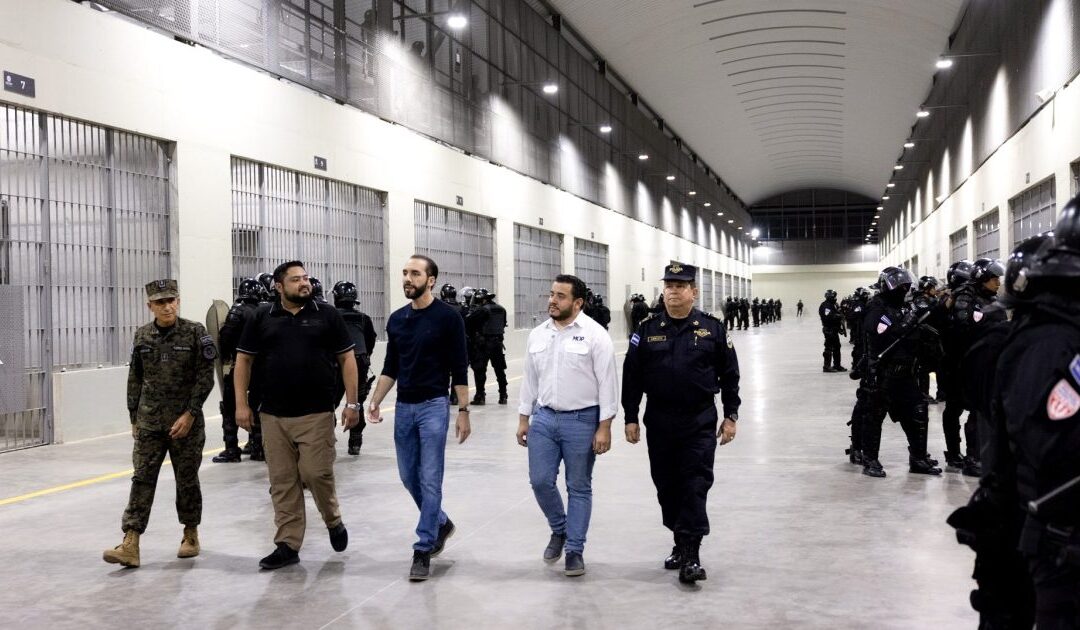
El Salvador President Nayib Bukele tours the Terrorism Confinement Center (CECOT), where he has imprisoned thousands of gang members. Casa Presidencial, El Salvador, CC0, via Wikimedia Commons
“Not one grain of rice” will be given to prisoners in the Terrorism Confinement Center, vowed El Salvador’s president, Nayib Bukele, if innocent people are killed in the streets.
President Bukele has become a model for the right and a target for liberals and human-rights organizations because of his harsh crackdown on gangs, which is saving lives daily in El Salvador. By locking up 100,000 gang members, he has transformed El Salvador from one of the most dangerous countries in the world into one of the safest in the Americas.
In a press conference, Bukele addressed rumors that gangs were considering retaliating against ordinary citizens at random. He issued a direct warning. “There are rumors that they want to start taking revenge on the honest people, at random. Do that, and there won’t be a single meal in prison.”
He said that if gangs carried out such attacks, imprisoned members would face immediate consequences. “Let’s see how long their homeboys last in there,” he said. “I swear to God they won’t eat a single grain of rice.”
Bukele dismissed potential criticism from international organizations, saying he did not care what they might say in response to stricter prison measures. “Let them come and protect our people,” he said. “Let them come and take their gang members, if they want them so much. We’ll give them all to you, two for one.”
Bukele has shown the world that crime can be stopped. Criminal gangs can be neutralized by locking them up. In a previous interview, he said the purpose of prison was not to punish, but simply to remove criminals from society so they could not hurt people anymore.
His plan not only worked in El Salvador, but could work anywhere. There just needs to be the political will.
In a separate press conference, he came down hard on Mexico’s president, Claudia Sheinbaum. Bukele argued that no government is incapable of eliminating crime if it truly exercises state power. “How is it possible that a criminal organization can control an entire territory and the government can’t take it out?” he asked. In his view, the idea that a state cannot defeat crime is “absurd,” because “Leviathan, the state, is always stronger than any criminal organization.”
He said El Salvador had already demonstrated this principle. Critics often claim that drug trafficking alone explains the power of criminal groups, but Bukele rejected that argument as incomplete.
Pointing to Europe, he said he is “totally against drugs” and emphasized that El Salvador is fighting a drug war. Yet, he argued, drug consumption in Europe is “much higher, legal and illegal,” than in Latin America. Despite that higher consumption, Europe does not have cartels controlling territory. There may be dealers, he acknowledged, but there are no drug cartels, “much less controlling territories.”
In Europe, he said, no cartel controls the south of France while another controls the north. “That doesn’t happen in Europe because the state controls its territory.” By contrast, he argued that in parts of Latin America governments have effectively ceded control, saying they cannot control certain regions and must “leave that area to the cartels, the other area to the criminal organization, the neighborhoods to the gangs.”
“It can’t be. Something has to be wrong,” Bukele said. He cited large sectors of Mexico, Colombia, and Brazil as examples where criminal organizations exercise territorial control. He claimed that cartels in Latin America control territory comparable in size to Europe.
While that comparison may be somewhat exaggerated, it is close. Europe covers roughly 3.86 million square miles, about 10 million square kilometers.
If you combine the total land area of Mexico, Colombia, Peru, and Brazil, countries where powerful criminal organizations such as the Sinaloa Cartel, CJNG, Clan del Golfo, ELN, and Comando Vermelho operate, you reach approximately 5.02 million square miles, or about 13 million square kilometers.
Cartels do not formally own these countries, but in many areas they exercise parallel governance, collecting extortion payments, enforcing their own rules, controlling movement, and determining who can operate economically.
In much of Latin America, the state often maintains nominal control, meaning there is a flag, a police station, and formal institutions. Cartels frequently exercise effective control, deciding who lives, who works, and who pays.
In Mexico, U.S. intelligence assessments have estimated that cartels “control or influence” roughly 30 to 35 percent of national territory. That figure understates the problem. Even where the federal government retains a physical presence, courts, legislators, and the presidency often operate under constraints imposed by cartel power, limiting the government’s ability to enact policies contrary to cartel interests. One could argue that cartel influence extends far beyond the percentage of land they physically dominate.
In Colombia, armed groups and cartels such as the Clan del Golfo and the ELN exert significant control over large portions of rural territory, particularly in coca-growing regions, affecting governance in dozens of municipalities.
In Brazil, criminal organizations such as Comando Vermelho control hundreds of favelas and continue expanding into remote regions of the Amazon, an area geographically comparable in scale to parts of the European Union.
Modern cartels no longer need to control a single massive block of land like a traditional state. Instead, they dominate strategic corridors, including ports, mountain passes, and border towns. By 2026, this has evolved into a form of hybrid control, with cartels using drones to monitor territory and shadow governance structures to influence local elections, effectively ruling specific regions without formally replacing the state.
Repeating his central question, he asked how a criminal organization can control an entire territory while the government cannot remove it. His answer was blunt: “Because they are in the government. That’s why.”
We use technologies like cookies to store and/or access device information. We do this to improve browsing experience and to show (non-) personalized ads. Consenting to these technologies will allow us to process data such as browsing behavior or unique IDs on this site. Not consenting or withdrawing consent, may adversely affect certain features and functions.
Functional
Always active
The technical storage or access is strictly necessary for the legitimate purpose of enabling the use of a specific service explicitly requested by the subscriber or user, or for the sole purpose of carrying out the transmission of a communication over an electronic communications network.
Preferences
The technical storage or access is necessary for the legitimate purpose of storing preferences that are not requested by the subscriber or user.
Statistics
The technical storage or access that is used exclusively for statistical purposes.The technical storage or access that is used exclusively for anonymous statistical purposes. Without a subpoena, voluntary compliance on the part of your Internet Service Provider, or additional records from a third party, information stored or retrieved for this purpose alone cannot usually be used to identify you.
Marketing
The technical storage or access is required to create user profiles to send advertising, or to track the user on a website or across several websites for similar marketing purposes.


 BREAKING: The first image of Hillary Clinton testifying under oath about Jeffery Epstein to the Republican Oversight Committee.