BREAKING: Armed Muslim Man Wearing Military Gear Arrested After Walking Into Texas Elementary School
March 13, 2026
An armed Muslim man wearing tactical gear was arrested after walking into an elementary school in Spring, Texas, this week.
The suspect, 39-year-old Kyle Najm Chris, AKA, Muhi Mohanad Najm, walked into Zwink Elementary School on Tuesday after another visitor failed to secure the first set of doors to the school.
Although Najm Chris was able to enter through the first set of doors, the school’s double-door security system blocked him from entering the hallways and approaching the school children.
Klein ISD waited until Wednesday evening to notify parents about the breach.
The school district was reportedly working with the FBI before officers arrested him at his home, 4 miles away from the school.
Najm Chris initially told police he was a security guard; however, he is unemployed and does not hold any certifications or licenses to serve as an officer.
A man dressed in military-style clothing and carrying a holstered firearm entered Zwink Elementary School in Spring Tuesday, prompting a multi-agency investigation that led to a felony arrest, according to court documents and a letter from school officials.
Kyle Najm Chris, also known as Muhi Mohanad Najm, 39, of Klein, was charged with possession of a prohibited weapon, a third-degree felony, which prohibits carrying weapons on school premises. The Harris County District Attorney accepted the charges, and Chris was arrested at around 6:30 p.m. Wednesday.
According to the criminal complaint, Chris entered the front office of Zwink Elementary, which is located off Spring Stuebner and Frassati, at around 1:30 p.m. after slipping through the front entrance when another visitor failed to fully secure the door behind them. A school employee told investigators Chris was wearing full green military or tactical law enforcement attire, including a load-bearing vest, a taser and a holstered firearm.
When the employee asked Chris how he entered without access and whether there was armed security on campus, he told her the front door was not latched. When she asked for identification, he provided none and didn’t identify himself by name or agency. He then left the building, got into a dark blue Dodge Charger and drove away.
More on this story from ABC 13 Houston:
This is not getting enough attention:
3 days ago, Muhi Mohamad Najm went into an elementary school in Klein, TX. He was armed, wearing tactical gear.
HOLY SMOKES: Drone Strikes Are Now Targeting IRGC Police Units at Street Level
March 13, 2026
A new phase of the Iranian war has begun – drone strikes against IRGC and Basij units are taking place at the street level. This is amazing. The Iranian people … Read more
Peter Schweizer Exposes China’s Birth Tourism Industry Creating Army of U.S. Citizens Raised Under Communist Influence During Powerful Senate Testimony (VIDEO)
March 13, 2026
During his testimony before the U.S. Senate Judiciary Subcommittee on the Constitution, investigative journalist and Government Accountability Institute President Peter Schweizer exposed the alarming scale of China’s birth tourism operations targeting the United States.
Schweizer revealed during Tuesday’s hearing, titled “Protecting American Citizenship: Birthright Citizenship for Illegal Aliens and Tourists,” that over 1,000 birth tourism companies in China are almost exclusively focused on facilitating births in America, potentially resulting in up to 1 million U.S. citizens being raised in the People’s Republic of China.
Schweizer, author of the book The Invisible Coup: How American Elites and Foreign Powers Use Immigration as a Weapon, described birth tourism as an “industrial-scale” operation where Chinese nationals pay up to $100,000 for concierge services.
These services include travel arrangements, medical care, and logistical support to ensure their children are born on U.S. soil, thereby granting them automatic citizenship under the 14th Amendment.
“In China alone, we have identified more than 1,000 birth tourism companies that are almost exclusively focused on the United States,” Schweizer stated.
WATCH:
.@PeterSchweizer: “In China alone, we have identified more than 1,000 birth tourism companies that are almost exclusively focused on the United States.”
“You are looking at roughly 1 million ‘U.S. citizens’ who are being raised in the People’s Republic of China today.” pic.twitter.com/8Wyr7fyyzi
Schweizer cited Chinese government estimates of about 50,000 such births annually, though other sources suggest figures as high as 100,000 or even 180,000 in peak years like 2018.
Doing the math, Schweizer warned, “You are looking at roughly 1 million ‘U.S. citizens’ who are being raised in the People’s Republic of China today.”
This practice exploits U.S. birthright citizenship laws, allowing children born here to later sponsor family members through chain migration and even vote in American elections, potentially from abroad via mail-in ballots.
Birth tourism involves pregnant foreign nationals traveling to the U.S. specifically to give birth, securing citizenship for their children.
While the practice is not illegal per se, it circumvents immigration processes and has been criticized for demeaning naturalization. The U.S. does not track parental nationalities for births, making precise data scarce, but estimates indicate it’s a multi-billion-dollar industry.
China has companies advertising services in Mandarin and targeting affluent families. Women often enter on B-1/B-2 visas, misrepresenting their intent or using loopholes like visa-waiver programs in U.S. territories.
For instance, the Northern Mariana Islands (including Saipan) allow visa-free entry for Chinese nationals under the Guam-CNMI Visa Waiver Program, leading to a surge in births there, nearly 600 in 2018 alone, outnumbering local births.
After birth, mothers and their babies typically return to China, where the children are raised until they can leverage their U.S. citizenship for education, jobs, or family reunification.
Schweizer highlighted national security risks, noting that these citizens, indoctrinated in China, could undermine U.S. sovereignty as part of a broader “asymmetric warfare” strategy by the Chinese Communist Party.
In response to these revelations, Rep. Tom Tiffany, Rep. Chip Roy, and Sen. Rick Scott have introduced the “One Nation, One Visa Policy Act.”
The bill requires all Chinese nationals to obtain a valid visa for entry into any U.S. territory, eliminating visa-free access to places like the Northern Mariana Islands and preventing exploitation of birthright citizenship.
“Communist China has a track record for exploiting America’s weaknesses to advance its interests and undermine our national security,” Scott stated.
“U.S. citizenship is valuable, not something foreign holidaymakers should be able to pick up like a hotel gift-shop souvenir,” Tiffany told Breitbart News. “For far too long, a dangerous loophole opened during the Obama administration and widened under the Biden administration has allowed pregnant women from China to travel visa-free to the Northern Mariana Islands to give birth and secure U.S. citizenship for their children.”
President Trump Responds to John Thune Claiming He Can’t Get the Votes for The Save America Act (AUDIO)
March 13, 2026
Credit: Gage Skidmore/Flickr
President Trump does not like the excuses of Senate Majority Leader John Thune (R-S.D.) regarding why he can’t get the SAVE America Act to his desk.
AS TGP readers know, Thune has quashed an effort to use ‘the talking filibuster’ to pass the SAVE America Act, citing opposition from at least four Republicans and doubts regarding the ability to outlast Democrats.
On Tuesday afternoon, Thune performed a U-turn of sorts, telling reporters that there would be a vote, giving those advocating for the SAVE America Act a chance to pass it. The vote will happen next week.
But the Senate Majority Leader quickly poured cold water on its chances of passage.
“We’ll give them (advocates) a chance,” Thune told reporters. “Like I said, they’ll have that opportunity to vote one way or the other on this.”
“But I would be very, very surprised.”
WATCH:
JUST IN: Senate Leader John Thune says he will FORCE a vote on the SAVE America Act, but he can NOT guarantee it will pass because that needs 60 votes
“That debate will happen. But like I said, I can guarantee the debate. I can guarantee a vote. I just can’t guarantee an… pic.twitter.com/GKKPlJDssi
While appearing on Brian Kilmeade’s radio show on Friday morning, Trump expressed exasperation over Thune’s dithering.
Trump noted that he and other Americans are not asking for much. After all, no one should be opposed to Voter ID or proof of citizenship for voting and registering to vote, respectively.
LISTEN:
JUST IN: President Trump responds to Senate Majority Leader John Thune being unable to get the votes for the SAVE America Act
“I mean, how can you NOT get voter ID approved? How can you not get, you know, citizenship approved? Proof of citizenship! That’s ALL we’re asking!”… pic.twitter.com/2zBx6ryDbT
FT Report: Iran War Draining Years’ Worth of US Weapons Supplies
March 13, 2026
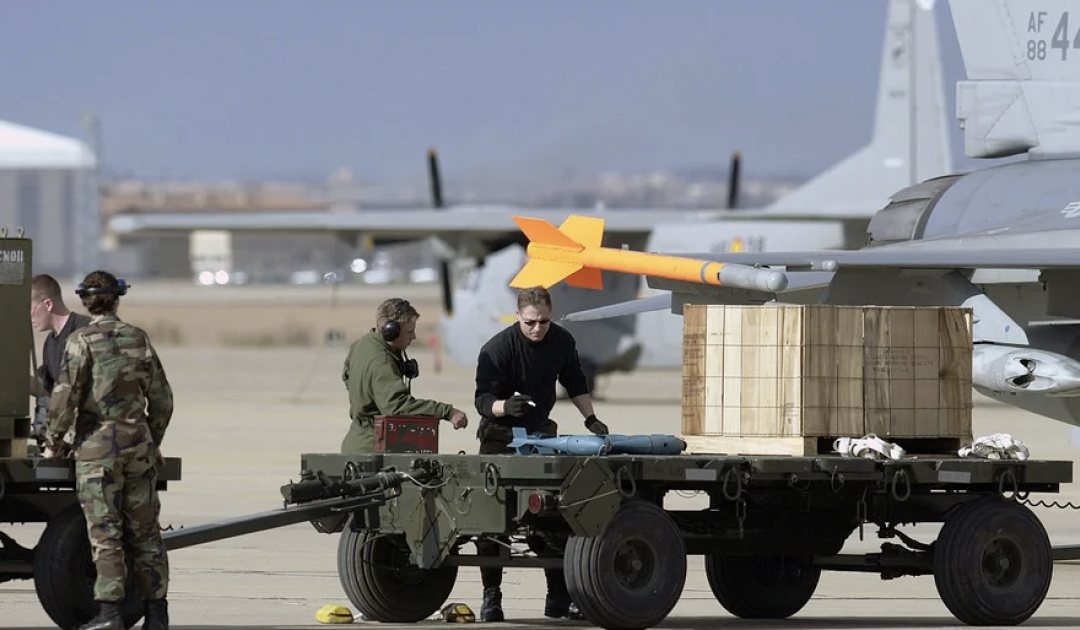
US Air Force Munitions via GetArchive
The opening phase of the Trump administration’s military campaign against Iran is already revealing the staggering financial and logistical demands of modern warfare. In just a matter of days, the conflict has consumed vast quantities of advanced weapons and billions of dollars in military resources.
According to a new report published by the Financial Times and other outlets, American forces have already burned through stockpiles of critical munitions that would normally last for years. Officials say the pace of weapons usage is raising serious questions inside Washington about the long-term sustainability of the campaign.
During a closed-door briefing on Capitol Hill, Pentagon officials told lawmakers that the first six days of the war alone cost at least $11.3 billion. The estimate primarily reflects the value of munitions used during the initial strikes.
The true cost is likely far higher. Additional expenses include the deployment of forces to the region, logistical support, medical care, and the replacement of aircraft and equipment damaged or lost in combat.
The scale of the spending has begun to alarm lawmakers from both parties. Members of Congress are increasingly demanding clarity about how long the conflict may last and what the administration ultimately hopes to achieve.
Much of the early expenditure has been tied to the use of sophisticated long-range weapons. Among the most significant examples are the Navy’s Tomahawk cruise missiles, which were used extensively in the opening phase of the campaign.
Analysts estimate that American forces fired roughly 168 Tomahawk missiles within the first 100 hours of combat operations. Each missile carries a price tag of approximately $3.6 million, meaning hundreds of millions of dollars in weapons were expended in a matter of days.
Military analysts say this level of consumption could have lasting consequences for the Navy’s inventory. One source familiar with the situation told the Financial Times that the service will likely “feel this expenditure for several years.”
The concern stems from the fact that these missiles cannot be replaced quickly. Over the past five years, the American military has purchased only a few hundred Tomahawks, far fewer than the number now being consumed in combat. For fiscal year 2026, the Pentagon had planned to acquire just 57 additional missiles. That order, costing roughly $206 million, would replace only a fraction of those already fired during the current campaign.
Other expensive weapons have also played a central role in the early strikes. These include the AGM-154 Joint Standoff Weapon, a precision glide bomb that can cost between roughly $578,000 and $836,000 per unit.
Such weapons allow aircraft to strike targets from long distances with remarkable accuracy. But the technology comes at a steep price, making large-scale campaigns extraordinarily expensive. As the war has continued, the Pentagon has reportedly begun shifting toward less costly munitions. One widely used option is the Joint Direct Attack Munition, or JDAM, which converts conventional bombs into guided weapons.
JDAM systems dramatically reduce costs compared with cruise missiles and other advanced strike platforms. Even so, the financial burden of the campaign remains immense.
During the earliest days of the conflict, analysts estimated that the United States was spending roughly $2 billion per day on munitions alone. That figure has reportedly dropped closer to $1 billion per day as cheaper weapons have been introduced into the strike campaign.
Despite that reduction, the overall burn rate remains extraordinarily high. Modern high-tech warfare relies on precision weapons that are both expensive and difficult to produce quickly.
To replenish depleted stockpiles, Pentagon officials are now expected to seek additional funding from Congress. Reports indicate the Defense Department may request as much as $50 billion in new military spending to sustain operations and rebuild inventories.
Such a request could face significant resistance on Capitol Hill. Lawmakers in both parties are increasingly wary of approving another large defense package without a clear understanding of the war’s scope and objectives.
Some Democrat lawmakers have already raised constitutional concerns, noting that Congress has not formally authorized the military campaign. But skepticism is also emerging among Republicans who worry about the financial and strategic implications of an open-ended conflict.
Republican Senator Lisa Murkowski of Alaska, a member of the Senate Appropriations Committee, recently signaled unease about approving additional spending without clearer answers. She noted that Washington previously warned Ukraine and its European partners that American weapons supplies were limited. Those earlier warnings now appear difficult to reconcile with the massive quantities of munitions being used in the current conflict. The contrast has fueled further debate about whether the United States can sustain such operations indefinitely.
Defense Secretary Pete Hegseth has insisted that American arsenals remain robust. Earlier this month he assured the public that American stockpiles were fully prepared for the demands of the campaign. “Our munitions are full up and our will is iron-clad,” Hegseth said at the time. Yet the early data from the conflict suggests the strain on weapons inventories may be more significant than initially acknowledged.
President Donald Trump has also argued that America possesses the industrial strength to sustain long conflicts. At one point he suggested that the country’s defense capabilities would allow it to fight wars “forever” if necessary.
But modern warfare presents new challenges. Precision weapons, advanced guidance systems, and long-range strike platforms require complex manufacturing processes that cannot be scaled up overnight.
That reality means even the world’s most powerful military must carefully manage its resources. Rapid depletion of advanced weapons could complicate the Pentagon’s ability to respond to future crises elsewhere.
For the United States, which maintains global security commitments across multiple regions, this challenge carries particular significance. Maintaining readiness requires not only military strength but also careful stewardship of resources.
The Iran conflict is now becoming a case study in those pressures. As the war continues, lawmakers in Washington are increasingly confronting the
We use technologies like cookies to store and/or access device information. We do this to improve browsing experience and to show (non-) personalized ads. Consenting to these technologies will allow us to process data such as browsing behavior or unique IDs on this site. Not consenting or withdrawing consent, may adversely affect certain features and functions.
Functional
Always active
The technical storage or access is strictly necessary for the legitimate purpose of enabling the use of a specific service explicitly requested by the subscriber or user, or for the sole purpose of carrying out the transmission of a communication over an electronic communications network.
Preferences
The technical storage or access is necessary for the legitimate purpose of storing preferences that are not requested by the subscriber or user.
Statistics
The technical storage or access that is used exclusively for statistical purposes.The technical storage or access that is used exclusively for anonymous statistical purposes. Without a subpoena, voluntary compliance on the part of your Internet Service Provider, or additional records from a third party, information stored or retrieved for this purpose alone cannot usually be used to identify you.
Marketing
The technical storage or access is required to create user profiles to send advertising, or to track the user on a website or across several websites for similar marketing purposes.








 JUST IN: Senate Leader John Thune says he will FORCE a vote on the SAVE America Act, but he can NOT guarantee it will pass because that needs 60 votes