
Barron Trump Set to Enter ‘Next Phase’ of Life as He Celebrates ‘Turning Point’ Birthday: Report

Barron Trump Set to Enter ‘Next Phase’ of Life as He Celebrates ‘Turning Point’ Birthday: Report

Barron Trump Set to Enter ‘Next Phase’ of Life as He Celebrates ‘Turning Point’ Birthday: Report
March 22, 2026

First son Barron Trump turned 20 on Friday, and he reportedly is already following in his father’s footsteps, making his way in the business world.

Trump, who is a sophomore at New York University’s Stern School of Business, transferred this year from the Manhattan campus to its location in Washington, D.C., to be close to his family, according to People.

“Barron has inherited his father’s interest in making money and a name for himself, and is well on the way to becoming an entrepreneur,” a social source told the news outlet. “He is smart, focused and resourceful. He is always looking for areas that interest him and is quite ambitious for such a young age.

“He wants to make his own mark.”

People noted that the college student was the “motivating force” behind the Trump family jumping into the cryptocurrency world with both feet in recent years, earning them billions of dollars, based on reporting by Forbes.

The publication said that Barron is believed to already be worth $150 million, and has an estimated 2.3 billion locked-up tokens, which could be valued at $525 million when they are able to be sold.

“He has been actively pursuing successful ventures for several years,” a source told People. “Turning 20 is indeed a turning point for him as he gets older and wants to engage with projects that not only interest him, but will make him a lot of money.”

“Barron is interested in developing real estate in areas where he sees growth, especially keeping up with trends of younger buyers,” the source said. “I think the next phase of his life will include property development as well as other projects that he has researched enough to know they will be profitable.”

A political source observed that Trump’s close relationship with his mother, Melania, has greatly shaped his personality.

“Barron is a carbon copy of his father, yet he is blessed without the elder’s brashness,” the source said. “He is more like his mother with a European aloof and quiet sophistication.”

Japanese Prime Minister Sanae Takaichi mentioned Trump’s birthday during a dinner at the White House on Thursday night.

“Tomorrow is the birthday of your son, Mr. Barron Trump, and I know he has grown up so much, into a very tall, good-looking gentleman. As I see you, Donald, it is very clear where he got it. Of course, from his parents, there is no doubt about it. So if Donald, if I may ask you, please convey my sincere happy birthday wishes to him,” she said with President Trump by her side.

USA Today pointed out that Barron is at least 6-foot-7, though there are conflicting reports.

First lady Melania Trump told Fox Business Network host Maria Bartiromo in January that Barron is an “incredible young man.”

“This time it’s very different, because he’s 19 years old and [the] first time he was 10 years old,” she added, regarding the family’s return to the White House. “He understands politics, he gives advice to his father, we talk about it, so very different.”

In December 2024, Melania credited Barron with helping Donald Trump get re-elected by encouraging his father to appear on podcasts that young men watch.

“Because nowadays, the younger generation, they don’t sit in front of TV anymore. They are all on the tablets. They’re on the phones and all of these podcasts and streamers,” Melania noted.

“He was very vocal, and he gave advice to his father. And it was incredible how he brought in success, because he knew exactly who his father needed to contact and to talk to,” she said.

In particular, Barron reportedly told President Trump to go on various podcasts — such as “The Joe Rogan Experience,” influencer Adin Ross’ stream on Kick, “This Past Weekend with Theo Von,” and the “PBD Podcast” with businessman Patrick Bet-David.

Altogether, Trump’s appearances racked up over 80 million views.

He won the 18-29-year-old male voter demographic 56 to 42 percent.

Young women also moved in Trump’s direction, shifting from 33 percent support in 2020 to 40 percent in 2024, according to a Tufts survey.

Overall, the Republican candidate garnered 46 percent of the demographic in 2024, up from 36 percent in 2020.

This article appeared originally on The Western Journal.

The post Barron Trump Set to Enter ‘Next Phase’ of Life as He Celebrates ‘Turning Point’ Birthday: Report appeared first on The Gateway Pundit.

Go to Source
Author: Randy DeSoto, The Western Journal

Stephen Miller’s Wife Grills Deputy Attorney General Todd Blanche During Podcast on Why the FBI Hasn’t Arrested Deep State ‘Traitors’ Like Clapper, Comey, and Brennan

Stephen Miller’s Wife Grills Deputy Attorney General Todd Blanche During Podcast on Why the FBI Hasn’t Arrested Deep State ‘Traitors’ Like Clapper, Comey, and Brennan

Stephen Miller’s Wife Grills Deputy Attorney General Todd Blanche During Podcast on Why the FBI Hasn’t Arrested Deep State ‘Traitors’ Like Clapper, Comey, and Brennan
March 22, 2026

Podcast hosts engaged in conversation in a modern studio setting, featuring stylish decor and branding for "The Katie Miller Podcast."
Deputy Attorney General Todd Blanche was grilled by Katie Miller during her podcast (The Katie Miller Pod/X)

Katie Miller, the fierce and unapologetic wife of top Trump adviser Stephen Miller, put Deputy Attorney General Todd Blanche on the hot seat during a recent episode of her podcast.

The grilling came just days before Blanche and Attorney General Pam Bondi were set to face the House Oversight Committee in a closed-door session on the long-overdue release of Jeffrey Epstein files.

Miller didn’t waste time getting to the heart of what many Americans are asking: where is the accountability?

Referencing the DOJ’s handling of the Jeffrey Epstein case and its sprawling web of elite connections, Miller framed the issue in stark terms.

“The moms are desperate to know because they want to be protectors of kids… Do you think you’ve failed them thus far?”

More from The Independent:

Blanche launched into a defense of the DOJ’s release of 3.5 million government documents on Epstein in compliance with the passage of the bipartisan Epstein Files Transparency Act through Congress late last year.

“I mean, no, not in any way, shape or form,” he answered. “When I hear this narrative that we are letting down victims or that we are failing victims… I want to make sure people know that every day we fight for victims.”

Moving on to the circumstances of Epstein’s death, which a coroner determined to be the result of suicide, Miller asked Blanche whether he accepted the ruling or believed he had been murdered at the Metropolitan Correctional Center in Brooklyn.

[…]

“Do the cameras in the jail fail frequently or just in this specific case?” she asked. “No time of death was ever determined, only that his body was discovered [at] 6.30 a.m. the next morning. Why couldn’t investigators establish a clearer timeline?”

“That’s a good question,” Blanche conceded. “And it’s one of the failures, right? What happened with Epstein leads to these type of fair questions about what happened that night.”

Not finished there, Miller asked her guest whether any potential connection was ever investigated between Epstein and the notorious Pizzagate conspiracy theory, which evolved into the QAnon movement, and alleged that a secret sex trafficking operation existed, run by elite Democrats, including Hillary Clinton.

“Well the Pizzagate conspiracy theory has been debunked repeatedly by law enforcement, not by me, by law enforcement,” Blanche answered.

“Sure, it was totally debunked,” Miller came back. “And then you look at what happened with Epstein, where a wealthy, well-connected man was actually trafficking underage girls in elite circles. And then you begin to think, ‘Hmm, maybe things aren’t a real conspiracy theory?’”

The real fireworks, however, erupted when Miller turned to the elephant in the room: the blatant lack of accountability for the Deep State operatives who weaponized federal agencies against President Trump and the American people.

“Why haven’t we arrested Clapper, Comey, Brennan? So many traitors to our country. Why haven’t we done more to hold people accountable?” Miller demanded, echoing the frustration of millions who watched these figures lead endless witch hunts against Trump for purely political reasons.

Blanche’s response was cautious, some would say evasive.

Todd Blanche:
I think that—well, first of all—I’m not going to talk about any ongoing investigations, and I can’t. But I think the Attorney General, myself, and Director Patel are focused on nothing more than accountability.

Katie Miller:
These are people who waged witch hunts against President Trump for purely political purposes. Yet I’m sure they’re all guilty of committing various crimes—which I know you can’t comment on, so we’ll give you a pass. But don’t you agree that we should hold people accountable who do these types of things?

Todd Blanche:
I think there’s nothing more important in the Department of Justice than accountability. Yes, I agree with that.

WATCH:

The post Stephen Miller’s Wife Grills Deputy Attorney General Todd Blanche During Podcast on Why the FBI Hasn’t Arrested Deep State ‘Traitors’ Like Clapper, Comey, and Brennan appeared first on The Gateway Pundit.

Go to Source
Author: Jim Hᴏft

Supreme Court Set to Decide Fate of Mail-In Ballots — Could END Post-Election Counting Nationwide

Supreme Court Set to Decide Fate of Mail-In Ballots — Could END Post-Election Counting Nationwide

Supreme Court Set to Decide Fate of Mail-In Ballots — Could END Post-Election Counting Nationwide
March 22, 2026

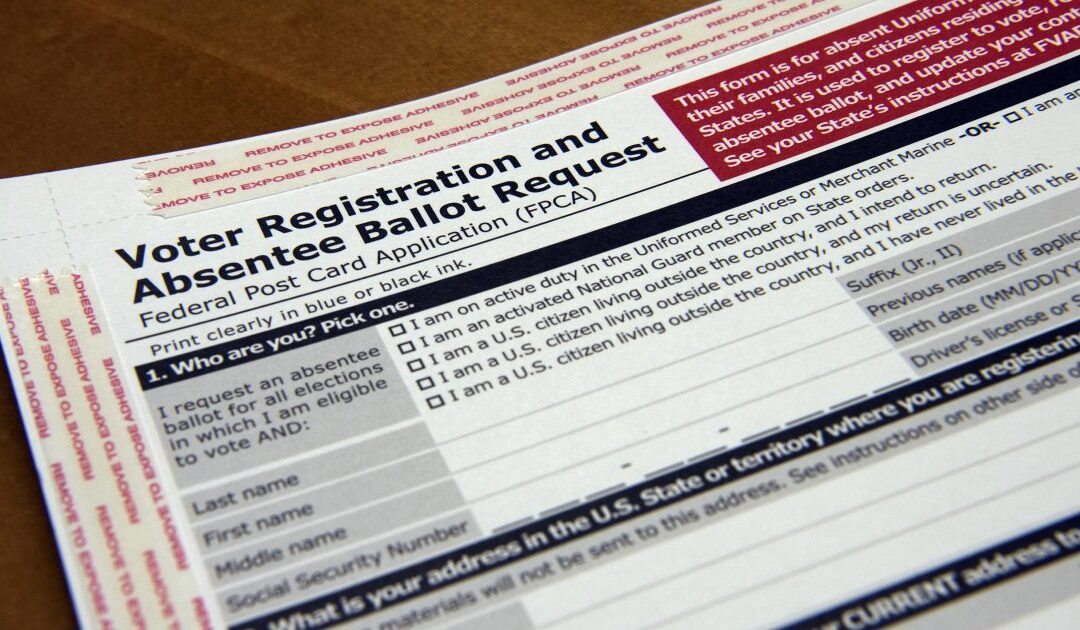
Voter registration and absentee ballot request form for U.S. citizens, featuring sections for personal information and eligibility criteria.
(U.S. Air Force photo by Airman 1st Class Zoe Thacker)

The battle over election integrity is headed straight to the highest court in the land.

The U.S. Supreme Court is set to hear arguments Monday in a blockbuster case that could fundamentally reshape how elections are conducted across the country.

At the center of the dispute is Watson v. RNC, a case challenging Mississippi’s law allowing absentee ballots to be received up to five business days after Election Day, so long as they are postmarked on or before Election Day.

Mississippi law requires that voters submit their ballots by Election Day, but allows election officials to receive and count them afterward within a limited window.

However, the Fifth Circuit Court of Appeals ruled that federal law mandates something stricter, that ballots must be both cast and received by Election Day, effectively invalidating Mississippi’s statute.

That ruling triggered the Supreme Court showdown.

Mississippi officials argue that the appeals court got it wrong, both legally and historically.

According to the state’s petition, federal statutes establish a uniform Election Day, but do not dictate ballot receipt deadlines.

The state maintains:

  • An “election” occurs when voters make their choice by casting ballots
  • Ballot receipt and counting are administrative steps—not part of the election itself
  • Many states have long accepted ballots arriving after Election Day without issue

Mississippi warns that the lower court’s ruling could cause “destabilizing nationwide ramifications” if allowed to stand.

As Gateway Pundit has repeatedly reported, the expansion of mail-in voting, especially during the COVID era, created a system ripe for confusion, inconsistency, and, critics say, manipulation.

Now, the Supreme Court may finally draw a line.

Roughly 30 states and Washington, D.C. currently allow some form of post–Election Day ballot receipt—provided ballots are mailed on time.

If the Supreme Court upholds the Fifth Circuit’s decision:

  • These laws could be struck down
  • States may be forced to overhaul election systems quickly
  • Future elections could face legal chaos and last-minute litigation

More from SCOTUS Blog:

The Supreme Court will kick off its March argument session by hearing a case that could have major implications for the 2026 elections and beyond. In Watson v. Republican National Committee, the justices will decide whether federal law requires not only that voters cast their ballots by Election Day, but also that election officials receive the ballots by then. If the justices agree that it does, laws in more than a dozen states could be upended.

The Constitution provides that “[t]he Times, Places and Manner of holding Elections for Senators and Representatives, shall be prescribed in each State by the Legislature thereof; but the Congress may at any time by Law make or alter such Regulations.” In 1845, Congress – which has the power to determine when the president is elected – chose the Tuesday after the first Monday in November as “election day,” and in 1872 it directed that congressional elections should occur on this day, as well.

In 2020, in response to the COVID-19 pandemic, Mississippi changed its election laws to allow mail-in ballots to be counted as long as they were postmarked by, and then received within five business days of, Election Day.

In 2024, the Republican National Committee and the Mississippi Republican Party, along with a Mississippi voter and a county election official, went to federal court to challenge the post-election ballot deadline; the Libertarian Party of Mississippi filed a similar lawsuit a few weeks later, which was combined with the first suit. The challengers contended that the Mississippi law conflicted with the federal law setting the Tuesday after the first Monday in November as the “election day.”

Senior U.S. District Judge Louis Guirola, Jr., upheld the law. He wrote that “Congress set a national election day to avoid the ‘evils’ of burdening citizens with multiple election days and of risking undue influence upon voters in one state from the announced tallies in states voting earlier. Neither of those concerns,” he concluded, “is raised by allowing a reasonable interval for ballots cast and postmarked by election day to arrive by mail.”

The U.S. Court of Appeals for the 5th Circuit reversed. A three-judge panel made up of Judges James Ho, Kyle Duncan, and Andrew Oldham ruled that federal law requires all ballots to be received by Election Day. Over a dissent by five judges, the full court of appeals turned down Mississippi’s plea to rehear the case, and the Supreme Court agreed in November to weigh in.

In its brief on the merits, Mississippi argued that, for purposes of the federal law, an “election” occurs when voters cast their ballots and choose the candidate that they want to serve in office, and an election does not hinge on when election officials receive those ballots, just as it does not depend on when officials count the ballots.

The Supreme Court’s 2020 ruling in Republican National Committee v. Democratic National Committee, Mississippi wrote, “reinforces that ballot receipt is not part of an election.” In its ruling on the interim docket, Mississippi said, the court blocked a lower-court order that would have allowed ballots to be mailed after Wisconsin’s primary election day. In doing so, Mississippi emphasized, the court distinguished between “the date by which ballots may be … received” by election officials and the date by which they must be cast by voters, thereby acknowledging that the latter is “‘fundamental[]’ to voting and thus to the election itself,” while the former is not.

Read more here.

The post Supreme Court Set to Decide Fate of Mail-In Ballots — Could END Post-Election Counting Nationwide appeared first on The Gateway Pundit.

Go to Source
Author: Jim Hᴏft

British Home Office Trying To Block Prince Harry’s Taxpayer-Funded Security as Too ‘Politically Risky’

British Home Office Trying To Block Prince Harry’s Taxpayer-Funded Security as Too ‘Politically Risky’

British Home Office Trying To Block Prince Harry’s Taxpayer-Funded Security as Too ‘Politically Risky’
March 22, 2026

Prince Harry – Photo by UK Government/Wiki Commons

Home office threw a spanner in Harry’s works.

King Charles III’s prodigal son, Harry, and his American actress wife, Meghan, quit being ‘working royals’ in 2020 and left Britain for a new life on the other side of the pond.

Since then, Harry has been attempting to regain his right to a complete taxpayer-funded security package, without which he feels it’s impossible to take his family to the dangerous UK.

In 2025, the UK’s High Court denied Harry’s request to reinstate his taxpayer-funded security, but a review of the decision is ongoing, and reports suggest the court may rule in his favor.

That is, until today, when it’s been reported that Home Office officials are moving to block Harry from getting taxpayer-funded security due to political considerations.

Harry and Meghan may not get their taxpayer-funded security, after all.

The Telegraph reported:

“The Royal and VIP Executive Committee (Ravec), which authorizes security for senior members of the Royal family on behalf of the Home Office, is assessing whether or not to reinstate security provision for Prince Harry and his wife, Meghan.

Civil servants from the Home Office, the Cabinet Office and the Foreign Office who sit on the committee are understood to oppose granting the couple taxpayer-funded protection whenever they are in the UK because it would carry too much political risk.”

Harry: his security is deemed ‘politically risky’

A risk assessment has so far yielded no decision.

“The source said: ‘There is nervousness among certain members of the committee who fear a public backlash. The political side believe there is too much political risk while the police and security chiefs believe that he absolutely must have it due to the extant threat’.”

Harry wrote to Shabana Mahmood, the Home Secretary, asking her to reconsider the decision. He believes the threat against him has worsened since he left the UK.

Read more:

Prince Harry Expected To Regain Taxpayer-Funded Security, Take His Children to the UK To See King Charles, Who Is Reportedly Not Happy With the News

The post British Home Office Trying To Block Prince Harry’s Taxpayer-Funded Security as Too ‘Politically Risky’ appeared first on The Gateway Pundit.

Go to Source
Author: Paul Serran

Nearly Half of Immigrant Households Take Government Welfare, Census Data Shows

Nearly Half of Immigrant Households Take Government Welfare, Census Data Shows

Nearly Half of Immigrant Households Take Government Welfare, Census Data Shows
March 22, 2026

Nearly half of households headed by immigrants in the United States receive welfare, according to a detailed analysis of Census Bureau data by the Center for Immigration Studies (CIS).

The report, based on the Current Population Survey Annual Social and Economic Supplement (CPS ASEC), found that 47 percent of immigrant households, including legal and illegal immigrants, use one or more traditional welfare programs.

When tax credits such as the Earned Income Tax Credit (EITC) and Additional Child Tax Credit are included, the figure rises to 54 percent.

By comparison, 28 percent of U.S.-born households receive welfare, rising to 31 percent when those same tax credits are included.

The analysis covers major means-tested programs, including TANF, SSI, SNAP, WIC, Medicaid, public housing, and subsidized school meals, as well as refundable tax credits paid to low-income workers.

Researchers found that restrictions on non-citizens accessing welfare have only a limited effect.

“This is primarily because non-citizens often receive benefits on behalf of their U.S.-born children, and the restrictions only apply to some programs.”

They added that many legal immigrants qualify after years in the U.S., while some states provide benefits to otherwise ineligible migrants.

Welfare use varies sharply by the country and region of origin.

Rates reach 74 percent for households from Central America, 65 percent for the Caribbean, 53 percent for South America, and 51 percent for the Middle East.

Lower rates are recorded for Europe at 34 percent and South Asia at 19 percent.

At the country level, the highest rates are recorded for Afghanistan at 87 percent, the Dominican Republic at 78 percent, Guatemala at 77 percent, Honduras at 75 percent and Mexico at 67 percent.

Among the lowest are India at 16 percent, Canada at 21 percent, the United Kingdom at 25 percent, and South Korea at around 30 percent.

Separate reporting has found that in Minnesota, approximately 81 percent of Somali households receive some form of public assistance.

The analysis states that high welfare usage is not primarily driven by unemployment but instead by having children.

“Most are employed, but the relatively low education level of many and the resulting low incomes means they or their U.S.-born children often receive traditional welfare and/or are income-eligible for the EITC and ACTC,” it states.

Even among working households, 46 percent of immigrant-headed households use welfare, rising to 53 percent when tax credits are included.

The comparable figures for U.S.-born households are 27 percent and 31 percent.

The analysis also found a strong link between education levels and welfare use. A one-year increase in average schooling for a country of origin is associated with nearly a seven percentage-point drop in welfare use or eligibility.

The U.S. issues roughly one million green cards annually and admits about one million temporary workers each year, although the Trump administration has promised to reduce this figure.

Meanwhile, estimates of the illegal immigrant population range between 20 and 30 million.

The post Nearly Half of Immigrant Households Take Government Welfare, Census Data Shows appeared first on The Gateway Pundit.

Go to Source
Author: Ben Kew