President Trump’s Powerful Leadership Highlights American Strength as Energy Dominance Delivers Global Stability
April 15, 2026
President Trump’s Powerful Leadership Highlights American Strength as Energy Dominance Delivers Global Stability The following is from the Trump team. President Donald J. Trump has directed a bold and decisive … Read more
Groundbreaking Cancer Study That Big Pharma Doesn’t Want You To Know About
April 15, 2026
(Note: Thank you for supporting businesses like the one presenting a sponsored message below and working with them through the links below which benefits Gateway Pundit. We appreciate your support!)
Treating cancer is big business and one that makes the big pharmaceutical companies massive amounts of cash. In 2024 alone, cancer treatments generated at least $200 billion in worldwide sales for the pharmaceutical industry. This is more than generated by the booming obesity drug rush.
Unfortunately, according to a Bloomberg analysis, fewer than half of treatments they reviewed — some of which have painful side effects — have been shown to extend patients’ lives.
Given the massive profit motive it shouldn’t be surprising that big pharma has shown zero interest in low-cost cancer treatments. Indeed, off-label use of of anti-parasitic drugs like ivermectin and mebendazole have demonstrated highly promising anti-cancer activity in preclinical models. But despite compelling preclinical data and documented safe use in cancer patients, robust clinical evidence evaluating the ivermectin–mebendazole combination in oncology remains limited.
This is exactly why Dr. Peter McCullough, and a number of his colleagues at The Wellness Company, have recently authored a first of its kind study of the application of Ivermectin+Mebendazole in the treatment of cancer.
The results of this study are nothing short of groundbreaking.
84.4% reported clinical benefit (no evidence of disease, tumor shrinkage, or stable disease)
48.4% reported the strongest positive outcomes — tumor shrinkage or no current evidence of disease
86.9% completed their initial prescription with most side effects reported as mild
These two Nobel Prize-recognized and FDA-approved compounds work through a dual-action mechanism: Ivermectin disrupts tumor growth pathways and triggers cancer cell death (apoptosis), while Mebendazole starves abnormal cells by blocking their ability to absorb glucose. Together, in one compounded capsule, they deliver a protocol that patients could actually follow — and did.
According to Dr. McCullough, “This study reveals an exciting new potential that should expand the consideration of ivermectin and mebendazole for inclusion in the treatment of multiple cancer types. We urgently need a full-fledged scientific investigation into this class of medications and their impact on cancer treatment.”
What Does this Potential Breakthrough mean for You?
Here is a tough reality – Cancer doesn’t care how healthy you are. It doesn’t announce itself. And by the time most people find out, they’re handed a treatment plan that’s brutal on the body, devastating on the wallet, and uncertain in its results. Standard chemotherapy drugs can cost tens of thousands of dollars per cycle — and too often, the outcomes don’t match the price tag.
And here’s what makes it worse: you feel powerless. You’re told there’s only one path — the conventional path — and questioning it makes you a “difficult person.”
Meanwhile, you watch the side effects pile up, the bills multiply, and the uncertainty eat away at your peace of mind. You’re left wondering: Is this really the best we can do?
We need effective options that work with the body — not against it — that are accessible, affordable, and backed by real clinical data.
Every day without a proactive plan is another day you’re leaving your health to chance. Cancer rates are rising, and conventional treatments alone aren’t delivering the results patients deserve. But now, there’s real-world clinical evidence pointing to a powerful complementary option — compounded by a licensed 50-state U.S. pharmacy and prescribed by licensed American doctors.
Have a clinically studied, doctor-prescribed tool in your corner — one that’s affordable, easy to follow, and backed by the kind of real-world results that give you and your family genuine hope and control over your health.
How You Can Get Ivermectin + Mebendazole
The Wellness Company is the only company in the world to prescribe compounded Ivermectin + Mebendazole, in a high-dose 90-day supply:
Ivermectin – Backed by science and honored with a Nobel Prize, Ivermectin delivers precise treatment against parasitic infections, ensuring effective care and well-being for your family with trusted precision.
Mebendazole– Trusted by healthcare professionals, Mebendazole targets and eliminates intestinal parasites with precision, ensuring your family’s health and well-being with proven efficacy and safety.
Head over to The Wellness Company today to order a 90-day supply of the ultimate parasite cleanse – Ivermectin + Mebendazole. Simply fill out the 2-minute intake questionnaire after checkout to complete your prescription request.
I am grateful to have a medicine as potentially beneficial as ivermectin and mebendazole, but the most important thing for me is the faith I have in Dr. McCullough and The Wellness Company for making a safe product, in our country. I am grateful for them protecting us through the use of proven products and the peace in knowing that I’m taking something that is precisely what it states on the labels. – Jennifer W.
My daughter was diagnosed with uterine cancer and lung nodules that turned out to be cancerous. She started taking ivermectin/mebendazole 2 weeks ago. She had a PET scan last month and her lungs were littered with dime and pea sized nodules from the top to the bottom of her lungs. She had a biopsy on the 14th of April and the Physcian had to SEARCH for a nodule big enough to get a sample from, and the ONE that he found was at the bottom of her left lung that he said was only a few centimeters wide…. Thank All of you Doctors on this site for giving us HOPE and HEALING!!! – Helen
Note: The information provided here is intended for informational purposes only and should not be considered medical advice or used as a substitute for professional healthcare guidance. It is your responsibility to comply with all applicable laws, regulations, and guidelines regarding the purchase, possession, and use of prescription medications.
New California Gubernatorial Frontrunner Caught in a Major Hypocrisy as He Releases This Outrageous Immigration Platform
April 15, 2026
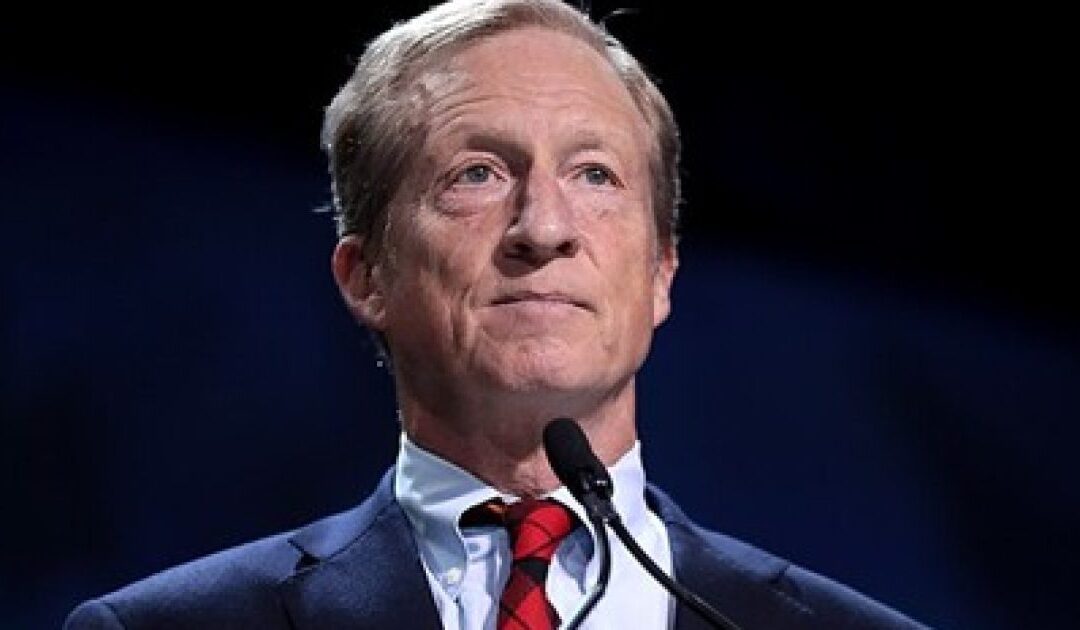
California Democratic gubernatorial candidate Tom Steyer. Credit: Gage Skidmore/Wikimedia Commons
The frontrunner to be California’s next governor has perhaps released the nation’s most radical immigration platform, but is not practicing what he preaches.
Radical billionaire and Democrat donor Tom Steyer, who launched a short-lived run for president in 2020, has now emerged as the person to beat after Eric Swalwell dropped out of the race due to major sexual assault allegations Steyer has already burned through over $100 million to buy the election.
On Tuesday, Steyer released an immigration platform so far to the left that he almost makes Gavin Newsom look like President Trump on the issue.
Not only does he want to abolish ICE completely and throw agents in jail, but he also wants to ensure California taxpayers pay for every dime to support legal representation for illegals.
Steyer is even vowing to ignore a recent U.S. Supreme Court ruling in favor of ICE. And people have the gall to call Trump a tyrant?
Read Steyer’s immigration platform and weep:
– Abolish ICE – Put ICE agents in jail & “treat them like the mob”.
– Bring those “kidnapped & detained by ICE back home.” – Give CA AG power to imprison ICE agents & their leadership.
– Taxpayer-funded legal representation & support for illegal aliens.
– Ignore a SCOTUS ruling that allows ICE to utilize race, language, job, and location to contribute to “reasonable suspicion” for immigration arrests, and instead, “California should take matters into our own hands and extend legal protections to its residents, despite the federal government’s failure.”
NEW: CA gubernatorial candidate Tom Steyer (D) releases an immigration platform that is radically left of Gov. Newsom. It includes:
– Abolish ICE
– Put ICE agents in jail & “treat them like the mob”.
– Bring those “kidnapped & detained by ICE back home.”
– Give CA AG power to… https://t.co/XqM8eK7Hhf
But Steyer seemed at one point to be okay with putting illegal aliens into custody as long as it enhances his bottom line. As The New York Post reported, the billionaire Democrat once invested almost $90 million in a company responsible for some of California’s largest immigration detention center.
Steyer founded a hedge fund named Farallon Capital Management in 1986. Under his management, the fund put money into CoreCivic, which runs private prisons. Farallon’s shares in the company were valued at $89.1 million at one point.
Now, the company runs five facilities in California, according to its website. At least two of them house people detained by federal immigration agents — one near San Diego and another in Kern County.
Steyer, who sold his stake in the Farallon back in 2012, is now attempting to do damage control as his poll numbers rise.
“We never had anything to do with running the company,” Steyer said in an interview with the Sacramento Bee. “But it was a mistake to think that that was a place where it was decent to make money.”
Irish Government Survives Vote of No-Confidence Over Handling of Fuel Tax Protests, but Minister of State Resigns, Accusing the Coalition of Losing Touch With the People
April 15, 2026
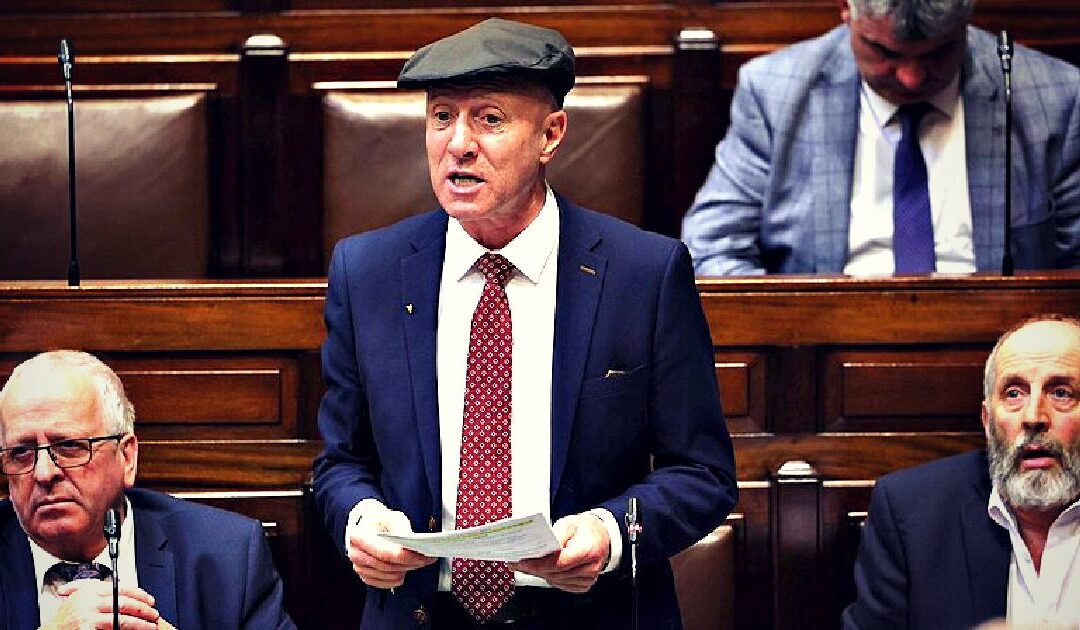
Former Irish Minister of State Michael Healy-Rae (center) – photo by Houses of the Oireachtas/Wiki Commons
Ireland is erupting against the government.
We have been following the massive protests taking place across Ireland on TGP, as angry citizens protest the cost of fuel and the government’s suicidal energy policies.
Yesterday, the Irish coalition survived a confidence vote in Parliament over how it handled a week of disruption with demonstrations blocking access to oil supplies, causing gas pumps to run dry and creating massive traffic jams.
BREAKING: THE VOTE OF NO CONFIDENCE IN IRELAND HAS FAILED
It was a relatively close vote with a split of 92 to 78.
“Irish Prime Minister Micheál Martin defended his coalition government by saying it had acted to end the ‘destructive blockade which threatened to cause much deeper damage’.
The 92-78 vote in support of the government preserved his leadership. If the confidence vote failed, his government would have been forced to resign and Parliament would have either elected a new prime minister or called a general election.”
Protests have been ongoing since April 7, with slow-moving convoys clogging roadways, and with truckers, farmers, and taxi and bus operators blocking key infrastructure.
The government sent the police and the military to break the blockages, but that only further inflamed the Irish people.
“Demonstrators called for price caps or tax cuts to alleviate soaring fuel costs they said would drive people out of business.
After the vote, a crowd of protesters gathered outside the Dáil, the parliament building in Dublin, chanted ‘sell out’ and ‘get them out’.”
Irish independent politician Michael J. Healy-Rae, who served as a Minister of State, has resigned, and announced he’ll be voting no confidence in the government.
But the victory in Parliament came with losses for the government, as the Minister of State for Agriculture, Food, Fisheries and the Marine, Michael Healy-Rae, announced his resignation, accusing the coalition of losing touch with the people.
“He said that he could not, in his heart, vote confidence in the Government.
[…] This was a bombshell moment in the Dáil as Mr. Healy-Rae took most people gathered by surprise, as he quit the Government and his role as Junior Minister for Agriculture.
[…] As his brother Danny Healy-Rae watched on from the opposite side of the chamber and his son from the public gallery, he said that the sight of grown men crying over the cost of fuel left him with no choice but to leave the Government.”
SHOCK: Ireland’s TRAITOR Government just told the Protestors to DROP DEAD…
A NO-CONFIDENCE vote FAILS 92-78 while they ram through CLIMATE TYRANNY that’s CRUSHING THEIR PEOPLE…
If these Globalist SCUM aren’t listening…then MAKE THEM HEAR YOU…bigger, louder or BURN IT DOWN. pic.twitter.com/NvL2NnWwMR
Oil and War: The Case That Trump Has Strengthened U.S. Global Positioning
April 15, 2026
As a result of the Iran conflict and U.S. actions in Panama and Venezuela, American control over global oil supplies has expanded significantly, while the power of Iran, Russia, and China has declined.
The ongoing U.S.-Iran war has closed the Strait of Hormuz, the narrow waterway through which approximately 20% of the world’s oil and liquefied natural gas normally transits daily, triggering the largest energy supply disruption in the history of global oil markets. The closure has paralyzed China’s Belt and Road shipping infrastructure, eliminated Iran’s primary source of government revenue, and forced the world’s buyers to seek reliable alternative suppliers.
Whether by design or by a convergence of fortuitous circumstances, President Trump has used the war and its economic pressure points to position the United States as the dominant force in global energy, systematically reducing the power of Iran, China, and Russia while consolidating U.S. control over critical shipping lanes from the Persian Gulf to the Panama Canal.
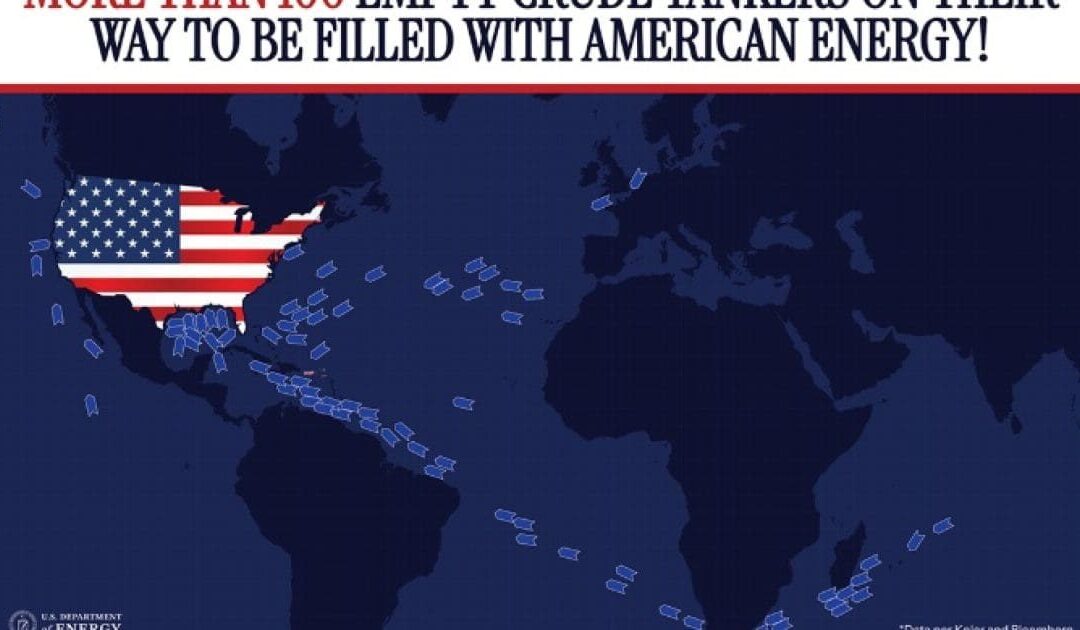
U.S. crude exports are projected to reach a record 5.2 million barrels per day in May, as Asian buyers snap up cargoes to offset the loss of Middle Eastern supply. Currently, 171 crude tankers are bound for the U.S. Gulf Coast, compared with approximately 110 in a typical month, with supertanker bookings for May at 28 vessels against a monthly average of just five. The world’s buyers are choosing American oil because there is no comparable alternative at scale and reliability.
The IMF projects the U.S. economy will grow 2.3% this year, the strongest of any major advanced economy, cushioned partly by its status as a net energy exporter. That is a direct economic benefit accruing to the United States, while every other major economy absorbs damage from the same disruption.
On Iran specifically, the damage to its power is severe and multidimensional. The rial has fallen from 42,000 to over 1.1 million against the dollar, making it effectively the least valuable currency in the world. The U.S. naval blockade is cutting off Iranian oil revenue at an estimated $150 million per day, against a backdrop where oil accounted for roughly one quarter of government revenue and the government could not meet payroll obligations even before the war began. The IRGC’s parallel economic empire, which processed approximately half of Iran’s oil exports, is being directly targeted.
It has been widely reported that the IRGC created a toll system charging ships transiting the Strait of Hormuz up to $2 million per vessel, payable in Chinese yuan, Bitcoin, or cryptocurrency stablecoins. However, there are no confirmed reports that any ship has actually paid this toll. Shipping companies, when interviewed, described being approached with the offer but did not confirm agreeing to it. Independent vessel tracking data confirms that approximately 10 to 11 ships per day have traversed the strait, and some analysts have estimated IRGC daily toll revenue at $20 million based on that traffic volume. That figure is purely mathematical, derived by multiplying the number of transits by the stated fee. It does not constitute evidence that any payment was made.
China’s export profit margins were already razor-thin before the Iran war began. The Producer Price Index spent 40 consecutive months in negative territory through early 2026, industrial profits fell 13.1% year-on-year in November 2025, and manufacturing capacity utilization had dropped to 74%. The loss of access to discounted Iranian crude, 1.4 million barrels per day that made up over 80% of Iran’s shipped oil exports, combined with the surge in global energy and logistics costs produced by the Hormuz closure, is compounding that margin compression.
China is being forced to source oil from markets where the U.S. has pricing and supply influence, at prices roughly 50% above pre-war levels. Belt and Road shipping infrastructure through the Gulf is paralyzed, disrupting both petroleum imports and manufactured goods exports simultaneously. Beijing is absorbing the economic damage while having no effective military or diplomatic response.
On Russia, the indirect effect is significant. Russia had been benefiting from being a sanctioned-but-functioning energy exporter selling to China and others at a discount. As U.S. oil floods global markets at premium prices and buyers compete for American barrels, the structural case for Russian oil as an indispensable alternative weakens. U.S. LNG running at near-peak export capacity simultaneously undermines Russian natural gas leverage over Europe, which had been Moscow’s primary geopolitical tool since Ukraine.
U.S. strategic power consolidation in the Western Hemisphere is supported by U.S. actions in Panama and Venezuela. Last year, President Trump convinced Panama to remove Chinese commercial control over Panama Canal port facilities. Canal operations, while remaining the property of Panama, now more closely align with U.S. foreign policy objectives.
This was followed by the arrest of Venezuelan President Nicolás Maduro earlier this year during Operation Absolute Resolve, a U.S. military operation that resulted in his arrest in January 2026. Venezuelan oil policy is now substantially aligned with U.S. direction following the operation.
Combined with U.S. military dominance in the Caribbean established during the Venezuela operation, the U.S. sinking of narco-trafficking ships in the Caribbean, and joint U.S. military actions against traffickers in Ecuador and other countries, the Western Hemisphere is more firmly within the U.S. sphere of influence than at any point in decades.
Media have claimed that the war is causing friction with U.S. Gulf allies such as Saudi Arabia, the UAE, and Kuwait, which are absorbing serious economic damage from the Hormuz closure. However, this has produced no practical reduction in U.S. global power or the security architecture that underpins it.
Before the war, Gulf states expressed diplomatic reservations about U.S. military action against Iran and declined to offer their airspace for strikes. Once the war began, Iran attacked them directly with missiles and drones. The Arab League Secretary-General strongly condemned the Iranian retaliatory attacks against Qatar, Bahrain, Kuwait, the UAE, Jordan, and Saudi Arabia, characterizing them as a flagrant violation of sovereignty.
The UN Security Council adopted resolution 2817, submitted by Bahrain on behalf of the entire GCC plus Jordan, condemning Iran’s strikes. China and Russia abstained. Gulf states sided with the U.S. position against Iran at the UN while China and Russia refused to condemn attacks on Arab soil.
Throughout the conflict, Gulf states continued hosting U.S. military forces and received active U.S. and British air defense support. Saudi Arabia’s AI company, Humain pledged, not to purchase Chinese equipment, and the UAE’s G42 cut ties with Huawei, aligning both countries with the U.S.-led technological bloc restricting China’s access to advanced semiconductors.
No Gulf state has switched to China as a security partner, adopted yuan-denominated oil pricing as a result of the conflict, or reduced U.S. military access to the region. Iran attacking its Arab neighbors has driven Gulf states deeper into dependence on U.S. military protection, not away from it.
The war is accelerating a structural shift that will permanently reduce Iran’s ability to use the Strait of Hormuz as a geopolitical weapon. Within hours of Operation Epic Fury beginning, Saudi Arabia activated its long-prepared contingency plan. The East-West pipeline reached full capacity of 7 million barrels per day, with crude exports via the Red Sea port of Yanbu surging from a pre-crisis baseline of under 800,000 barrels per day to nearly 5 million barrels per day. The UAE simultaneously maximized its Abu Dhabi Crude Oil Pipeline, carrying up to 1.8 million barrels per day to Fujairah on the Gulf of Oman, bypassing Hormuz entirely.
The crisis has converted theoretical pipeline expansion plans into active investment decisions. Saudi Arabia is weighing expansions to the East-West pipeline and new Red Sea export terminals. The UAE is exploring a second pipeline to Fujairah. Proposed multi-country projects include pipelines linking Iraqi oil fields to Mediterranean ports and integrated energy links within the India-Middle East-Europe Economic Corridor.
The existing bypass capacity does not fully replace the strait. Combined alternative route capacity amounts to approximately 8 to 9 million barrels per day against the 17 to 21 million barrels per day that normally transits Hormuz. However, each new pipeline that comes online permanently erodes Iran’s ability to hold the global economy hostage by threatening closure. The 1980s Iran-Iraq war produced the East-West pipeline. The 2026 war is producing a second generation of bypass infrastructure on a larger scale, with active U.S. strategic backing, making a future Iranian closure of the strait progressively less catastrophic for global energy markets.
With exports reduced to almost nothing, Iran’s economy was projected by the IMF to contract by 10%. However, the IMF counts produced and stored oil as part of GDP even though it cannot be sold, so the real contraction will be even greater. The U.S. blockade of the strait is meant to ensure that no country purchases Iranian oil and that no country pays the $2 million toll for use of the strait.
By cutting off the IRGC’s revenue, the Trump administration hopes to accelerate the regime’s collapse and bring about an end to the war.
Unfortunately, this improved strategic positioning has come at a cost for American consumers, who are facing higher gasoline prices. Average U.S. gas prices are up roughly 40%, approximately $1.18 per gallon, since the start of the war. Oil prices are expected to come down once control of the strait has been completely wrestled from the grasp of the IRGC.
We use technologies like cookies to store and/or access device information. We do this to improve browsing experience and to show (non-) personalized ads. Consenting to these technologies will allow us to process data such as browsing behavior or unique IDs on this site. Not consenting or withdrawing consent, may adversely affect certain features and functions.
Functional
Always active
The technical storage or access is strictly necessary for the legitimate purpose of enabling the use of a specific service explicitly requested by the subscriber or user, or for the sole purpose of carrying out the transmission of a communication over an electronic communications network.
Preferences
The technical storage or access is necessary for the legitimate purpose of storing preferences that are not requested by the subscriber or user.
Statistics
The technical storage or access that is used exclusively for statistical purposes.The technical storage or access that is used exclusively for anonymous statistical purposes. Without a subpoena, voluntary compliance on the part of your Internet Service Provider, or additional records from a third party, information stored or retrieved for this purpose alone cannot usually be used to identify you.
Marketing
The technical storage or access is required to create user profiles to send advertising, or to track the user on a website or across several websites for similar marketing purposes.



 BREAKING: THE VOTE OF NO CONFIDENCE IN IRELAND HAS FAILED
 (@BROKENBRITAIN0)