SICKENING VIDEO: Evil Mob of Karmelo Anthony Supporters Follow and Harass Grieving Metcalf Family Outside Courthouse After 35-Year Sentence, ‘We Glad Austin’s Dead!’

SICKENING VIDEO: Evil Mob of Karmelo Anthony Supporters Follow and Harass Grieving Metcalf Family Outside Courthouse After 35-Year Sentence, ‘We Glad Austin’s Dead!’

SICKENING VIDEO: Evil Mob of Karmelo Anthony Supporters Follow and Harass Grieving Metcalf Family Outside Courthouse After 35-Year Sentence, ‘We Glad Austin’s Dead!’
June 10, 2026

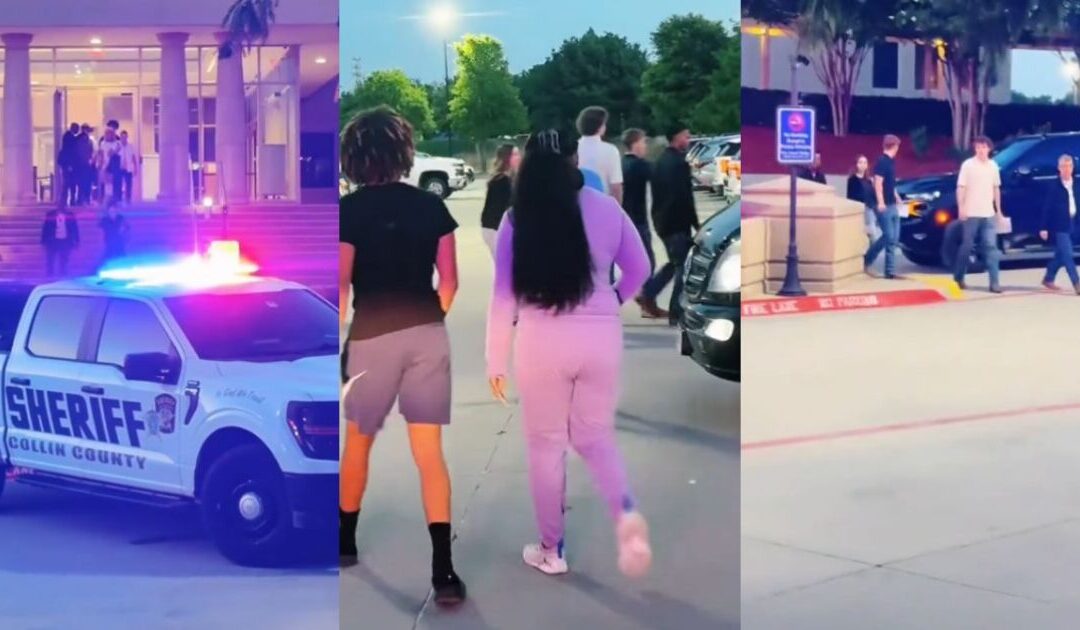
Collin County sheriff vehicle with flashing lights outside an event as attendees walk away from the venue in the evening.

In a disturbing escalation of the anti-white racial hatred already on display throughout the Karmelo Anthony murder trial, supporters of the convicted killer swarmed and verbally assaulted Austin Metcalf’s family as they left the Collin County Courthouse on Wednesday, after Anthony was sentenced to 35 years in prison.

Footage posted to X captures the family, still grieving from losing their 17-year-old son and brother, being taunted with the vile chant “We glad Austin’s dead!” as they walked from the courthouse steps to their vehicles in the parking lot.

In the video, the Metcalf family is trying to just walk down the stairs to leave.

As the family members, including Austin’s identical twin brother Hunter, who held his brother as he bled out and died, make their way across the lot toward waiting cars, a group of the killer’s supporters closes in.

The clip shows supporters of the murderer yelling directly at and taunting the family, who somehow remained calm.

The family keeps moving toward a black SUV as the harassment continues under the watch of sheriff’s deputies. The harassment continues even as vehicles pull away.

Video of the harassment was originally posted to TikTok by a user named “Chief_Malo,” who also supports the murderer.

WATCH:

@chief_maloAustin Metcalf family leaving the courthouse after Karmelo Anthony was found guilty in sentenced to 35 years in prison and it is full of emotion from everyone that is out there♬ original sound – Chief Malo

Anthony, 19, was convicted of first-degree murder on Tuesday after an eight-day trial.

The jury deliberated less than three hours before rejecting his self-defense claim over the 2025 stabbing of Austin Metcalf at a Frisco high school track meet.

Following the verdict, the same jury sentenced Anthony to 35 years in prison.

The crowd outside the courthouse also openly called for the death of Austin’s twin brother Hunter, with one supporter declaring “BOTH of the brothers should’ve been dead” to cheers from the group.

DISGUSTING VIDEO: Karmelo Anthony Supporter Declares ‘Both Brothers Should’ve Been Dead’ Outside Courthouse After Guilty Verdict, Black Panthers Push ‘Race War’

Black Panthers and other agitators gathered in the court's parking lot, declared “this is a war,” and ranted about a “racist-ass country.”

Anthony supporters engaged in multiple confrontations outside the courthouse, including surrounding vehicles of Metcalf supporters, berating sheriff’s deputies, and generally acting like fools.

The family's representative, Dominique Alexander, blamed the jury, which he falsely labeled “all-white,” despite the presence of non-Black minority jurors, and vowed to fight the conviction on appeal, with the Next Generation Action Network contributing $10,000 toward legal fees.

The post SICKENING VIDEO: Evil Mob of Karmelo Anthony Supporters Follow and Harass Grieving Metcalf Family Outside Courthouse After 35-Year Sentence, ‘We Glad Austin’s Dead!’ appeared first on The Gateway Pundit.

Go to Source
Author: Cassandra MacDonald

WATCH: Trump Says US Will Attack Iran “Very Hard” Today – “They Should Have Signed the Deal”

WATCH: Trump Says US Will Attack Iran “Very Hard” Today – “They Should Have Signed the Deal”

WATCH: Trump Says US Will Attack Iran “Very Hard” Today – “They Should Have Signed the Deal”
June 10, 2026

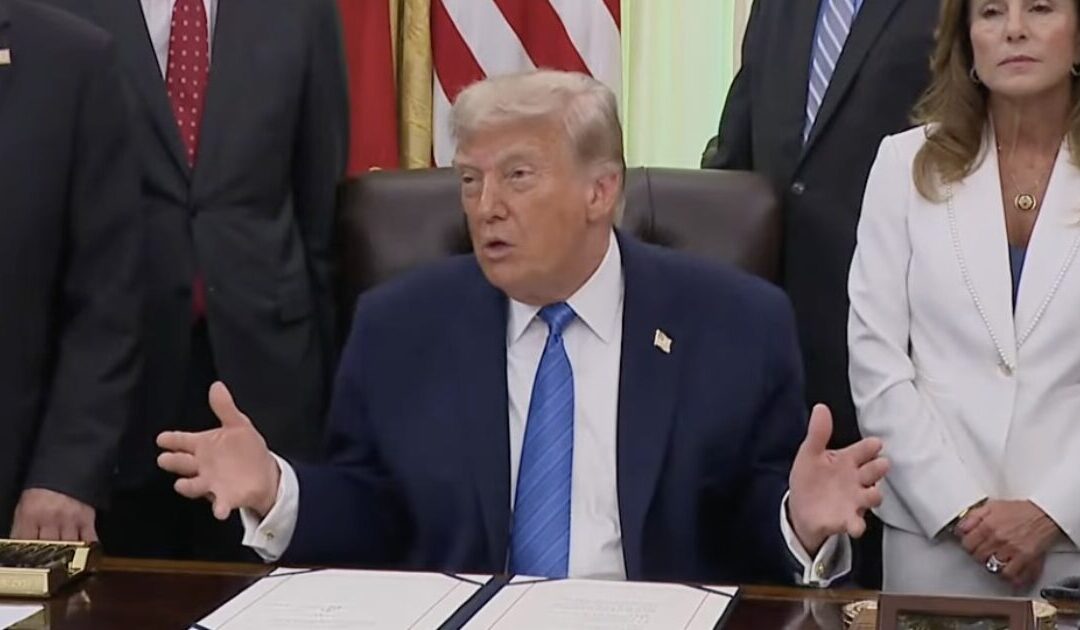
President Trump on Wednesday told reporters that US strikes on Iran will continue after trading attacks last night.

“I’ve been working with Iran for a number of months, and they should have signed the deal,” Trump told reporters.

Tump said earlier, “They’ve taken too long to negotiate a deal that would have been great for them, now they will have to pay the price!!!”

“We’re going to be attacking them, attacking them very hard,” Trump said.

“Based on the helicopter, I guess we have the right to do that. You know, they shot down a very, very incredible, actually an incredible machine. And at first they said they didn’t do it, then they admitted they did. It sort of easy, because we have the, we have the bomb. We actually have the bomb.”

“We’ll see what happens, but we hit them hard yesterday, and we’re going to hit them again hard today, in case you miss it, in case you don’t turn on your television set, and we’ll see what happens with the deal,” Trump continued.

“We were, we’re really close to a deal, but they keep tapping us along, they keep playing us for suckers, because you know what. They dealt with some very stupid presidents. I have to say that I’m embarrassed to say some very stupid people were sitting here,” he said.

WATCH:

Trump later declined to confirm whether he plans to target Iranian power plants and bridges as he said earlier.

As The Gateway Pundit reported earlier, Trump announced the end of the US-Iran ceasefire this morning, declaring that Iran will “pay the price” after taking “too long to negotiate a deal that would have been great for them.”

Iran and the US traded fire last night after Iran shot down a US Apache helicopter on Monday.

Trump threatened that he “may keep going” with strikes, even targeting Iran’s infrastructure.

MORE:

JUST IN: “The Bully of the Middle East is DEAD!!!” – Trump Says Iran “Took Too Long” to Negotiate Deal and Will “Pay the Price”, Threatens to Target Power Plants and Bridges

This is a developing story.

The post WATCH: Trump Says US Will Attack Iran “Very Hard” Today – “They Should Have Signed the Deal” appeared first on The Gateway Pundit.

Go to Source
Author: Jordan Conradson

“Free Karmelo…You’re Gonna Die” – Florida ‘Digital Creator’ ASSAULTS Innocent White Man Following Karmelo Anthony Verdict, Accuses Him of Being on The Jury (VIDEO)

“Free Karmelo…You’re Gonna Die” – Florida ‘Digital Creator’ ASSAULTS Innocent White Man Following Karmelo Anthony Verdict, Accuses Him of Being on The Jury (VIDEO)

“Free Karmelo…You’re Gonna Die” – Florida ‘Digital Creator’ ASSAULTS Innocent White Man Following Karmelo Anthony Verdict, Accuses Him of Being on The Jury (VIDEO)
June 10, 2026

A Florida digital creator assaulted an innocent white man following the Karmelo Anthony verdict. Credit: Combak KidBoe Facebook/Instagram

A so-called ‘digital creator’ broadcast himself engaging in a disgusting racial hate crime following the Karmelo Anthony verdict in Texas.

As The Gateway Pundit reported, Karmelo Anthony was sentenced to 35 years in prison yesterday after a jury convicted him of murder in the fatal stabbing of Austin Metcalf. He was facing 99 years in prison.

But now Anthony will be eligible for parole after serving half the time.

Anthony and his mother sobbed in court after the judge read the guilty verdict.

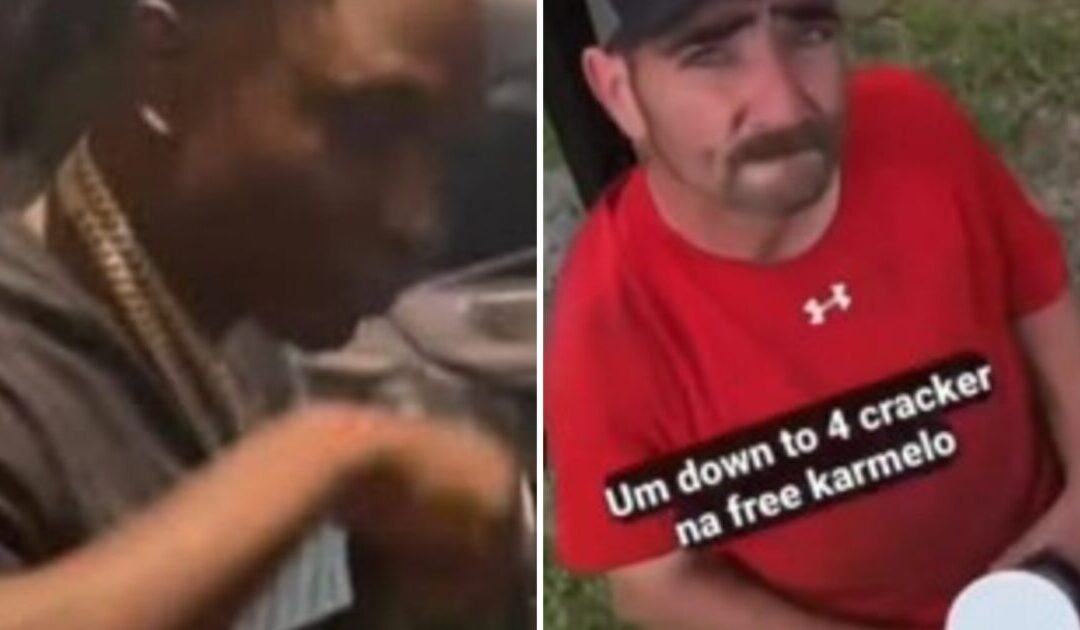
On Wednesday morning, a black man going by the username Combak KidBoe broadcast himself on Facebook driving through his hometown of Jacksonville, Florida, on his bike looking for revenge.

He soon got his wish after stumbling upon a middle-aged man in a hat sitting on the ground, who was harming absolutely no one.

KidBoe demanded to know why the white man was on jury selection before slugging him in the face. He immediately recoils from the pain.

The woman with the innocent white man points out that KidBoe was wrong, but he continues to insist otherwise and tells the man, “You’re gonna die.”

After more words are exchanged, KidBoe finally drives off while sarcastically admitting he was mistaken.

An X user also captured the video on the thug’s Facebook page before it was removed.

The caption reads: “Down to 4 crack*r na free Karmelo.”

WATCH:

KidBoe also put his assault video on Instagram following Facebook’s action.


View this post on Instagram


A post shared by Combak KidBoe (@combakkidlilboe)

The post “Free Karmelo…You’re Gonna Die” – Florida ‘Digital Creator’ ASSAULTS Innocent White Man Following Karmelo Anthony Verdict, Accuses Him of Being on The Jury (VIDEO) appeared first on The Gateway Pundit.

Go to Source
Author: Cullen Linebarger

SICK! White-Hating Racist Lawyer Jasmine Crockett Says She Would Have Killed Austin Metcalf, Claims His Fists Were a “Deadly Weapon” (VIDEO)

SICK! White-Hating Racist Lawyer Jasmine Crockett Says She Would Have Killed Austin Metcalf, Claims His Fists Were a “Deadly Weapon” (VIDEO)

SICK! White-Hating Racist Lawyer Jasmine Crockett Says She Would Have Killed Austin Metcalf, Claims His Fists Were a “Deadly Weapon” (VIDEO)
June 10, 2026

Failed Senate candidate and US Rep. Jasmine Crockett (D-TX) reacted to the Karmelo Anthony verdict on Tuesday, suggesting that Anthony was justified in murdering Austin Metcalf and that she would have done the same. 

As The Gateway Pundit reported, 19-year-old Karmelo Anthony was sentenced to 35 years in prison after a jury convicted him of murdering then-16-year-old track and football star Austin Metcalf.

Metcalf was brutally stabbed to death by Karmelo Anthony in April 2025 during a championship track meet at Kuykendall Stadium in Frisco, Texas. Supporters of Anthony claim, without evidence, that he acted in self-defense, stabbing the white teen to death, but numerous eyewitnesses testified that Anthony was the aggressor and instigated the fight.

During a livestream on her “Clock it with Crockett” podcast last night, Crockett ignored the evidence that Anthony started the fight and claimed that because Austin Metcalf was a football player, his hands could be considered “deadly weapons.”

Crockett claimed that it’s a “gray area” in terms of self-defense because “me, as a 5’3″ woman, if a 300B man is beating me like on top of me and beating me down, I’m not limited to fists,” she claimed. Karmello Anthony, a football player, is not a 5’3″ woman, and Austin Metcalf is not a 300 lb man.

Would she say the same about a 5’3″ White woman killing an unarmed 300 lb black man?

“You know, I would argue that even the only time we go into things like people’s hands being um considered deadly weapons is typically like if they’re a professional boxer or that kind of stuff. But I think by the time you start getting to like football player, good argument. Good freaking argument!” Crockett said.

“We not talking about like the golfers. We’re talking about football players, right? Like this is what they are trained to do is to inflict like serious physical contact,” she said. “And it’s my understanding the decedent was that.” The killer, Karmello Anthony, was also a football player and, according to Crockett,” he too was “trained to do is to inflict like serious physical contact.”

She further went full Black Lives Matter, claiming that black people “have different levels of force, which is why us most of the time as black people feel a way.” She continued, “Cuz like black people just be walking down the street, and they be like, ‘But I feared for my life.” And you are a whole trained officer, and you were scared? You were scared as a whole, fully trained, licensed officer, and somehow you get to use deadly force?”

“And when you look at even like George Floyd, like George Floyd died, and they never took out a quote unquote weapon, right?” she added.

WATCH:

Crockett: There are people that argued about the escalation, okay. Because self-defense is, you know, I want to say eye for eye– it’s the easiest way for me to do it as I’m trying to basically like, you know, explain it very simply to y’all or whatever. That’s basically what it is, right? Like, you punch me, I punch you back. You cuss me, I cuss you back. You slap me, I slap you back. You shoot at me, I shoot you back. Like, so that’s a very simplistic way.

But obviously we have different levels of force, which is why us most of the time as black people feel away. Cuz like black people just be walking down the street and they be like, “But I feared for my life.” And you are a whole trained officer, and you were scared? You were scared as a whole, fully trained, licensed officer, and somehow you get to use deadly force? And people are like, “That’s cool because, you know, you just should have just been quiet. You should have just stayed still. You should have just gave him your license.” Like they come up with every excuse, right?

So, um I do want to say that while the simplistic way of um describing this is it’s kind of eye for eye, it’s still a little bit of gray area because again me, as a 5 foot three woman, if a 300B man is beating me like on top of me and beating me down, I’m not limited to fists, cuz I’m telling you right now, if you were twice my weight and got way more strength than me and you got me pinned down, I don’t believe I’m going to survive. And when you look at even like George Floyd, like George Floyd died, and they never took out a quote unquote weapon, right?

So, this idea that you can’t die is wild, right? And you know, I would argue that even the only time we go into things like people’s hands being um considered deadly weapons is typically like if they’re a professional boxer or that kind of stuff. But I think by the time you start getting to like football player, good argument. Good freaking argument! We not talking about like the golfers. We’re talking about football players, right? Like this is what they are trained to do is to inflict like serious physical contact. Um, and it’s my understanding the decedent was that. So, I just wanted to like get some of that out because I know that there’s been a lot of questions around that.

Clearly, Crockett just hates White people.

Just hours before this, as The Gateway Pundit reported, Crockett went off on an unhinged tantrum about “White men” before attacking Charlie Kirk in a House Judiciary Committee hearing meant to probe the Southern Poverty Law Center.

(VIDEO) Rep. Jasmine Crockett Goes on Racist Screaming Rant Against White Men, Attacks Charlie Kirk and Claims Alveda King Can’t Represent MLK


The post SICK! White-Hating Racist Lawyer Jasmine Crockett Says She Would Have Killed Austin Metcalf, Claims His Fists Were a “Deadly Weapon” (VIDEO) appeared first on The Gateway Pundit.

Go to Source
Author: Jordan Conradson

Louisiana Energy – Part 4: End the Legacy Lawsuit Litigation Lottery, Deliver Real Stewardship

Louisiana Energy – Part 4: End the Legacy Lawsuit Litigation Lottery, Deliver Real Stewardship

Louisiana Energy – Part 4: End the Legacy Lawsuit Litigation Lottery, Deliver Real Stewardship
June 10, 2026

Part 4: Legacy Lawsuits – End the Litigation Lottery, Deliver Real Stewardship

Guest post by Danielle Walker, The State of Freedom and Brad LeBlanc, Geoscientist and President of Bradford Minerals Corp.

See Part I, Part II, and Part 3.

In Part 3 we called out Environmental, Social, and Governance (ESG) demands for what they are: a non-kinetic Softwar campaign—Jason Lowery’s framework for power projection by other means—designed to constrain American energy production, inflate capital costs, and shift control upward. One of the key action items was this: build on recent legacy-lawsuit reforms with a final, principled resolution.

To be clear on the statutes: Act 312 (2006) is Louisiana’s legacy oilfield remediation law. It gave courts heavy control over cleanup standards and opened the door to damages well beyond actual restoration costs. Act 458 of 2025 (SB 244) is the major reform. Effective for cases filed after September 1, 2027, it shifts cleanup-plan approval to the Louisiana Department of Energy and Natural Resources (LDENR), raises the evidentiary bar, and begins to rein in the worst abuses.

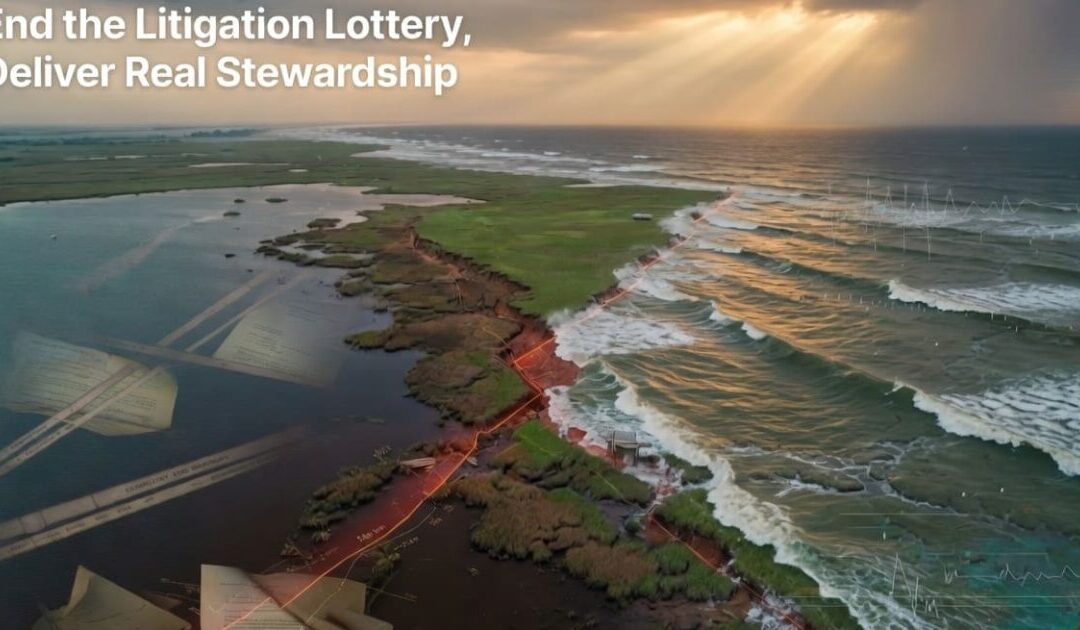
Governor Jeff Landry and Attorney General Liz Murrill have advanced Act 458, a clear step in the right direction. Yet they continue to support key coastal lawsuits alleging oil and gas companies “destroyed the Louisiana coastline.” The substantial geologic evidence strongly indicates otherwise: the real driver of land loss is natural subsidence driven by downward movement along surface-reaching faults. This fault-generated subsidence exposed the marsh to greater wave action and accelerated erosion. Dredging for drill sites was never the primary cause.

For decades, the widely accepted narrative in Louisiana has been that coastal land loss was primarily caused by oil and gas canals and dredging. The belief was that these canals allowed saltwater intrusion, which then eroded the marsh and turned it into open water. That story drove hundreds of legacy lawsuits and shaped public policy for years.

Chris McLindon, President of the New Orleans Geological Society, has summarized a multi-university effort that put industry-supplied seismic data under rigorous review. Teams from UNO, Tulane, and the University of Texas at Austin analyzed more than 500 square miles of transition-zone seismic data to produce the Atlas of Surface Fault Traces in South Louisiana, presented at the Louisiana Coastal Geology Symposium. The patterns are unmistakable: land loss tracks active, surface-reaching faults with precision. Dredging canals for oil-field exploration and development was never the primary driver. Seasonal deltaic sedimentation continues to deposit fresh material that is distributed laterally, rebuilt, eroded, and rebuilt again—recharging the delta system even as it drives compaction and localized fault movement. Subsidence is a natural geologic process.

Hurricanes dramatically accelerate this process. Once fault-driven subsidence lowers the marsh platform below critical elevation, major storms cause rapid and catastrophic land loss. This raises the critical question of causation: Did poor management of marshes and barrier islands, along with canal dredging, cause greater subsidence that hurricanes then worsened—or were those features already doomed by underlying faults? The seismic data shows that the active growth faults came first. They created the fundamental vulnerability. Both industry decisions to cease routine maintenance and government policies that turned every canal into a potential liability made localized problems worse, but the geologic foundation set the stage. Hurricanes did not create the subsidence problem—they exposed and intensified it.

The time has come to move forward pragmatically and urgently: stop the litigation lottery, fund verifiable restoration through an industry-led trust, and preserve the wetlands, marshes, and estuaries we still can. This evidence aligns with the broader perspective of Western Washington University Professor Emeritus Don Easterbrook.

His decades of research on recurring climate cycles—detailed in works such as Evidence-Based Climate Science—show that Earth’s temperatures have fluctuated naturally for millennia, long before industrial CO₂ levels rose. Ice-core records reveal temperatures rising 600–800 years before atmospheric CO₂ followed after the last Ice Age—clear proof that CO₂ is largely a follower, not the driver, of climate change. Sea-level rise itself has been modest and steady at roughly seven inches per century, a natural geologic process. In the New Orleans area, the natural rate of subsidence is two to three times that of natural sea-level rise. The real crisis in coastal Louisiana is not this modest global rise, but the much faster relative sea-level rise caused by natural subsidence and the loss of new sediment supply—the very processes the fault atlas documents.

Critically, Louisiana’s actual flood-protection and coastal-restoration work is increasingly grounded in this same science. The Greater New Orleans Urban Water Plan, $14 billion in post-Katrina flood infrastructure, and the Coastal Protection and Restoration Authority’s (CPRA) Master Plan all draw heavily on university-industry collaborations. In Plaquemines Parish, 28 different faults were mapped—most reaching the surface—with several corresponding to “abrupt shifts from emergent wetlands to fully submerged areas of open water.” CPRA’s own presentations feature the Ironton fault trace near the proposed Mid-Barataria Sediment Diversion. These projects are being designed around verifiable fault and subsidence data, not around the claims driving the lawsuits.

The recent termination of the Mid-Barataria Sediment Diversion in July 2025 further validates this shift. Ballooning costs, suspended federal permits, and stakeholder litigation led CPRA under Governor Landry to cancel the politically charged mega-project and redirect funds to smaller, targeted alternatives. The decision aligns with the geologic reality McLindon documented: the Ironton fault crosses the site, and fault-driven subsidence would have undermined long-term land-building claims regardless of sediment volume. As McLindon warned in his 2019 Advocate op-ed, “Suing energy industry won’t help preserve N.O.,” the city’s lawsuit “tears at the fabric of this cooperative relationship” and could not have come at a worse moment for the science driving the 2023 Master Plan. Commercial fishermen, oystermen, and shrimpers stood united against the diversion, correctly seeing it as an immediate threat to their working waterfront.

Governor John Bel Edwards chose confrontation instead of cooperation. In a 2016 Advocate interview he warned coastal parish presidents: sue the oil companies, or I will. This created such a toxic business climate that capital fled Louisiana for more predictable states like Texas. More than 300 legacy suits targeted the oil and gas sector. Instead, endless litigation delivered the opposite: lawyer fees, fleeing investment capital, loss of jobs and businesses in the service sector, and the problem of coastal land loss remained unresolved.

Act 458 of 2025 is a step forward. But partial reform is not victory, and the trial lawyers have been suing the industry with abandon for twenty years now. Last week’s announced agreement in principle with ExxonMobil to resolve coastal disputes and partner on orphaned wells shows that pragmatic resolutions are possible—though, as is customary in these cases, full terms remain under court seal.

The principled resolution is straightforward and long overdue:

  • Enact a comprehensive, time-limited remediation framework with reasonable time limits on when old claims can be brought—closing the door on legacy lawsuits sooner than the September 2027 cutoff in Act 458.
  • Strengthen an industry-funded coastal cleanup trust dedicated exclusively to verifiable wetlands and environmental impacts—measured by science, not speculation, and managed by scientists and proven financial managers, not politicians.
  • Deliver full liability certainty to operators who meet transparent, science-based standards—while ensuring that any legitimate, verifiable environmental impacts are still fully addressed and accountability remains in place.

This is not about letting anyone off the hook. It is about replacing the litigation lottery—which has generated far more billable hours than acres of restored marsh—with measurable, on-the-ground stewardship that actually protects the coast. Raising public awareness to the atlas of surface-reaching faults provides a roadmap to more appropriately address the issue; Easterbrook’s geologic cycles put the broader CO₂ narrative in its proper historical context; the trust provides the funding mechanism; and genuine liability certainty provides the capital trigger.

If Louisiana offers the oil and gas industry the regulatory certainty and production-focused incentives it needs, capital and jobs will come roaring back—while delivering real, science-based stewardship for the coast and its people. This is an all-ships-rise approach: no zero-sum tradeoffs detrimental to the coast, working families, taxpayers, or the industry itself (trial lawyers pursuing the legacy lottery excepted—they’ve had their day).

  • True permitting reform, not crony speed. Replace the current duplicative, unpredictable process with fixed timelines at the Louisiana Department of Energy and Natural Resources (LDENR): 90 days for routine permits, 180 days for complex ones. One-stop shop using existing seismic and fault-atlas data so operators are not buried in redundant reviews. This slashes capital costs without sacrificing environmental safeguards.
  • Production-focused tax treatment that rewards output, not carbon burial. Targeted severance-tax relief or production credits for new wells, recompletions, and workovers in legacy fields. Contributions to the industry-funded coastal cleanup trust become fully deductible or creditable. Raw hydrocarbon production pays the bills; 45Q credits do not.
  • Accelerated orphaned-well plugging with liability certainty. Fold a practical orphaned-well solution into the legacy framework: industry trust dollars plus operator matching funds (and potentially other targeted federal mechanisms) plug wells faster, with full liability shields for good-faith participants. This directly benefits fishermen by reducing potential leaks while clearing the decks for new investment.
  • Direct benefits for coastal parishes and working families. New production revenue is shared with coastal parishes for local infrastructure, fisheries habitat projects, and workforce training. Fishermen and communities get tangible wins—targeted, fault-aware sediment work and canal backfilling where science shows it will stick—funded by the very industry that developed the coast in the first place.
  • Genuine engagement with local communities. Listen to their concerns up front rather than blindsiding them with projects hidden behind NDAs and government-driven secrecy. The top-down approach being used to force CCS on coastal parishes cannot and will not be repeated when it comes to refineries, exploration, and genuine energy expansion.

One additional note on the broader picture: Large-scale CCS injection carries documented geomechanical risks, particularly near active faults. High-pressure CO₂ can reduce effective stress on pre-existing faults, raising the chances of reactivation and accelerated localized subsidence—the very process already driving coastal land loss. Major producers should therefore drop support for unconstitutional CCS projects in Louisiana and double down on traditional expansion here, where the geology is known and the infrastructure exists.

Brad LeBlanc Frames the Economic Choice

Supporting real oil and gas is GDP+. You bring a valuable commodity that did not previously exist at the surface up from the ground, sell it for profit, and pay taxes on the product. The state and its people win again and again. Supporting CCS is GDP-. Taxpayer-funded subsidies stick CO₂ in the ground; there is no marketable product, no continual jobs, no recurring revenue stream—only permanent liability transferred to Louisiana and its citizenry after a few short years, and after 50 years permanent responsibility for any disasters that occur from CO₂ injection. Favoring tax incentives for a GDP- process while the state’s own energy heartland bleeds investment is backwards economics.

Europe, begging for American LNG while its own net-zero fantasies leave it exposed to every Hormuz shock and every adversarial Russian supply disruption, has zero standing to demand ESG compliance. Louisiana has even less reason to keep punishing the industry that built its once-great economy and its coast in the first place. On the contrary, we have every incentive to ensure they can be happy and highly productive here.

Danielle Walker Shares A Personal Perspective

I grew up, live, and fish in one of the areas of greatest noted subsidence in South Louisiana. I see it with my own eyes, and the devastation to the once-great inland fishing waters, bays, and estuaries is undeniable. This is not about forgetting the people, the livelihoods, or the homes of those who live and work on our beloved coast. It is simply about addressing the real root cause as we do everything possible to protect and restore what we can—and pray about the problems we cannot fix with human means alone. I don’t pretend to have all the answers here, but the fault atlas is public and deserves far more attention. The geologic evidence is public. The economic choice is public. We should work from reality—not political talking points or feel-good policies that simply waste time and money.

End the litigation lottery. Finish the Act 312 reforms. Deliver stewardship that works. Give producers the regulatory certainty and production-focused incentives they need to invest here—not in carbon credits or foreign markets. That is how Louisiana turns the Softwar campaign on its head and reclaims energy dominance on our own terms.

(The series continues with Part 5: Softwar on American Soil.)


The post Louisiana Energy – Part 4: End the Legacy Lawsuit Litigation Lottery, Deliver Real Stewardship appeared first on The Gateway Pundit.
Go to Source
Author: Joe Hoft