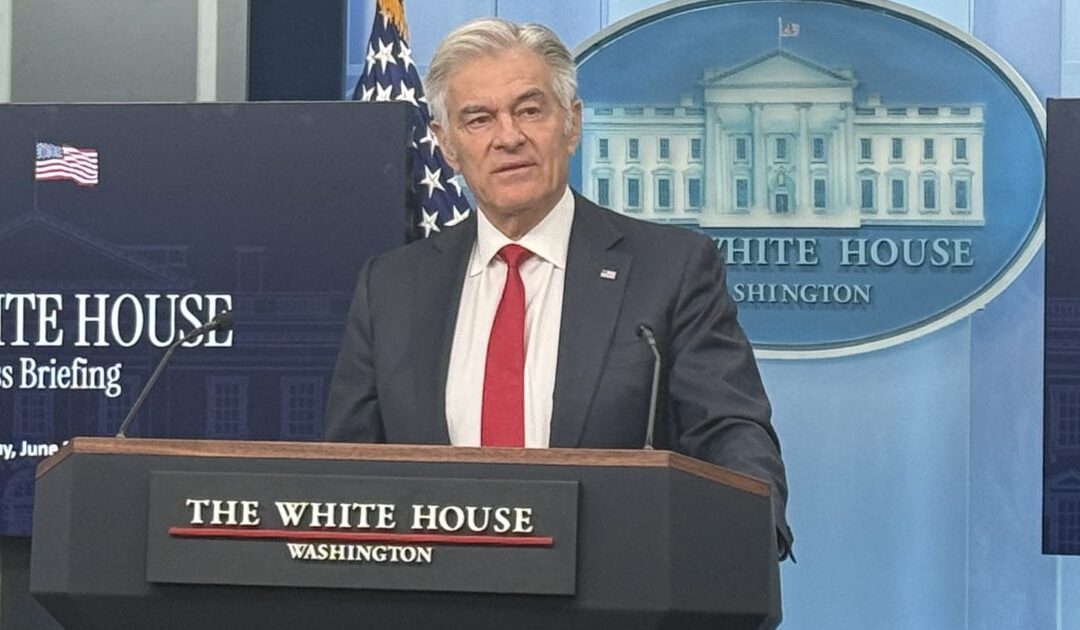
WATCH LIVE: CMS Administrator Dr. Oz Delivers White House Press Briefing – 1 PM ET

WATCH LIVE: CMS Administrator Dr. Oz Delivers White House Press Briefing – 1 PM ET

WATCH LIVE: CMS Administrator Dr. Oz Delivers White House Press Briefing – 1 PM ET
June 2, 2026

CMS Administrator Dr. Mehmet Oz delivers White House press briefing – June 2, 2026

Centers for Medicare & Medicaid Services Administrator Dr. Mehmet Oz will take the podium at a White House press briefing this afternoon.  

White House Press Secretary Karoline Leavitt is currently on maternity leave, and top administration officials are stepping in to fill her spot at the podium.

In the past, Secretary of State Marco Rubio, Vice President JD Vance, and Treasury Secretary Scott Bessent have delivered the briefing.

Oz will likely highlight his work with Vice President Vance’s anti-fraud task force to bust fraudsters abusing Medicare and Medicaid benefits, as well as the success of TrumpRX.gov, the new government-sponsored prescription drug platform to lower costs for US drug consumers.

Last month, Oz joined Vance to announce that the federal government is suspending 800 fraudulent hospice care providers deferring $1.3 billion in Medicaid reimbursements to California.

Vance Announces Federal Government is Deferring $1.3 Billion Dollars in Medicaid Reimbursements to California, Suspends 800 Hospices (VIDEO)

This also comes amid new requirements for Medicaid beneficiaries to prove they are working in order to prevent welfare abuse.

Per the Hill:

Oz’s turn at the podium comes a day after the Trump administration issued a final rule requiring most Medicaid beneficiaries ages 19-64 to provide proof they are working, complete community service or participate in a work program to be awarded benefits.

The press briefing is scheduled to begin at 1 pm ET.

Watch live below:

The post WATCH LIVE: CMS Administrator Dr. Oz Delivers White House Press Briefing – 1 PM ET appeared first on The Gateway Pundit.

Go to Source
Author: Jordan Conradson

Media Lies! No, Pritzker Did Not Just Balance the Illinois Budget

Media Lies! No, Pritzker Did Not Just Balance the Illinois Budget

Media Lies! No, Pritzker Did Not Just Balance the Illinois Budget
June 2, 2026

Governor signs legislation with a group of officials in a formal setting, highlighting collaboration and governance.
Illinois Governor JB Pritzker claims to have signed a balanced budget, but he is only correct definitionally, as Illinois law requires the governor to sign a balanced budget. In reality, the state carries approximately $173 billion in debt, and the Commission on Government Forecasting and Accountability (COGFA) projects a $673 million deficit. Photo courtesy of JB Pritzker via Instagram.


According to a press release from the office of the governor, the Illinois General Assembly passed Governor JB Pritzker’s eighth consecutive balanced budget, totaling $55.9 billion for Fiscal Year 2027. The plan focuses on making Illinois more affordable for working families, fully funding the state’s pension obligations, and investing in education, all while keeping discretionary spending increases below 1%.

Senate President Don Harmon (D-Oak Park) praised the budget, calling it a choice for “stability, responsibility and compassion” amid economic uncertainty and federal spending cuts. He said the plan supports working families, protects access to hospitals and health care, provides more than $300 million in new funding for public education, and includes a sales tax-free shopping holiday for parents, while avoiding increases in the state income tax or sales tax.

Similar to many Democratic spending claims, it includes terms such as “protects access to hospitals and health care.” Of course, no one was denying anyone access to hospitals. Hospitals are open, they remain open, and no one was being denied entry. Ostensibly, this is code for taxpayer-funded welfare programs continuing.

It is also telling that Democrats often refer to federal spending cuts as irresponsible. Just as Democrats become angry about the termination of temporary programs, such as the temporary free lunch program or temporary protections under DACA, once money has been spent or a particular policy has been put in place, they argue that it must continue indefinitely.

Pritzker claims that although he is reducing government revenue through tax cuts and increasing government spending through expanded social-benefit programs, he has produced a balanced budget. His office frames this as “fiscal discipline,” but a quick review of the state’s books shows that while he cut taxes in some areas, he increased them in others. The state continues to carry both massive debt and a deficit. Additionally, state pension contributions are structured under a ramp formula that underfunds what actuaries actually require.

A “balanced budget” in state government parlance means only that projected revenues equal projected expenditures for that fiscal year,  an annual operating measure, not a gauge of overall fiscal health. Illinois is constitutionally required to pass a balanced budget each year, so the claim is partly definitional. It says nothing about accumulated obligations.

On revenue, the picture is mixed. Pritzker eliminated the 1% state grocery tax effective January 2026 and expanded a child tax credit, but simultaneously required $1.1 billion in new taxes in FY2025 through corporate tax changes, sports wagering levies, and limits on business loss deductions. The net effect has been higher overall revenue extraction.

General Funds revenues totaled $53.998 billion in FY2025, and the legislature’s nonpartisan Commission on Government Forecasting and Accountability (COGFA) projects FY2027 revenues at $55.5 billion, $550 million below the governor’s own estimate of $56.05 billion, a gap that is itself a point of dispute.

On spending, the state budget expanded from roughly $35.4 billion in FY2015 to $53.07 billion in FY2025 — a 30%-plus increase. The FY2027 proposal totals $56.03 billion, leaving a nominal surplus of just $24 million against the governor’s revenue estimate. Of that spending, roughly 64% is fixed or nondiscretionary, pensions, debt service, Medicaid, and education mandates, before lawmakers spend a dollar on discretionary programs.

The deficit picture depends on whose revenue numbers are used. Under the governor’s figures, FY2026 produces a surplus of $75 million. Under COGFA’s independent projections, the same budget produces a $673 million deficit.

Either way, the enacted FY2026 budget relies on $1.1 billion in one-time and manufactured revenue enhancements to sustain its funding levels, meaning the structural deficit persists regardless of which surplus figure is cited. Illinois’ own Governor’s Office of Management and Budget had earlier projected a $3.2 billion deficit for FY2026 before revenue revisions and legislative maneuvers narrowed it.

None of this touches the state’s actual debt. Illinois carries approximately $30 billion in outstanding bond debt, ranking fifth nationally. Far larger is the pension liability: unfunded pension debt stood at $143.5 billion at the end of FY2025, making Illinois the only state in the nation with over $100 billion in unfunded pension obligations.

Combined, total long-term obligations exceed $173 billion, a figure that does not appear on the “balanced budget” ledger. When state and local pension obligations are combined, Illinois leads the nation with nearly $16,000 per capita in unfunded pension liabilities, nearly double Connecticut, which ranks second.

The pension contributions Pritzker calls “full funding” are themselves structured under a ramp formula that falls approximately $5 billion short of what actuaries say is needed annually to prevent the debt from growing. The five pension systems already consume 20% of the state budget. A “balanced budget” in this context means revenues cover that year’s spending plan on paper. It does not mean the state’s finances are in order.

The post Media Lies! No, Pritzker Did Not Just Balance the Illinois Budget appeared first on The Gateway Pundit.

Go to Source
Author: Antonio Graceffo

European Central Bank: Gold Has Replaced US Treasuries as the World’s Top Reserve Asset

European Central Bank: Gold Has Replaced US Treasuries as the World’s Top Reserve Asset

European Central Bank: Gold Has Replaced US Treasuries as the World’s Top Reserve Asset
June 2, 2026


Gold has overtaken US Treasuries as the world’s leading reserve asset, according to a new European Central Bank report, marking a striking shift in the global financial order and a warning signal for the US dollar.

By the end of 2025, gold accounted for 27% of global central bank reserve assets, up sharply from 20% the previous year. U.S. Treasury bonds, long treated as the safest and most important reserve instrument in the world, fell from 25 % to 22%.

The change, while seemingly small, does not mean the dollar has been dethroned overnight or anytime soon, but it does show that central banks are increasingly hedging against a system dominated by American debt, American sanctions power, and Washington’s ability to weaponize access to dollar-based finance.

The United States, for decades, has benefited enormously from the dollar’s role as the world’s reserve currency. That status allows America to borrow more cheaply, run larger deficits, finance military commitments abroad, and export some of the consequences of its monetary policy to the rest of the world.

The ECB’s findings suggest that more countries are quietly asking a question many American policymakers prefer to ignore: what happens if that privilege is no longer guaranteed?

Reserve assets are highly liquid holdings used by central banks to defend currencies, meet international payment obligations, and provide stability during financial crises. In practical terms, they are the emergency reserves of the global monetary system.

For generations, US Treasuries have sat at the center of that system. They were considered deep, liquid, dependable, and backed by the full faith and credit of the United States.

Gold, by contrast, was often treated by most Western financial elites as a relic. Yet central banks are now returning to it in force, driven by geopolitical uncertainty, inflation concerns, sanctions risk, and, among much of the Global South and states in the globe’s eastern hemisphere, growing distrust of the Western-dominated financial architecture.

ECB President Christine Lagarde acknowledged the trend directly in the report. “Geopolitical tensions continue to drive strong central bank demand for gold,” she wrote.

The shift accelerated after 2022, when the United States and its allies froze Russian foreign reserves following the outbreak of the Russia-Ukraine war. To America and the European Union, the move was a tool of pressure against Moscow; to many other governments, it was a reminder that dollar reserves can become vulnerable to political decisions.

That lesson was not lost on countries outside the Western bloc. If a major power’s reserves can be frozen, then holding too much wealth in another country’s currency or debt instruments becomes not only a financial decision, but a sovereignty risk.

This is where gold’s appeal becomes obvious. Gold is no one else’s liability. It cannot be printed by a central bank, sanctioned by a foreign treasury department, or defaulted on by a debtor government.

That is one reason central banks around the globe bought 850 tons of gold last year. Although that was below the roughly 1,000 tons purchased the year before, it remained well above prewar levels.

Private investors also moved aggressively into gold. Private gold investment doubled last year to 2,200 tons, according to the ECB report.

Part of gold’s rising share reflects higher prices rather than only new buying. Still, the direction is unmistakable: governments and investors are seeking protection outside the traditional dollar-debt system.

The euro, meanwhile, failed to benefit meaningfully from the turbulence. Despite hopes in Brussels and Frankfurt that erratic American economic policy might create a “global euro moment,” the common currency European gained little ground.

Across a broad set of indicators, the euro’s global role remains around 20%.. That is slightly above last year’s level but still far below where many European officials hoped it would be more than two decades after the currency’s creation.

Lagarde has always argued, rather unconvincingly, that the euro could become a more credible alternative to the dollar if European leaders finally completed long-delayed financial reforms. But the report made clear that global investors are not yet rushing into the euro as a replacement.

“There is an opening for the euro to enhance its global appeal—provided that European policymakers create the necessary conditions and put words into action,” Lagarde said.

She added that Europe would need to strengthen economic resilience, legal and institutional integrity, and geopolitical credibility. That is a polite way of saying that investors still do not fully trust the eurozone to act as a unified global power.

The euro’s share of foreign exchange reserves actually slipped by 0.5 percentage point to 20.2%. The dollar still held a far larger 57% share of reserves, demonstrating that America’s position remains dominant but no longer unchallenged.

The euro did make gains in international debt issuance. Euro-denominated international debt exceeded $1.1 trillion last year, its highest level since the currency was created.

A major driver was the rise of “Reverse Yankee” bonds, debt issued by American companies in euros and then swapped back into dollars. That issuance rose nearly 50%, helped by lower costs and tight spreads.

But on the central question of reserve power, the euro remains stuck. Investors looking to diversify away from the dollar appear more interested in gold and smaller currencies than in handing Europe the keys to the global monetary system.

The Chinese renminbi has also gained ground, reaching a 9% share in the ECB’s broader analysis. That growth reflects China’s increasing weight in global trade and the desire of some countries to reduce dependence on Western-controlled payment systems.

The BRICS nations have spent years discussing alternatives to the dollar-dominated order. Brazil, Russia, India, China, and South Africa, now joined by additional members and partners, have debated everything from a currency basket to a possible gold-backed settlement unit.

The proposed “Unit,” a potential BRICS-linked instrument, remains uncertain and far from implementation. Still, the fact that such discussions are happening at all shows how much dissatisfaction has built up with the existing system.

A new BRICS currency would face enormous practical challenges. The participating countries have different economies, political systems, strategic interests, and widely varying levels of trust.

India, for example, has been more cautious about any overt move away from the dollar. At the 2025 BRICS summit in Brazil, talk of a new currency was more muted than many of those proponents of de-dollarization had expected.

Nevertheless, the long-term trend remains important. Countries do not need to create a perfect dollar replacement to weaken the dollar’s dominance; they only need to reduce their dependence gradually, asset by asset and transaction by transaction.

Oil markets are one example. While the dollar still dominates global energy trade, one-fifth of oil trades in 2023 were reportedly conducted using non-dollar currencies.

That does not amount to a full-scale collapse of dollar supremacy. But it does represent erosion at the margins, and reserve currency status is often weakened first at the margins before the political class notices the danger.

For the United States, the consequences of losing reserve-currency privilege would be severe. Americans could face higher borrowing costs, a weaker ability to finance deficits, reduced leverage over foreign governments, and less capacity to sustain the global military and financial commitments Washington has accumulated over decades.

The federal government’s debt burden would become much harder to manage if global demand for Treasuries weakened significantly. A country that has grown accustomed to the world buying its debt would discover quickly how painful it is when that demand declines.

Ordinary Americans would not be insulated from the fallout. Higher interest rates could hit mortgages, credit cards, auto loans, business investment, and federal spending priorities.

A weaker dollar could make imports more expensive, feeding inflation and reducing household purchasing power. It could also force the state to make choices it has avoided for years, namely drastically cutting spending, raising taxes, shrinking commitments abroad, or accept lower living standards.

That is why the ECB’s report should matter to American voters, not just central bankers. It is a warning that the global system underpinning Washington’s power is not eternal.

For nationalist conservatives and economic populists, the lesson is straightforward. A nation cannot assume permanent financial dominance while running massive deficits, hollowing out its industrial base, outsourcing production, and relying on debt-fueled consumption.

The dollar’s status was built on American strength: industrial power, political stability, deep capital markets, military dominance, and global confidence. If those foundations weaken, the currency privilege built on top of them eventually weakens too.

The rise of gold as the world’s top reserve asset should therefore be read as more than a market development. It is a geopolitical signal.

Central banks are preparing for a more fragmented world. They are buying assets that sit outside Washington’s direct control and reducing exposure to the vulnerabilities revealed by sanctions, war, inflation, and financial volatility.

Lagarde’s warning was direct. “There is no room for complacency,” she said. “Forces of fragmentation are becoming more pronounced.”

That line should resonate in Washington. The greatest danger for the United States may not be an immediate dollar collapse, but the slow arrogance of assuming that reserve-currency status is a birthright rather than a privilege that must be earned.

Gold’s rise does not at all mean the dollar era is over. But it does mean the world is preparing for the possibility that it may not last forever.

For a country already burdened by debt, deindustrialization, and ever-widening political division, that should be treated as a warning sign. The dollar is still king, no doubt, but the world is clearly buying insurance.

The post European Central Bank: Gold Has Replaced US Treasuries as the World’s Top Reserve Asset appeared first on The Gateway Pundit.

Go to Source
Author: Robert Semonsen

THE RIGHT THING: Australian Populist Rightwing One Nation Party Surges in the Polls, Becomes the Country’s Most Popular

THE RIGHT THING: Australian Populist Rightwing One Nation Party Surges in the Polls, Becomes the Country’s Most Popular

THE RIGHT THING: Australian Populist Rightwing One Nation Party Surges in the Polls, Becomes the Country’s Most Popular
June 2, 2026

Pauline Hanson (center) and One Nation supporters: surging – Image https://www.onenation.org.au/

The Labor Party government and the liberal establishment are terrified.

The same trend is ongoing in most of the Western world’s countries: under pressure from suicidal Globalist policies implemented by their governments, citizens are flocking to the populist-right-wing-conservative parties searching for common-sense policies.

Wherever you look, the anti-Globalist forces are leading the polls or surging: US, UK, France, Germany… and even in Japan and in Latin America, the trend is clear.

Now, this right-wing shift has arrived down under, as Australia’s populist One Nation party surged past the ruling Labor party to lead a nationwide opinion poll for the first time.

Bloomberg reported:

“One Nation’s primary vote advanced 4 percentage points to 31% from a previous poll conducted ahead of the May 12 budget, while the center-left government slipped 3 points to 28%, according to a Redbridge Group/Accent Research survey published in the Australian Financial Review. The poll sampled 1,005 voters between May 25 and May 28 and has a margin of error of 3.4%.”

Sky News reported:

“One Nation has become the most popular political party in the country as Labor tanks to an all-time low amid ongoing fallout over the government’s broken budget promises.

[…] One Nation has devoured Labor’s traditional voting base, with 35 percent of working-class people intending to vote for Pauline Hanson’s party.

“’One Nation’s surge in primary vote support has come from working-class voters who have historically favored Labor’, YouGov’s Director of Public Data Paul Smith said. ‘Working class voters are the majority of voters in most electorates, so the battle for the working class vote between Labor and One Nation will decide the next election’.”

Read more:

Australia Grants Asylum to Members of the Iranian Women’s Soccer Team-One Player Makes Last Minute Plea as Players Return Home

The post THE RIGHT THING: Australian Populist Rightwing One Nation Party Surges in the Polls, Becomes the Country’s Most Popular appeared first on The Gateway Pundit.

Go to Source
Author: Paul Serran

NEW: Leftists Melt Down as President Trump Reveals His Bold Pick to Replace Tulsi Gabbard as Director of National Intelligence

NEW: Leftists Melt Down as President Trump Reveals His Bold Pick to Replace Tulsi Gabbard as Director of National Intelligence

NEW: Leftists Melt Down as President Trump Reveals His Bold Pick to Replace Tulsi Gabbard as Director of National Intelligence
June 2, 2026

Credit: Gage Skidmore/Flickr

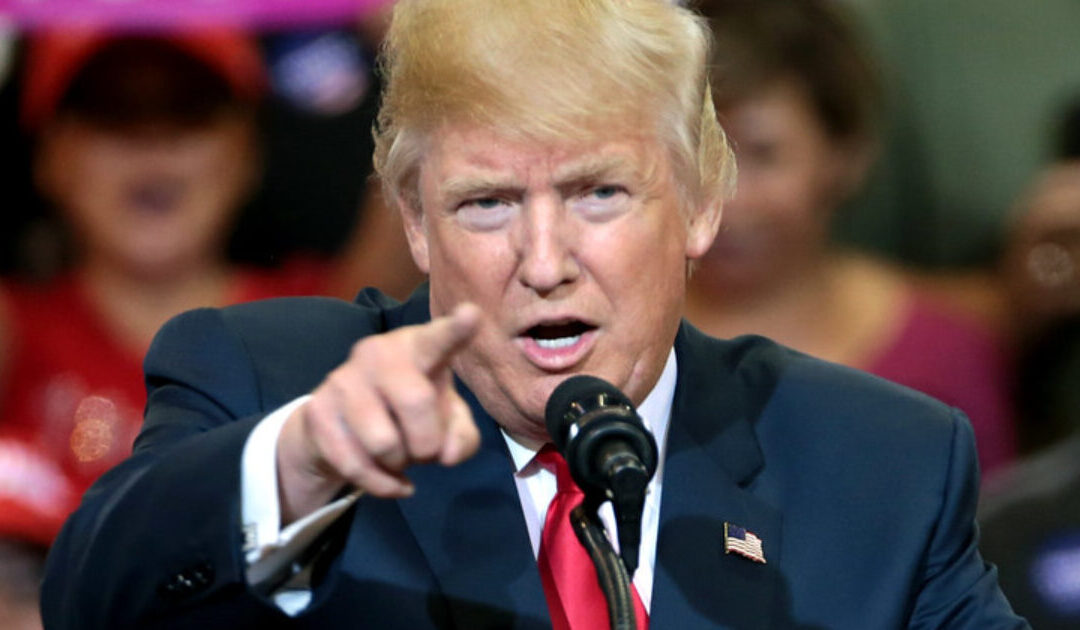
Donald Trump has revealed who will replace Director of National Intelligence Tulsi Gabbard following her planned resignation, and the left is very unhappy.

Trump announced that Bill Pulte, Director of the Federal Housing Finance Agency (FHFA) and Chairman of Fannie Mae and Freddie Mac, will serve as acting Director of National Intelligence.

I am appointing the Director of the Federal Housing Finance Agency, and Chairman of Fannie Mae/Freddie Mac, William J. Pulte, to serve as Acting Director of National Intelligence.

William has deep experience managing the most sensitive matters in America, the safety and soundness of the Markets, and over 10 Trillion Dollars at Fannie Mae/Freddie Mac, a substantial increase from where it was just 12 months ago.

During this period, he will remain Director of the Federal Housing Finance Agency, and Chairman of Fannie Mae/Freddie Mac.

Congratulations to Director Pulte! President DONALD J. TRUMP

Trump also said that Pulte will remain Director of FHFA and the Chairman of Fannie Mae and Freddie Mac while serving as acting DNI.

Pulte is a huge favorite of Trump’s and extremely loyal to the president.

But what makes this pick stunning is that Pulte has no experience in the national intelligence realm, either in the private or government sectors.

Leftists, including Chuck Schumer, threw a fit over Pulte’s nomination:

As The Gateway Pundit reported, Gabbard announced last month that she would be resigning as the Director of National Intelligence.

She is stepping down to be with her husband as he battles an extremely rare form of bone cancer.

“I’m deeply grateful for the trust you placed in me and for the opportunity to lead the Office of the Director of National Intelligence for the last year and a half,” she wrote to Trump in a letter.

“Unfortunately, I must submit my resignation, effective June 30, 2026,” she continued. “My husband, Abraham, has recently been diagnosed with an extremely rare form of bone cancer.”

The post NEW: Leftists Melt Down as President Trump Reveals His Bold Pick to Replace Tulsi Gabbard as Director of National Intelligence appeared first on The Gateway Pundit.

Go to Source
Author: Cullen Linebarger