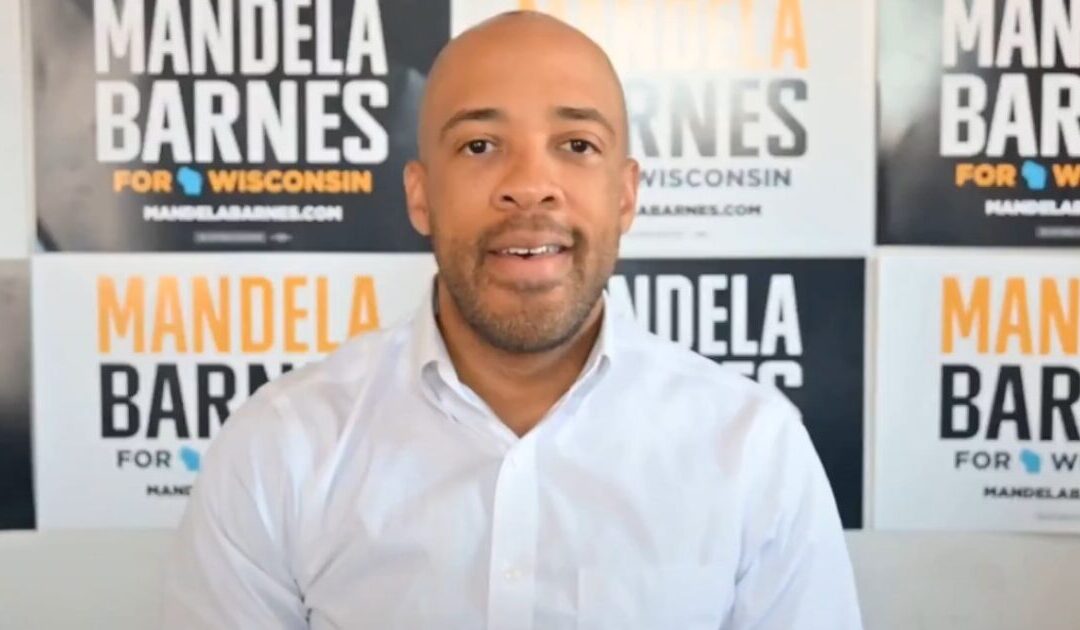
Democrat Mandela Barnes Drops Out of Wisconsin Governor’s Race Hours Before Damaging Articles About Him Drop
July 30, 2026
Democrat Mandela Barnes dropped out of the Wisconsin Governor’s race hours before damaging media reports about him are published.
Meanwhile, Socialist Francesca Hong is surging in the polls.
Earlier Thursday, Politico reported that Mandela Barnes was considering dropping out of the race before damaging articles about him dropped:
The announcement comes as Democratic officials in the state brace for damaging media reports about Barnes, which are expected to hit in the coming hours. Barnes and his team had been on calls Thursday discussing whether to drop out, POLITICO reported earlier.
Barnes’ campaign spokesperson Darby O’Connor said in a statement that “there are no allegations of misconduct or wrongdoing against Mandela.”
The primary had become increasingly messy as more moderate leaning Democrats have tried to stave off Hong’s rise, worried the democratic socialist’s victory could boost Tiffany. Wisconsin Gov. Tony Evers’ endorsement of David Crowley — who reentered the race in the final stretch after current Lt. Gov. Sara Rodriguez’s campaign imploded — further complicated the moderate coalition.
Democrats, including some close to Barnes, are hoping the last minute drop will allow voters to coalesce around Crowley, who is set to hit the campaign trail with Evers next week in the final stretch, according to four people with direct knowledge of the matter. Evers is also slated to appear at several fundraisers for Crowley in the coming days, including one in Madison on Thursday and a Friday event in Milwaukee.
Shortly after Politico published its article warning about the damaging media reports, Barnes announced he is dropping out of the governor’s race.
“Last night I had a very difficult conversation with staff,” Barnes said in a video posted to X on Thursday afternoon.
“We’re incredibly proud of all the things that we’ve accomplished and all the resources that we have raised to spread our message. But it’s become very clear who our nominee is going to be,” he said.
Divided panel deepens nationwide circuit split and sets up another potential Supreme Court immigration showdown.
The notoriously liberal Ninth Circuit handed the Trump administration a major setback Thursday, ruling 2–1 that illegal aliens apprehended inside the United States generally cannot be subjected to mandatory detention without access to a bond hearing while they fight deportation.
In Rodriguez Vazquez v. Bostock, the divided panel affirmed a lower court ruling in favor of a class of illegal aliens detained at the Northwest ICE Processing Center in Tacoma, Washington.
The majority, led by Trump-appointed Judge Daniel Bress and joined by Clinton-appointed Judge Margaret McKeown, held that aliens present without admission who are apprehended in the interior fall under 8 U.S.C. § 1226 (which allows for bond hearings) rather than the mandatory detention provisions of § 1225(b)(2)(A).
The court claimed Congress in 1996 never intended the strict no-bond rules to apply to those who successfully snuck past the border and embedded themselves in American communities for years.
Judge Carlos Bea dissented, correctly arguing that the statute treats those who entered without inspection as “applicants for admission” who are “seeking admission,” and therefore subject to mandatory detention.
Bea pointed out the absurdity of Congress requiring detention for those stopped at the border while letting those who evade detection and live here illegally walk free on bond to potentially abscond. Read the Ninth Circuit’s 99-page opinion here.
The Ninth Circuit’s decision binds courts across California, Arizona, Nevada, Washington, and other states in the circuit—precisely the regions that have long served as magnets for illegal immigration and sanctuary policies. It guarantees more habeas petitions, more releases, and more opportunities for illegal aliens to disappear while their cases drag on for years.
The ruling means immigrants who entered the U.S. illegally but are later arrested inside the country generally cannot automatically be held without bond in the Ninth Circuit. pic.twitter.com/AzHpAptHuV
This is the fifth federal appeals court to reject the Trump administration’s common-sense reinterpretation of immigration law.
The Fifth and Eighth Circuits have sided with the government, recognizing that illegal entrants should not get a free pass simply because they made it past the border. The Second, Sixth, Tenth, Eleventh, and now Ninth Circuits have gone the other way.
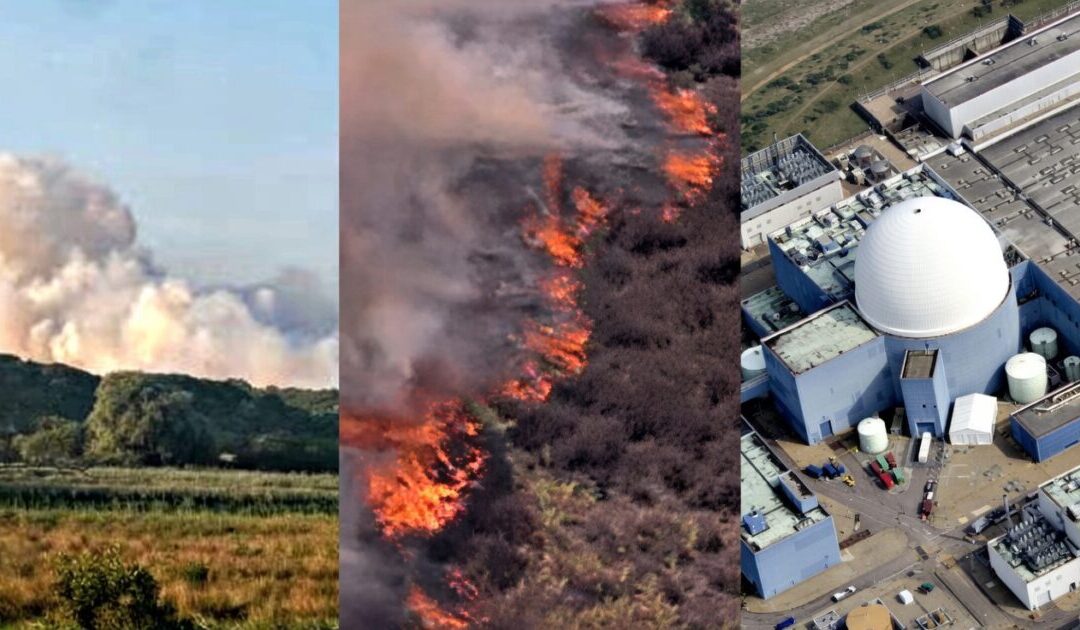
“Around 120 firefighters and 18 fire engines are battling a blaze at Dunwich Heath, near Leiston, a few miles from the Sizewell B nuclear plant, which provides 3 per cent of the UK’s electricity needs.
EDF, which operates the plant, said that it was ‘continuing to monitor the situation’ and insisted there was no cause for concern about the site’s safety because the wind was not blowing southwards.
However, a nuclear industry source warned that if the wind changed direction and started blowing smoke towards Sizewell B it could force the station to stop electricity generation. There is also a risk of the smoke clogging up the filters of the site’s heating, ventilation and air conditioning (HVAC) system, which draws air from outside.”
BREAKING: A major incident has been declared in Suffolk after a “significant wildfire” broke out on Dunwich Heath tonight
“Suffolk Fire and Rescue Service has warned that the blaze could continue for another two days, and said it was treating the fire as a ‘live and dynamic situation’.
Hundreds of properties have been evacuated as firefighters tackle the large heathland blaze.”
Wildfires are now sweeping through Suffolk, UK, as emergency crews tackle a major blaze just miles from a nuclear power station, which has been placed on high alert. pic.twitter.com/Z7uEsF91EP
WATCH: Schumer Awkwardly Dodges Question About DSA’s Plan to Abolish Senate
July 30, 2026
Senate Minority Leader Chuck Schumer was caught off guard when asked about the Democratic Socialists of America’s plans to abolish the Senate on Wednesday.
Instead of answering the question, Schumer ignored it and claimed that the party is united in “working to defeat Trump.”
Earlier this week, Fox’s Shannon Bream went through the DSA’s Workers Deserve More Platform with Megan Romer, National Co-chair of the Democratic Socialists of America.
“Just give me sort of a true or false on these,” Bream said before listing the radical policies, including abolishing the Senate, replacing the President and Supreme Court with Congressionally appointed leaders, abolishing ICE, abolishing borders and granting mass amnesty, defunding the Pentagon, abolishing prisons, and government ownership of business.
Romer confirmed all of the policies are part of their plan.
WATCH:
During a press conference on Wednesday, a reporter noted that the DSA’s new platform calls for abolishing the Senate and attempted to ask Schumer whether their views are replacing the Democratic Party’s positions.
But before the reporter could even finish, Schumer smiled awkwardly as he cut her off.
“Look, the bottom line is Democrats from one end of the spectrum to the other are going to be working to defeat Trump, to bring down costs, to go after his corruption, and to end the chaos,” Schumer said.
Notably, he did not deny the DSA’s growing influence over the party.
Houthis in the Iran Conflict: Asymmetric Warfare and Unlikely Surrender
July 30, 2026
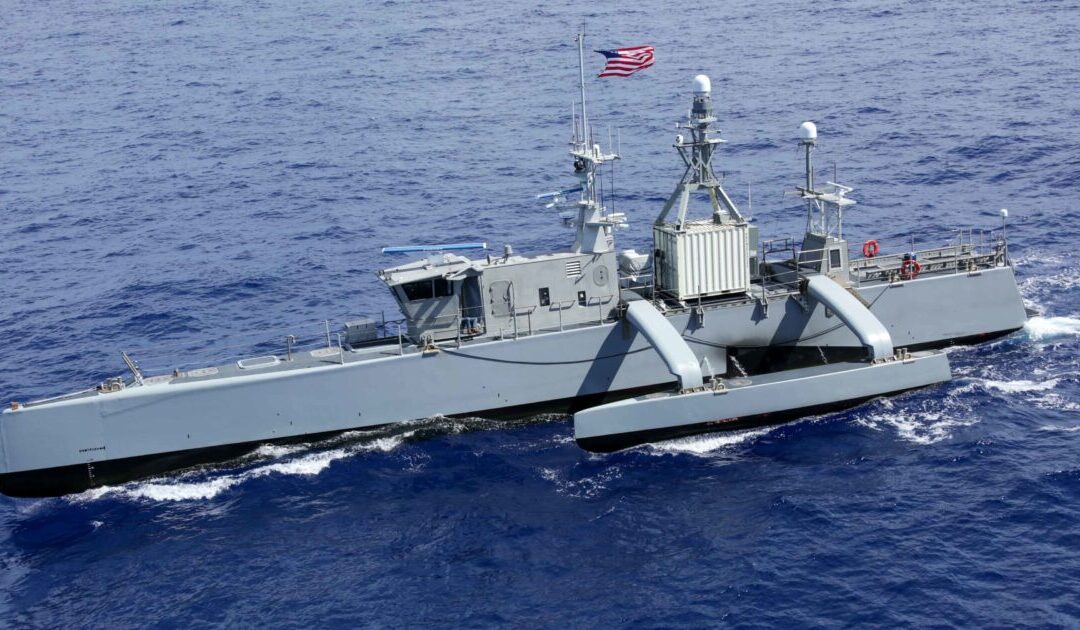
Asymmetric warfare, consisting of drones and sea mines, has rewritten the rules of engagement against the Houthis and the IRGC. Photo courtesy of Mass Communication Specialist 3rd Class Aleksandr Freutel, U.S. Navy. Public domain via Wikimedia Commons.
On July 20, the Houthis declared a naval blockade against Saudi Arabia in the Red Sea, retaliation for what they called a Saudi “siege” on Yemen, the group’s formal entry into the wider US-Iran war. Days later, the Houthis claimed missile and drone strikes on the Saudi oil tankers Encelia and Layla; Saudi authorities confirmed the Encelia was hit, with the crew safe, while the Layla strike remains unconfirmed.
Saudi Arabia briefly suspended oil shipments through Bab el-Mandeb on July 26, resuming them the following day after coalition protective measures were put in place. By July 27 to 28, UKMTO and JMIC reported explosions and missile positioning near the strait.
The United States possesses the world’s most powerful military, and the U.S. Navy is the dominant maritime force. Yet when confronting Iran’s Islamic Revolutionary Guard Corps (IRGC) in the Strait of Hormuz or the Iran-backed Houthis in the Red Sea, particularly around the Bab el-Mandeb Strait, the U.S. faces an asymmetric challenge.
The Houthis cannot mount a flotilla capable of confronting a U.S. carrier strike group. Instead, they rely on asymmetric tactics that exploit the geography of the region. Naval mines, explosive-laden drone boats, anti-ship missiles, and drones launched from small vessels can make key shipping lanes too dangerous for commercial traffic.
Rather than defeating the U.S. Navy at sea, the Houthis seek to raise the cost and risk of maritime commerce, threatening one of the world’s most important trade routes.
The Houthis are one of three primary proxy forces backed by Iran, alongside Hezbollah and Hamas. Their principal activity has been restricting shipping through attacks on vessels transiting the region. When the conflict between the U.S. and Iran began, the Houthis, like Iran’s other allies, issued statements of support but did not immediately join the fighting. After one or two early engagements, they went quiet for roughly five months before resuming attacks in recent days.
Iran’s broader network of allies has largely avoided direct confrontation since the fighting escalated: Hezbollah was reportedly ordered not to attack Israel, and neither China nor Russia has intervened overtly, though China has offered support “behind the scenes.”
The Houthis, unlike Iran’s other allies, have joined the fight, possibly because they recognize that the local geography favors their style of asymmetric warfare. The Red Sea presents an easier target than the Strait of Hormuz. The entrance to the Red Sea near Yemen, extending to the Suez Canal, is narrower and closer to the Saudi Arabian Peninsula, making it one of the world’s most consequential waterways to block, particularly for European shipping.
Yemen’s terrain and tribal structure have historically frustrated larger, better-equipped militaries. Egypt’s intervention in the North Yemen civil war between 1962 and 1970 is the clearest example. President Gamal Abdel Nasser deployed roughly 70,000 troops in support of the republican government, a commitment Nasser himself described to the U.S. ambassador as his “Vietnam.”
The war ultimately cost Egypt more than 10,000 men and billions of dollars, and Egyptian forces withdrew in 1967 without securing a decisive victory over Yemeni royalist and tribal fighters. The Houthi movement itself did not emerge until decades later, but the outcome underscores a broader pattern. Yemen’s fighters, regardless of era or faction, have consistently proven difficult for outside powers to subdue on their own terrain.
Saudi Arabia and the United Arab Emirates encountered a similar pattern more recently, leading a coalition against the Houthis beginning in 2015 that failed to dislodge the group from northern Yemen despite years of airstrikes and ground operations.
At the same time, Britain’s limited naval presence in the region has likewise done little to curb Houthi attacks on shipping. The recurring outcome across six decades of foreign intervention, including Egyptian, Saudi, Emirati, and British involvement, points to a country that has proven exceptionally difficult to conquer, however outmatched its fighters may be in conventional military terms.
The conflict “lends itself to asymmetric warfare,” since it doesn’t take many mines or drone attacks to make a strait impassable, and these weapons can be launched from rubber boats, fishing boats, or other small craft. A formal Houthi navy would be quickly destroyed in open confrontation with U.S. forces, but intercepting every small boat and recovering every mine is a far more difficult task.
Iran’s network of proxies does not function as a unified alliance, but rather as a set of actors whose objectives periodically align, particularly when opposing the U.S. or Israel. The Houthis have seized on a window of opportunity for personal gain, which also indirectly supports Iran. It is possible that other Iranian allies will do the same if an opportunity for personal benefit arises.
The concept of asymmetric warfare explains why some analysts are skeptical of President Trump’s warnings that U.S. troops will cut off Iran’s oil exports by invading and holding Kharg Island. The island’s terminal handles the vast majority of Iran’s oil exports. Iran has reinforced the island with layered air defenses, MANPADS, and mines, making it a heavily defended, fixed target. Any attempt by American forces to seize and hold the island would expose them to Iranian drone and missile strikes. A naval blockade, by contrast, could achieve the goal of cutting off Iranian oil exports without requiring U.S. troops to seize and hold Iranian territory indefinitely.
Comparisons to Afghanistan and Vietnam are unavoidable. In both conflicts, the U.S. achieved its initial military objectives relatively easily. However, holding territory and bringing about lasting democratic government proved far more difficult.
The 20-year U.S. war in Afghanistan ended with the completion of the U.S. withdrawal on August 30, 2021. In the end, the Taliban returned to power after a conflict that cost nearly 2,500 American service members’ lives and roughly $2 trillion.
Vietnam followed a similar trajectory. The U.S. won nearly every major battle while losing tens of thousands of American service members and killing millions on the other side. Yet U.S. combat troops withdrew in 1973 under the Paris Peace Accords, and the communists consolidated the country under their rule.
Both wars stand as cautionary examples of the United States’ ability to win battles, and even wars, while highlighting the difficulty of what comes afterward. Military victory does not necessarily translate into a stable government that the U.S. can support and defend over the long term.
Furthermore, both the Vietnam and Afghanistan conflicts took place before today’s level of technological development. At that time, asymmetric warfare relied primarily on improvised explosive devices and suicide bombers. Today, however, drones have completely rewritten the calculus. These unmanned explosive delivery systems give relatively small and unsophisticated fighting forces enough destructive power to challenge a ground invasion or prolonged occupation.
We use technologies like cookies to store and/or access device information. We do this to improve browsing experience and to show (non-) personalized ads. Consenting to these technologies will allow us to process data such as browsing behavior or unique IDs on this site. Not consenting or withdrawing consent, may adversely affect certain features and functions.
Functional
Always active
The technical storage or access is strictly necessary for the legitimate purpose of enabling the use of a specific service explicitly requested by the subscriber or user, or for the sole purpose of carrying out the transmission of a communication over an electronic communications network.
Preferences
The technical storage or access is necessary for the legitimate purpose of storing preferences that are not requested by the subscriber or user.
Statistics
The technical storage or access that is used exclusively for statistical purposes.The technical storage or access that is used exclusively for anonymous statistical purposes. Without a subpoena, voluntary compliance on the part of your Internet Service Provider, or additional records from a third party, information stored or retrieved for this purpose alone cannot usually be used to identify you.
Marketing
The technical storage or access is required to create user profiles to send advertising, or to track the user on a website or across several websites for similar marketing purposes.




 Happening now: WILDFIRES rage in Suffolk, UK
 BREAKING: A major incident has been declared in Suffolk after a “significant wildfire” broke out on Dunwich Heath tonight