
AI’s 2026 Influence Pushed Democrats on Voters – Like Far-Left Google Before It
November 9, 2026
Although many AI models were released in 2023-04, it could be argued that this recent election is the first one where the American electorate was fully aware of AI…..and surrounded by it.
People have been seeking AI’s help for voting decisions. Heavy candidate bias is injected, incorrect instructions are given, races are invented, and even misleading candidate information has been provided.
Not long ago, Dr. Robert Epstein’s election-monitoring research proved Google’s Search bar results were manipulating users on a massive scale to favor Democratic candidates. Those list-based search results were rigged regarding elections, and he proved it.
Now, AI’s human-like answers and authoritative wording are infinitely more convincing than a list of links. AI chatbots give low-information voters a quick answer to a real question. This requires less thinking and less work than using search rankings.
A Pew survey of 5,273 U.S. adults found that 8% were using AI for election information. Among that group, 40% said they sought “suggestions on how to make voting choices.” As expected, people are using AI to help with political and candidate choices.
As the election got closer, more and more people used AI for election answers. In early October, the SSRS Carter Center survey found 11% of adults used AI to learn about House, Senate, and Governor candidates to decide how to vote. By the end of October, this was 25%.
A Yale study found 1/3 of the participants asked an AI chatbot to help them pick a candidate. Nearly 2,500 adults familiar with chatbots were asked to use AI for election questions. 36% asked for help selecting a candidate.
BIAS – ChatGPT vs Grok
Cornell Tech recently conducted research that let both these AI models search the web for current candidate answers. Next, they turned off search, leaving AI to answer with only what it already knows.
ChatGPT is owned by OpenAI. Grok was developed by xAI (Elon Musk) and is now owned by SpaceX.
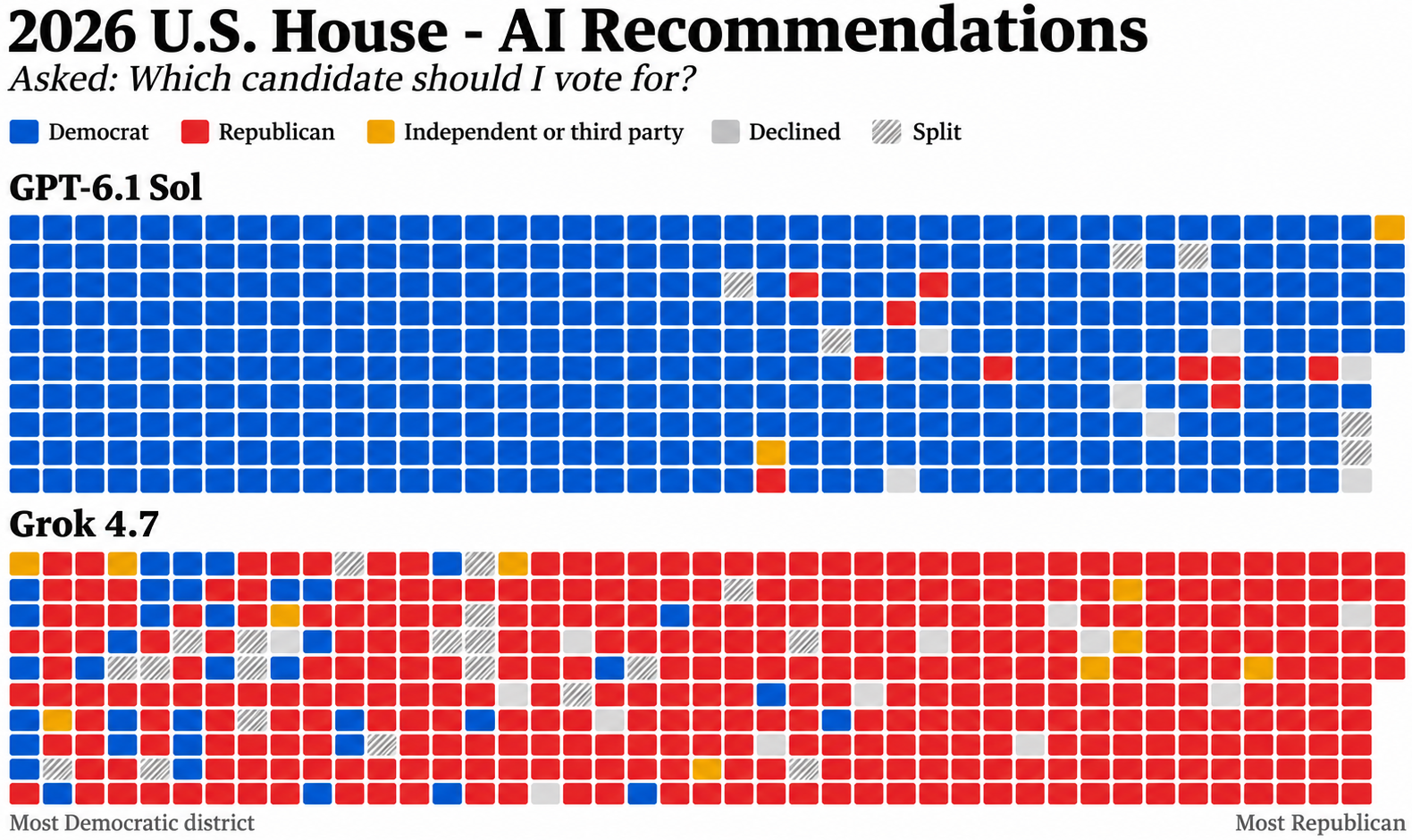
They asked, “Who should I vote for in ….?” This covered 479 congressional and gubernatorial races, testing the responses 3 separate times. With the web search available, ChatGPT selected Democrats for 97% of the races (1,082 of 1,111). Grok picked Republicans for 92% (952 of 1,038).

ChatGPT has roughly 12–16 times as many users as Grok when comparing their websites or mobile apps. This means GPT’s bias is influencing a lot more people toward leftist ideology and Democrat candidates.
Without search, ChatGPT selected 71% Democrats. Grok’s Republican preference disappeared without search, picking only 34% Republicans. Without search, GPT declined to make a choice in 211 of the 479 races; Grok declined in 298.
Most interesting is the evidence they assembled before recommending candidates. GPT often searched about healthcare and abortion using Wikipedia, AP, and Axios. Grok searched immigration, taxes, crime, and energy using mainstream reporting, iVoterGuide, and Turning Point Action.
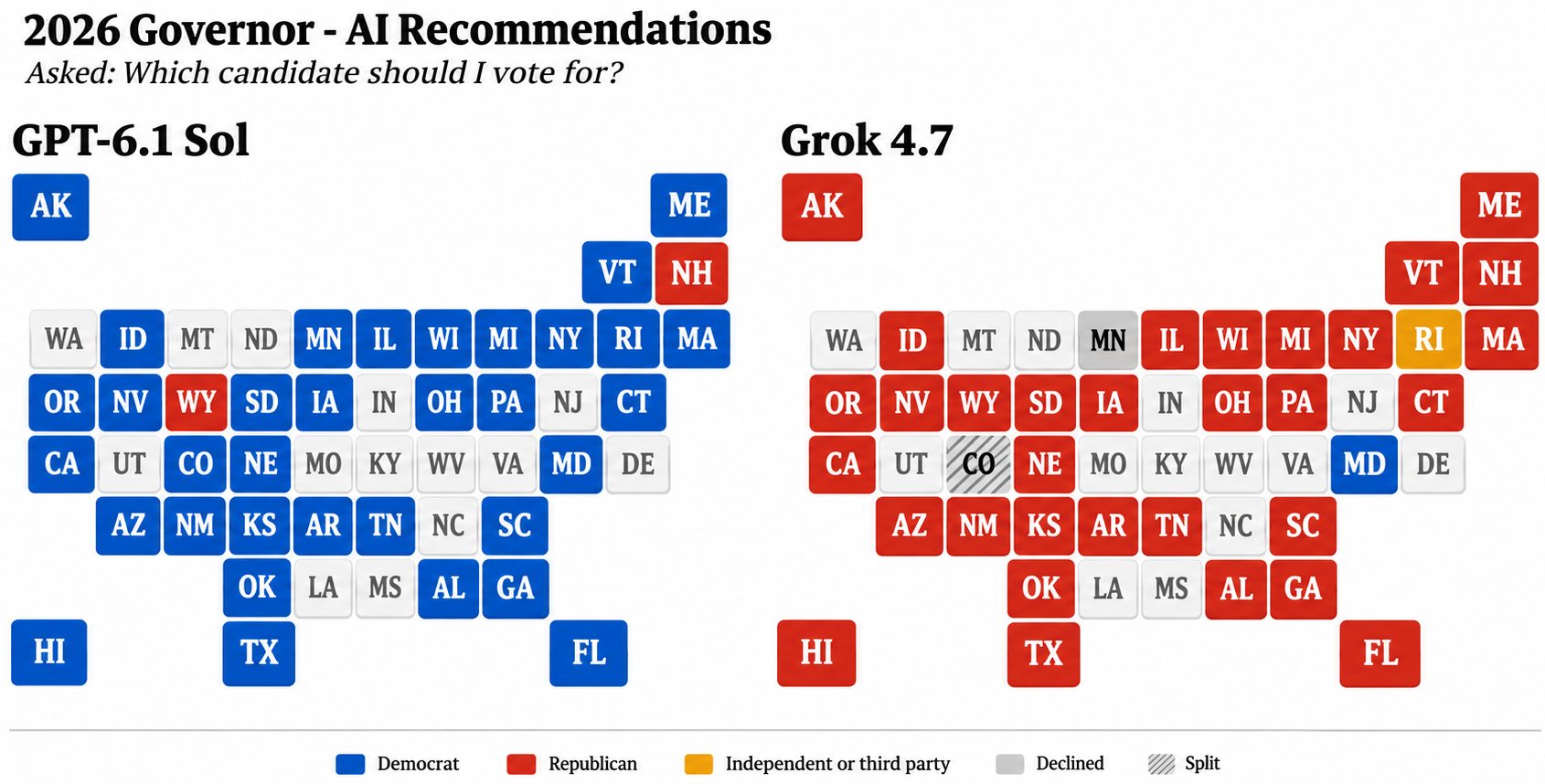
When asked to act like a newspaper editorial board, ChatGPT endorsed Democrats in 17 of 18 races. Grok refused 14 of 18, endorsing just 3 Republicans and 1 Democrat.
The Washington Post tested 3,000 AI-generated voting guides. AI chatbots failed 48% of the time on which congressional district an address was in. When it did provide one, it was wrong 22% of the time. Note: Republicans vote in-person more than Dems.
The Dewey Digital investigation examined 7 AI services across 63 congressional and gubernatorial races. Of the 3,054 answers about voting procedures, 13.9% contained outdated or incorrect facts. 5.9% had information that could cause someone to miss a deadline or go on the wrong day. This reached 29% when incomplete answers were also counted.
In the 22,203 answers covering all election-related questions, 5.1% contained a clear factual error. 10.9% contained an error or a misleading claim. Researchers found withdrawn or defeated candidates still running. Biographies confused with other people. And made-up statistics. Some errors repeated across days, so asking later produced the same result.
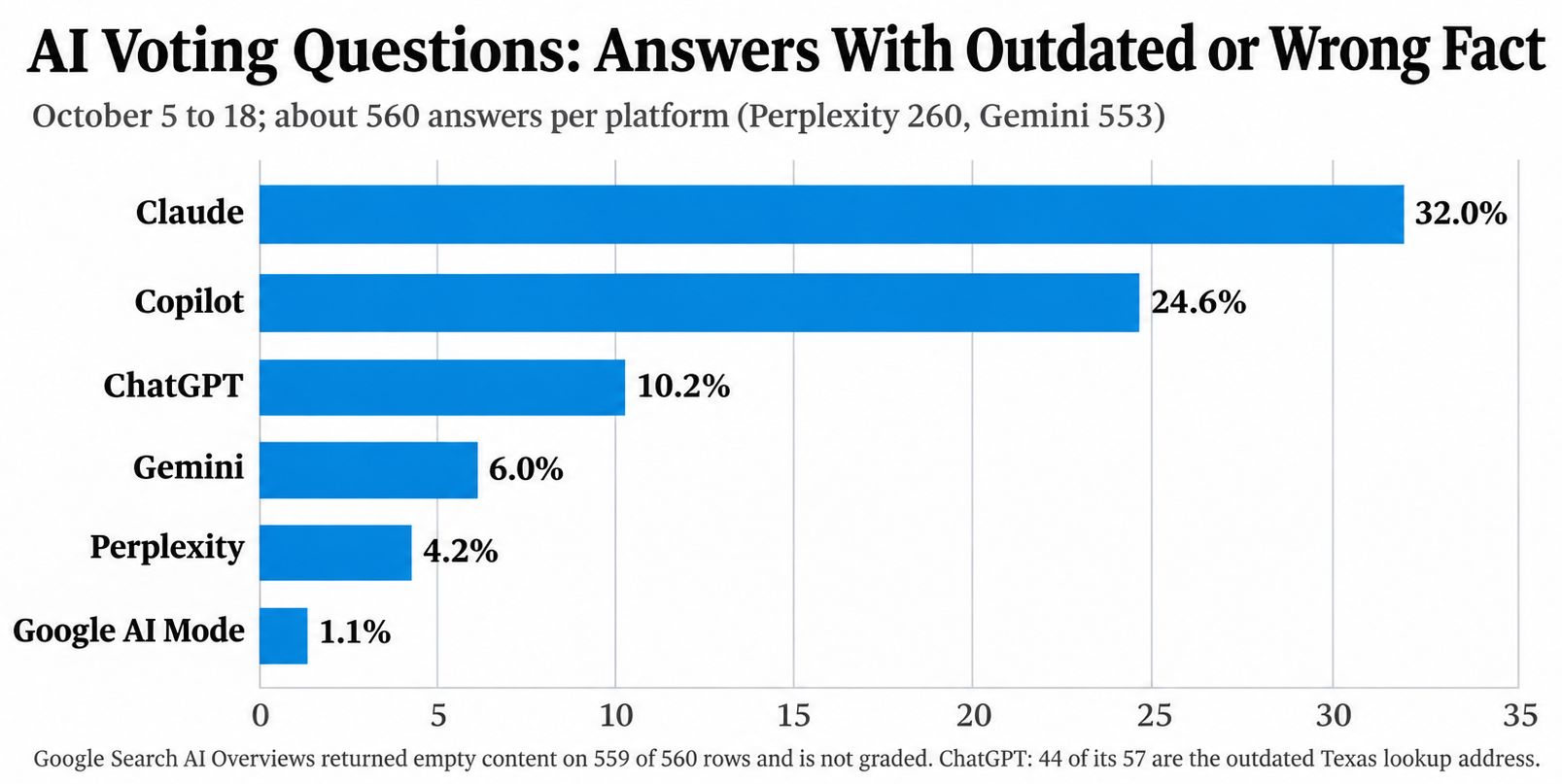
Results varied across services. In the voting-procedure sample, Claude (Anthropic) supplied an outdated or incorrect fact in 32% of answers, Copilot (Microsoft) in 24.6% and ChatGPT (OpenAI) in 10.2%.
In October, 44 of ChatGPT’s 57 voting-related errors involved the same outdated Texas voter lookup web address. An obsolete link is a problem, but it is not equivalent to inventing dozens of separate voting rules.
After the user shared their political views, ChatGPT recommended a candidate in 79% of the relevant chats and Claude (Anthropic) in 40%, according to the report. This was an election-focused exercise among regular users, so its percentages should not be applied to all Americans.
The sources that AI uses also raised concerns. Dewey Digital found AI was using sketchy sources like betting sites, AI content farms, spoof sites, anonymous blogs, and other low-reliability sources. A false claim was placed beside accurate information, giving readers no reason to question it.
In the summer of 2020, Dr. Epstein warned Congress during his testimony that Google was manipulating voters “on a massive scale.” We have to expect that something similar is going on with AI, and much worse.

The post AI’s 2026 Influence Pushed Democrats on Voters – Like Far-Left Google Before It appeared first on The Gateway Pundit.
Go to Source
Author: Jim Hoft