
American Liberals Silent as Hamas Crushes Anti-Hamas Protests
June 29, 2026

The “Free Palestine” movement has remained silent on the arrest, torture, and murder of anti-Hamas protesters in Palestine. The violence and repression committed by the Hamas terrorist organization against Palestinian civilians throw a wrinkle into its narrative blaming Israel and President Trump for all of the suffering in Gaza. The protests also dispel claims by the American left that Gazans want to be ruled by Hamas or that Hamas is the legitimate governing authority.
For the second time in little more than a year, Palestinians in Gaza took to the streets demanding an end to Hamas rule. According to the Palestinian Center for Policy and Survey Research, Hamas’s approval rating fell from 52 percent in December 2023 to 43 percent by May 2025. The demonstrations, organized as the “June 26 Peaceful Revolution,” reflected growing anger over nearly two decades of Hamas control, the devastation of the war, and allegations of corruption and repression.
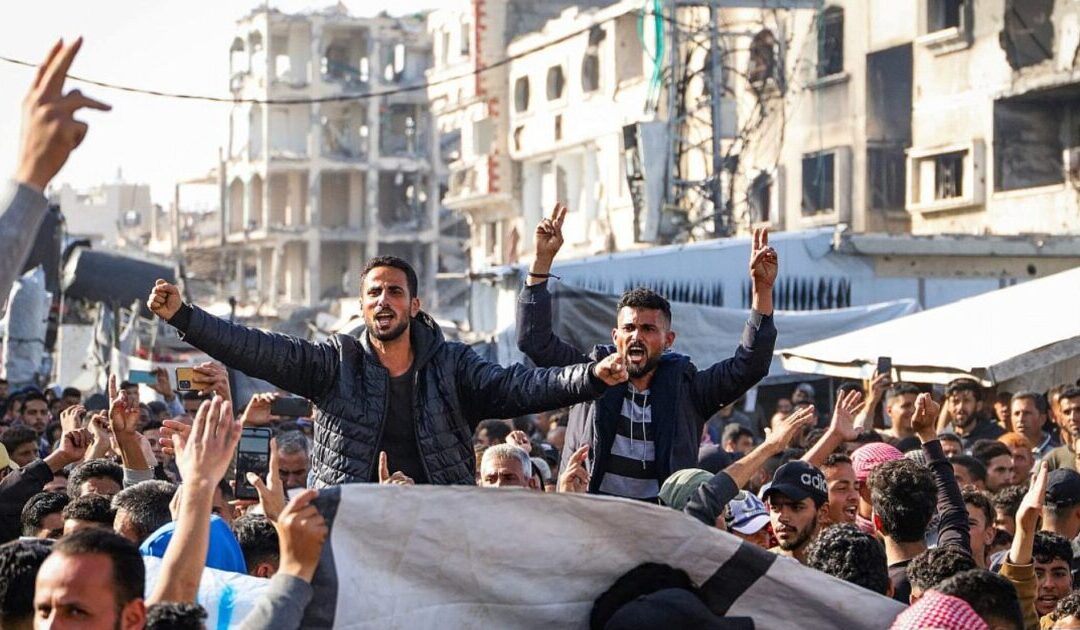
The protests were organized across 18 locations throughout the Gaza Strip. Demonstrators called on Hamas to disarm and transfer civil administration to a transitional governing authority.
Hamas responded with a sweeping crackdown. Security forces arrested organizers, kidnapped suspected participants, threatened demonstrators, and used mosques to denounce the protests before many rallies could begin. Armed operatives arrested Gazans in the streets, seized mobile phones, restricted movement around displaced persons camps, and rounded up others at hospitals.
Although the crackdown prevented large-scale demonstrations in many areas, hundreds of Palestinians defied the threats and publicly called for Hamas’s removal.
In the days preceding the protests, Hamas launched what activist Ahmed Fouad Alkhatib, a Gaza-born Palestinian now living in exile in the United States, described as an “industrial-scale campaign of terror, intimidation, interrogation, and blackmail” against thousands of Gazans who had planned to participate.
Hamas also provided itself religious cover for the crackdown. The Fatwa Committee of the Association of Palestinian Scholars issued a ruling declaring the demonstrations “a criminal movement,” accusing participants of assisting Israel and advancing objectives Israel had failed to achieve through military force. Participation could therefore be treated as collaboration with Israel, a crime punishable by death under Hamas rule.
On the day of the protests, Hamas police, intelligence units, and al-Qassam Brigade militias deployed throughout the Strip. Armed operatives were positioned near planned gathering points, civilian movement around displaced-person camps was restricted, and cellphones were confiscated from people identified with the protest calls. Observers reported that “The atmosphere on the ground was one of clear pressure.”
“Every attempt at public organization was met immediately by the presence of security forces.” Hamas supporters framed the measures differently, claiming they were intended “to protect public order and prevent chaos during wartime.”
Hamas used Gaza’s hospitals as detention and interrogation centers. Detentions were reported at four facilities: Al-Shifa, Nasser, Al-Ahli Arab, and Al-Aqsa Martyrs hospitals.
Alkhatib identified Al-Ahli Arab Hospital, also known as the Baptist Hospital, as a Hamas intelligence hub. According to him, Hamas security officials summoned people to the hospital, interrogated them, threatened them, and placed them under house arrest inside the facility.
Al-Qassam Brigades operatives, Hamas police, and internal security officers warned detainees that if they posted anything supporting the protests or assisted demonstrators, they would be “executed under revolutionary conditions” and treated as collaborators with Israel. They were told there would be no trial, no due process, and immediate execution.
Hamas warned journalists not to cover the protests. Its affiliated media outlets published footage of empty intersections and declared the “Failure of the June 26 Revolution.” Streets in Khan Younis, Al Qarara, and Al Nasr were described as eerily quiet.
On social media, Hamas-aligned accounts claimed the protest movement was orchestrated by IDF Arabic-language spokesman Lt. Col. Avichay Adraee. They portrayed the demonstrators as Israeli agents, the same collaboration accusation Hamas used to justify extrajudicial executions. Critics inside Gaza rejected the claim.
“There is a harsh reality on the ground,” one social media user wrote. “The attempt to silence every critical voice only deepens the crisis.”
Despite the crackdown, hundreds took to the streets carrying signs reading, “God willing, Hamas out,” “We are not pawns,” and “We want to live.”
The June 26 action was the second major wave of anti-Hamas unrest in little over a year. Between March and August 2025, protests erupted across Gaza demanding Hamas relinquish power and end the war with Israel. Hamas executed six Gazans and publicly flogged or kidnapped others who participated, with some remaining missing.
The fate of 22-year-old Uday Al Rabbay illustrated the cost of dissent. Kidnapped shortly after taking part in a protest, his body, covered in blood, was returned to his family’s doorstep days later as a warning against further demonstrations. The Committee to Protect Journalists reported that Hamas beat reporters and photographers and threatened their lives and families to suppress coverage.
The suppression is carried out by dedicated internal security units operating outside any legal process. A UN report found that Hamas’s Sahm Unit and Radaa Force killed at least 60 civilians in Gaza during 2024 and 2025.
During the 2017 and 2019 protest waves, Hamas security forces used violence, arrests, and intimidation to suppress demonstrations driven by Gaza’s economic conditions. During the current war, Hamas shifted to less visible methods. It carried out arrests and executions behind the scenes while avoiding open street confrontations, in part to reduce its exposure to Israeli strikes and limit international scrutiny.
Protest organizers appealed to governments, journalists, and human rights organizations to monitor events closely, warning that participants had already become targets of intimidation before the protests began.
“The right to peaceful assembly and political expression is a foundational civil liberty,” they wrote. “The population of Gaza is entitled to exercise this right without fear of violent reprisal.”
American liberals are unlikely to protest in favor of Hamas stepping down because the movement’s narrative is built around Israeli culpability and American support for Israel. Hamas’s removal disrupts that frame. The United States and Israel have both demanded that Hamas disarm and relinquish governance. Any liberal who echoes that demand is, in effect, agreeing with Israel and the Trump administration, a politically untenable position.
This is compounded by the left’s romanticization of Hamas as an anti-colonial resistance movement. Gazans demanding Hamas’s removal force an acknowledgment that Hamas is also an oppressor, undermining years of messaging.
Mainstream and left-leaning media have given minimal coverage to the anti-Hamas protests. As a result, most American liberals are unaware they are taking place. Where the protests have received attention, Hamas’s portrayal of the demonstrators as Israeli agents has been repeated in pro-Palestinian circles in the West, delegitimizing the movement before it could gain traction abroad.
Organizations such as Students for Justice in Palestine are ideologically aligned with Hamas’s political program. They cannot support calls for Hamas’s removal without fracturing their own coalitions. The result is that the people of Gaza demanding freedom from Hamas rule receive almost no solidarity from the Western left that claims to speak on their behalf.
The post American Liberals Silent as Hamas Crushes Anti-Hamas Protests appeared first on The Gateway Pundit.
Go to Source
Author: Antonio Graceffo