UPDATE: Company NJ Gov. Mikie Sherrill Blamed for Registering 6,600 Noncitizens Fires Back — Blames Division of Elections for Hundreds of Illegals Voting in State

UPDATE: Company NJ Gov. Mikie Sherrill Blamed for Registering 6,600 Noncitizens Fires Back — Blames Division of Elections for Hundreds of Illegals Voting in State

UPDATE: Company NJ Gov. Mikie Sherrill Blamed for Registering 6,600 Noncitizens Fires Back — Blames Division of Elections for Hundreds of Illegals Voting in State
July 22, 2026

New Jersey Governor Mikie Sherrill’s explanation for how roughly 6,600 noncitizens ended up on the state’s voter rolls is facing new scrutiny after the company she blamed publicly pushed back, saying it merely transmitted the information while the state’s own Division of Elections was responsible for determining voter eligibility.

On Tuesday, The Gateway Pundit reported that the governor of New Jersey announced a “serious software error” with the New Jersey Motor Vehicle System that led to the registration of almost 7,000 people “who indicated that they were not U.S. citizens” from June 2023 through June 2024 under the previous administration.

Governor Mikie Sherrill announced that the matter was under investigation and that “fewer than 400 individuals who were newly registered” voted.

According to DHS Secretary Markwayne Mullin, there may be as many as 35,152 non-citizens registered to vote in New Jersey.

Following this disturbing news, Assistant Attorney General Harmeet Dhillon of the Department of Justice’s Civil Rights Division, however, also announced a federal investigation.

The DOJ has requested the full names, dates of birth, nationalities, residential addresses, and registration dates and locations. Additionally, they are seeking to know where and when the 400 individuals voted and, if by mail, the certification and signature required under New Jersey law.

The letter also states that the DOJ will inform the district court in United States v. Caldwell of the disclosure today. This is the ongoing case in the U.S. District Court for New Jersey where the DOJ has requested unredacted voter registration lists. Thirty similar cases exist throughout the United States and the District of Columbia.

Following the news on Tuesday, IDEMIA, the software vendor for the New Jersey Motor Vehicle Commission, issued a statement blaming the New Jersey Division of Elections and the Department of State for the illegal non-citizen voters.

This does not look good for New Jersey election officials.

IDEMIA says it did not register anyone to vote.

According to the company, its system merely transmits application data collected by the Motor Vehicle Commission. The actual voter registration decision is made by New Jersey’s Division of Elections after reviewing the information.

New Jersey Globe reported:

“IDEMIA works with the New Jersey Motor Vehicle Commission, and has for more than 40 years, to support the process through which eligible individuals may indicate their interest in registering to vote when applying for or renewing a driver’s license or state-issued identification card. IDEMIA’s role is to transmit information through the motor vehicle system. The voter registration information is transmitted to the New Jersey Department of State, Division of Elections, which is ultimately responsible for verifying eligibility to vote. Information submitted by IDEMIA must still be validated and adjudicated by the Division of Elections.”

New Jersey election officials had better lawyer up.

The post UPDATE: Company NJ Gov. Mikie Sherrill Blamed for Registering 6,600 Noncitizens Fires Back — Blames Division of Elections for Hundreds of Illegals Voting in State appeared first on The Gateway Pundit.

Go to Source
Author: Jim Hᴏft

Part 1: The Declassified Election Files: Shocking CIA Note on Election Machine Vulnerabilities in Venezuela

Part 1: The Declassified Election Files: Shocking CIA Note on Election Machine Vulnerabilities in Venezuela

Part 1: The Declassified Election Files: Shocking CIA Note on Election Machine Vulnerabilities in Venezuela
July 22, 2026

Last Thursday, President Trump declassified election-related documents from the intelligence community, which suggest a range of detrimental issues with election infrastructure, ranging from known machine vulnerabilities to severe voter roll vulnerabilities and exploits to foreign interference by bad actors in the United States and abroad.

In this series, some of the most concerning declassified documents will be assessed and, in some cases, compared to issues that occurred during the 2020 election and beyond.

“Trust” is Not a Security Measure

Often, political pundits and lawmakers stand on their soapboxes and claim that trust in elections is eroding amid constant calls for election security and integrity.  Even President Trump during his public address on Thursday said, “You have to trust your country… if there can be no trust, there can be no greatness.  And that’s very simple.  No trust, no greatness.”

But trust should never be built on blind faith – it should be built on the ability to verify.  We demand audit trails from banks and financial institutions, secure chain-of-custody procedures in criminal investigations, and rigorous testing for the technology that carries our money, protects our health, and transports our families.

When experts discover that a system contains a vulnerability that could allow its results to be altered without reliable detection, we don’t simply hope no one exploits it;  we ask whether that system should continue to be trusted at all.

After all, the institutions responsible for investigating and remedying those vulnerabilities include intelligence agencies and elected officials whose authority and political futures depend upon the very elections the public is being asked to trust. That reality makes independent verification—not institutional assurances—the cornerstone of public confidence.

The declassified intelligence report in this article does not, by itself, establish any election was stolen or that a U.S. system was successfully compromised.  Rather, it documents that intelligence officials recognized vulnerabilities that could be exploited and undermine the integrity of electronically recorded votes.

In virtually every other field that involves public trust, the discovery of such vulnerabilities and the mere potential for impropriety that would go undetected would be enough to suspend the use of that technology.

Because the ‘secret ballot’ makes it impossible to reconstruct individual voter intent in a post-election audit, the highest standard should not be whether or not fraud can be proven after an election, but whether the system is designed to make meaningful verification possible before the results are accepted.

The CIA’s Own Words: Known Capabilities, Unproven Use

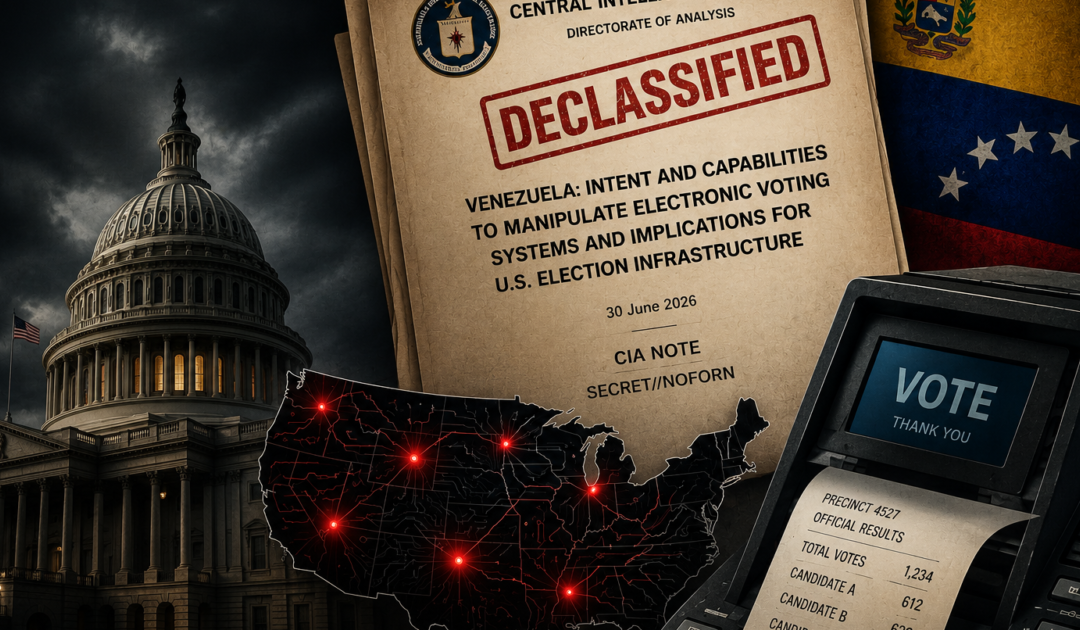
In a Central Intelligence Agency (CIA) Note released on June 29, 2026, the agency begins with a summary that alleges the Venezuelan government’s “sustained interest and likely some capability” to manipulate its own elections as well as a desire to “influence US politics.”

The document focuses on Intelligence Community (IC) reporting from 2004-2020 and “documented persistent concerns” about the “Venezuelan government manipulation of electronic voting systems and the potential national security implications for US election infrastructure.”

This ultimately led the US government to force Smartmatic, a company that was based in Florida and owned by three Venezuelan expats, to divest its US operations in 2007, in part because “electronic voting systems contained vulnerabilities that could theoretically be exploited by sophisticated actors with insider access.”

An April 2004 IC report indicated that then-President Hugo Chávez “stated his objective was to prevent the reelection of a sitting US president.”  This assessment formed part of the 2006 IC’s assessment that Smartmatic’s acquisition of Sequoia Voting posed a “moderate threat” to US national security, according to the CIA report.

Before the 2012 presidential election in Venezuela, the report says that Chávez’s intelligence agencies “worked with the National Electoral Council and Smartmatic to develop plans to manipulate election results using preprogrammed voting machines.”

The reported plan called for deploying altered machines to approximately 300 voting centers in traditionally pro-Chávez areas, with the objective of ensuring victory by approximately 1.5 million votes.

The report states:

In September 2020, <redacted> reported that Venezuela <redacted> had developed detailed technical plans to manipulate the December 2020 National Assembly elections using what were <redacted>.  According to this reporting, the technique involved creating a second set of virtual machines that would replicate legitimate voting machine results, then substitute manipulated data while making votes appear to originate from legitimate machines.

Whether any technically comparable circumstances existed in the 2020 U.S. election is a separate question that will be examined in Part 2.

In 2006, CIA analysts assessed that certain capabilities in regard to electronic voting manipulation “were technically possible and operationally feasible.”  Specifically, the report claims that “unspecified artificial intelligence components” could “alter vote tallies…detect when they were being audited, and could provide receipts without registering, recording or transmitting those votes.”

In a 2013 Devil’s Advocacy assessment — an alternative-analysis exercise designed to challenge the prevailing judgment, the CIA “outlined a plausible scenario for how large-scale electronic manipulation could have occurred in Venezuela’s 2012 election.”

The CIA’s baseline assessment, however, “maintained that no large-scale electronic fraud occurred.”  The basis for this assertion?  It was “based on pre-election polling data, absence of irregular voting patterns, and the opposition’s concession.”


A September 2020 intelligence report highlighted “the most detailed description of a specific technical approach to election manipulation.”  It claims the technique would entail:

  • Replicating digital hash files sent to the central vote counting database
  • Mimicking real voting machines that favored the ruling party
  • Overwriting hash files of voting machines that favored the opposition
  • Making altered votes appear to originate from legitimate voting machines

This is a significant acknowledgment that intelligence reporting contemplated methods capable of making altered electronic results appear legitimate while evading ordinary audit procedures and will be explored in Part 2 of this series.

The assessment concluded that the acquisition of Sequoia Voting by Smartmatic was “a potential instrument for Venezuelan officials seeking to undermine confidence in, or manipulate the electoral process in, the United States.

As a result, the Committee on Foreign Investment in the United States (CFIUS) forced the divestiture of Smartmatic’s ownership of Sequoia Voting in 2007.

Surprisingly, the report notes:

In March 2018, Smartmatic ceased operations in Venezuela after publicly accusing the Maduro regime of inflating voter turnout by over one million votes in the August 2017 National Constituent Assembly election – figures that diverged from data recorded by Smartmatic’s voting machines.  This represented a break between Smartmatic and the Venezuelan government after years of the company providing electoral technology to Venezuela.

The reversal raises an obvious question: how should one reconcile Smartmatic’s earlier reported relationship with Venezuelan authorities with its later public accusation that the Maduro government falsified turnout?

In 2014, SGO Corp., a London-based holding company, was named as the “parent company” for Smartmatic with Lord Mark Malloch-Brown as the Chairman.  Malloch-Brown would become the President of the Open Society Foundation in December 2020, following the 2020 election in the US.

The CIA Note acknowledges that a 2006 Intelligence Community assessment that concluded that neither Venezuela nor Smartmatic possessed the level of control or access required to manipulate an election outside Venezuela in a predictable fashion.

In order to do so, they would need the ability to control “every stage of the electronic voting process” including pre- and post-voting machine security, programming, storage of paper voting receipts, and control of the audit process.

Further, the report states that the CIA’s baseline assessment for the 2012 Venezuelan election claimed “large-scale election fraud did not occur.”  And in the December 2020 National Assembly election, “the regime did not need to resort to gross fraud to win the December 2020…elections, given that virtually the entire opposition boycotted” the election.

The Declassified Election Files, Part 2: When Theory Meets the Evidence

The question is no longer whether these vulnerabilities were considered possible. The question is whether the evidence from the 2020 election demonstrates that the same vulnerabilities were exploited—and whether the American people were ever given satisfactory answers.

Part 2 will examine the 2020 U.S. election record and compare specific, documented incidents to the vulnerabilities described in the CIA report—including unauthorized access, weaknesses in chain of custody, failures in auditability, and instances in which election systems or data were exposed to actors operating outside normal controls.


You can read the report in its entirety here:

Skip to PDF content

The post Part 1: The Declassified Election Files: Shocking CIA Note on Election Machine Vulnerabilities in Venezuela appeared first on The Gateway Pundit.

Go to Source
Author: Brian Lupo

Federal Judge Refuses to Toss Lawsuit of Texas Journalist Arrested Over Satirical Political Meme Posted on Facebook — Refuses to Grant Officials Qualified Immunity

Federal Judge Refuses to Toss Lawsuit of Texas Journalist Arrested Over Satirical Political Meme Posted on Facebook — Refuses to Grant Officials Qualified Immunity

Federal Judge Refuses to Toss Lawsuit of Texas Journalist Arrested Over Satirical Political Meme Posted on Facebook — Refuses to Grant Officials Qualified Immunity
July 22, 2026

Kolton Krottinger (L); Hood County Sheriff Rodger Deeds (R)

A federal judge has just handed Navy veteran and conservative commentator Kolton Krottinger a massive win in his lawsuit against Hood County officials.

Krottinger, a Navy veteran and local journalist, was arrested in November 2025 after authorities accused him of “online impersonation” over a satirical political meme posted to the “Hood County Sheepdogs” Facebook page.

The page openly described itself as satire, and Krottinger maintained that the meme was protected political speech.

His alleged “crime”? A photoshopped meme posted to another page that made it look like Tina Brown was endorsing Monica Brown for school board. In reality, Tina supported the rival.

According to investigative reporter Sarah Fields:

Kolton posted the meme from his satire page to a group meant to call out local corruption. Another individual had taken a screenshot of Tina Brown’s Facebook page and photoshopped it to make it appear as if she was supporting candidate Monica Brown. This was an obviously satirical meme to the local audience, who knew that Tina “Karen” Brown has no love for the former Granbury ISD school board candidate, Monica Brown.

According to the complaint, Tina “Karen” Brown went directly to the sheriff and stated that “the public is being misled by the post as to what *her* actual beliefs are”—a disingenuous statement considering the Granbury locals’ understanding of politics and a clearly marked satire page.

Investigator James Luckie swore out a complaint charging Krottinger with “Online Impersonation” under Texas Penal Code § 33.07(a), claiming intent to defraud the public.

Sheriff Rodger Deeds’ office moved quickly, arresting him, seizing his phone without a warrant, and holding onto it even after the charges collapsed, Texas Scorecard reported.

The criminal case quickly unraveled after a Texas judge found the state failed to establish probable cause, and prosecutors later declined to pursue charges because there was insufficient evidence tying Krottinger to the post.

Krottinger then sued for false arrest, malicious prosecution, First Amendment retaliation, unconstitutional phone seizure, and viewpoint discrimination in a public forum.

Now, Judge O’Connor has ruled that Krottinger’s constitutional claims deserve to proceed, according to

In a detailed 19-page order issued July 19, 2026, the court DENIED the defendants’ Motion to Dismiss across the board. Even more critically, Judge O’Connor refused to grant qualified immunity to Luckie and Sheriff Deeds at this stage, finding that Krottinger plausibly alleged clear violations of clearly established constitutional rights.

Key highlights from the order:

  • No probable cause existed for the arrest. The satirical post lacked any “intent to defraud” required by the statute. Deception alone isn’t fraud, and the small-town audience plus the page’s satire disclaimer made it obvious this wasn’t serious. Citing cases like Bailey v. Iles and Texas precedent, the court said no reasonable officer could believe this was criminal.
  • The post was protected political satire under the First Amendment. Arresting someone for it is unconstitutional.
  • Retaliation claims against both Luckie and Deeds survive — selective targeting of a vocal critic of the Sheriff, omissions in the warrant affidavit, and Deeds’ own public statements and comment restrictions scream motive.
  • Unlawful phone seizure without a warrant — and continued retention even after charges were dropped — violates the Fourth Amendment. Riley v. California makes that crystal clear.
  • The Sheriff’s Office Facebook page functioned as a public forum, and selectively restricting Krottinger’s comments while allowing others is viewpoint discrimination.
  • Monell liability for Hood County: Sheriff Deeds is a final policymaker, and his actions (plus ratification via public posts) stick to the county.

The court also denied as moot the defendants’ Motion for a Protective Order.

The post Federal Judge Refuses to Toss Lawsuit of Texas Journalist Arrested Over Satirical Political Meme Posted on Facebook — Refuses to Grant Officials Qualified Immunity appeared first on The Gateway Pundit.

Go to Source
Author: Jim Hᴏft

Commie Jew-Hating New York Mayor Mamdani Releases Statement Israeli Leader: “Benjamin Netanyahu Is Not Welcome in NY City – Nor Is Any Other War Criminal” (VIDEO)

Commie Jew-Hating New York Mayor Mamdani Releases Statement Israeli Leader: “Benjamin Netanyahu Is Not Welcome in NY City – Nor Is Any Other War Criminal” (VIDEO)

Commie Jew-Hating New York Mayor Mamdani Releases Statement Israeli Leader: “Benjamin Netanyahu Is Not Welcome in NY City – Nor Is Any Other War Criminal” (VIDEO)
July 22, 2026

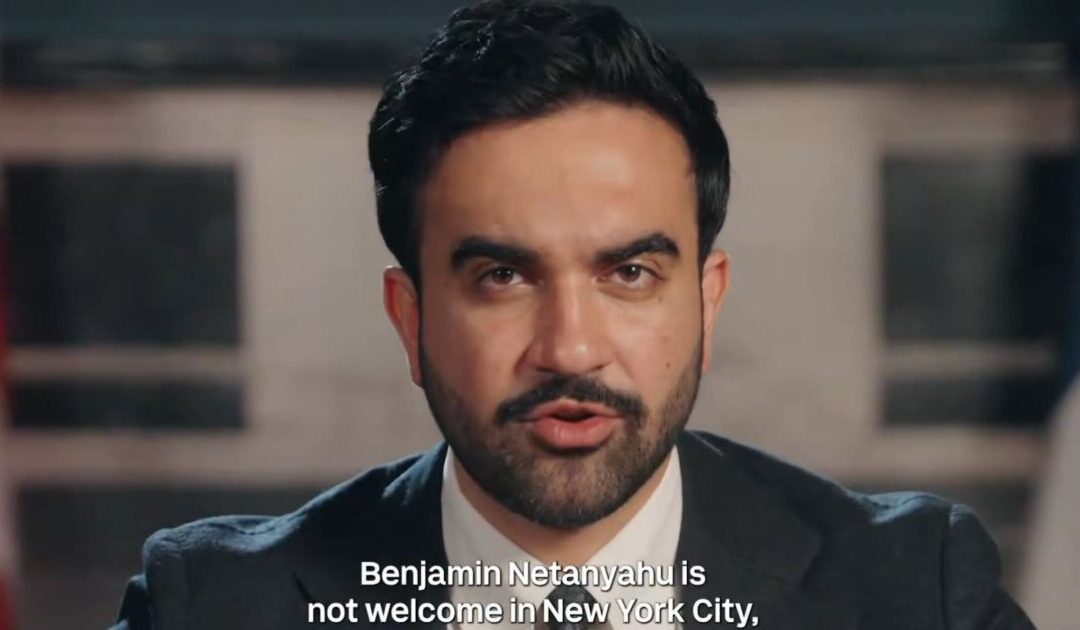
NY Mayor Mamdani tells Israeli leader he is not welcome in New York City. – screen grab Mayor’s office

Jew-hating New York City Mayor released an unhinged video on Tuesday calling on the Trump Administration to arrest Israeli leader Benjamin Netanyahu when he lands in New York City to speak in front of the United Nations General Assembly.

Mamdani called Netanyahu a “war criminal at large” who committed “genocide” against the Gaza Palestinians.

The communist mayor admitted he did not have the legal authority to arrest Netanyahu.

What a complete communist radical.

He’s more interested in jailing the Israeli leader than he is in making life better in New York City.

For the record, there are 960,000, or nearly a million, Jews in New York City today.

New York City has the largest Jewish population of any city outside Israel, making up roughly 11–12% of the city’s total residents.

We warned you that Mamdani was a danger.

Mayor Mamdani:  My administration has reviewed every avenue available under applicable law to determine whether New York City could execute the International Criminal Court’s arrest warrant if Benjamin Netanyahu came here.

It is clear that we do not have the independent legal authority to enforce this warrant.

The federal government, however, does, and I call on them to join the ICC and execute this warrant.

And I want to be equally clear: Benjamin Netanyahu is not welcome in New York City. Nor is any other war criminal at large.

While we cannot end the genocide on our own, we can decide whether our silence will become another weapon, and we can examine every tool we have to defend the humanity and dignity of all people. That is my commitment to you.

Via Open Source Intel:

This video was posted less than a week after Mamdani’s administration was caught arranging a diplomatic meeting with the Iranian terror regime.

The post Commie Jew-Hating New York Mayor Mamdani Releases Statement Israeli Leader: “Benjamin Netanyahu Is Not Welcome in NY City – Nor Is Any Other War Criminal” (VIDEO) appeared first on The Gateway Pundit.
Go to Source
Author: Jim Hoft

From Hardship To Hope: One Ohio J6er’s Journey As His Son Competes For Toddler Of The Year

From Hardship To Hope: One Ohio J6er’s Journey As His Son Competes For Toddler Of The Year

From Hardship To Hope: One Ohio J6er’s Journey As His Son Competes For Toddler Of The Year
July 22, 2026

photo courtesy of D. Valentine

It is always an honor, as a J6 supporter and advocate, to share a feel-good, positive story about a J6er. David Valentine has just that kind of story.

As you may imagine, the years immediately following January 6th, 2021, were marked by many challenges and losses.  However, those years were followed by rebuilding, hope, and the love of a father and son.

Like 1600 plus, people whose lives were affected by the events surrounding January 6, Valentine’s path over the last several years has been anything but ordinary. After spending nearly two years in Washington, D.C., supporting families and advocating for individuals charged in connection with January 6, he made the difficult decision in late 2023 to return to Ohio for one reason above all else: his infant son, Mathew.

Now back home and surrounded by family and supportive friends, his goal was simple: become the father his son deserved. That decision led to a lengthy custody battle, and in July 2024, David was awarded full custody of Mathew.

Only weeks later, on August 23, 2024, just four days before Mathew’s first birthday, David’s life was again turned upside down when federal agents came after David for his attendance on January 6th and executed a search warrant at his mother’s home. He was not there. According to Valentine, his mother was holding Mathew when agents arrived. Agents also searched his truck and camper at the campground where he had been living.

Among the items seized were the phones and computers David used to livestream and operate a small vinyl decal business that helped support his family. One of the items taken held deep personal value: a coat that had belonged to his late father, who had passed away unexpectedly only a few years earlier.

Like many families facing major life disruptions, the Valentines have spent the last two years rebuilding one step at a time.

Today, that rebuilding story has taken on a much brighter chapter.

Mathew Valentine, currently 2 years old, is competing in the National Toddler of the Year Competition. He will celebrate his third birthday on August 27, 2026.

photo courtesy of D. Valentine

The competition benefits the U.S. Marine Corps Reserve Toys for Tots Foundation, helping support its mission of providing toys and hope to children in need during the Christmas season.

As of July 13, 2026, Mathew is in first place in the Top 10 round of his group.

The current round of voting ends Thursday, and the Top 5 round begins Friday for contestants who advance. Each round becomes increasingly competitive as contestants move one step closer to the national finals.

VOTE FOR MATHEW HERE

If Mathew ultimately earns the title of Toddler of the Year, he will receive:

– A $25,000 cash prize
– A featured appearance in a national advertising campaign
– The opportunity to serve as Grand Marshal of the Hollywood Christmas Parade
– National recognition as the 2026 Toddler of the Year

For David, however, the competition represents far more than prizes or recognition.

After years marked by legal proceedings, uncertainty, and the work of rebuilding a stable home, watching his son grow into a happy, energetic little boy has become a reminder that difficult chapters do not have to define a family’s future.

The potential $25,000 prize would not simply be spent—it would become an investment in Mathew’s future. David plans to use the funds to help build a strong financial foundation for his son through long-term savings and investments, educational opportunities, and giving him a head start as he enters adulthood. Whether it ultimately helps pay for college or trade school, supports a future business venture, assists with the purchase of a first home, or simply provides financial security, the goal is to turn today’s opportunity into tomorrow’s blessing.

photo courtesy of D. Valentine

David has spent years trying to rebuild his family’s future after one of the most difficult chapters of his life. Winning this competition would not erase the past, but it would provide an opportunity to invest directly in Mathew’s future while also helping shine a light on the charitable work of Toys for Tots.

VOTE FOR MATHEW HERE

“For me, this has never been about the money,” David said. “It’s about giving my son every opportunity I can. If this competition helps build a better future for Mathew while also supporting the incredible work of Toys for Tots, then everyone wins.”

Friends, family, and supporters have rallied around Mathew throughout the competition, celebrating each round he advances. Regardless of the outcome, his journey has already become a story of perseverance, faith, family, and hope.

Those who would like to follow Mathew’s journey or cast a free daily vote can do so below.

Vote for Mathew:
https://toddleroftheyear.org/2026/mathew-8523

Watch Mathew’s Story:

or CLICK HERE TO GO TO YouTube VIDEO

For David, every milestone his son reaches is another reminder that, after years of adversity, life can still move forward and that the greatest legacy a parent can leave is not found in the past, but in the opportunities, they create for their child’s future.

The post From Hardship To Hope: One Ohio J6er’s Journey As His Son Competes For Toddler Of The Year appeared first on The Gateway Pundit.

Go to Source
Author: Jenn Baker