
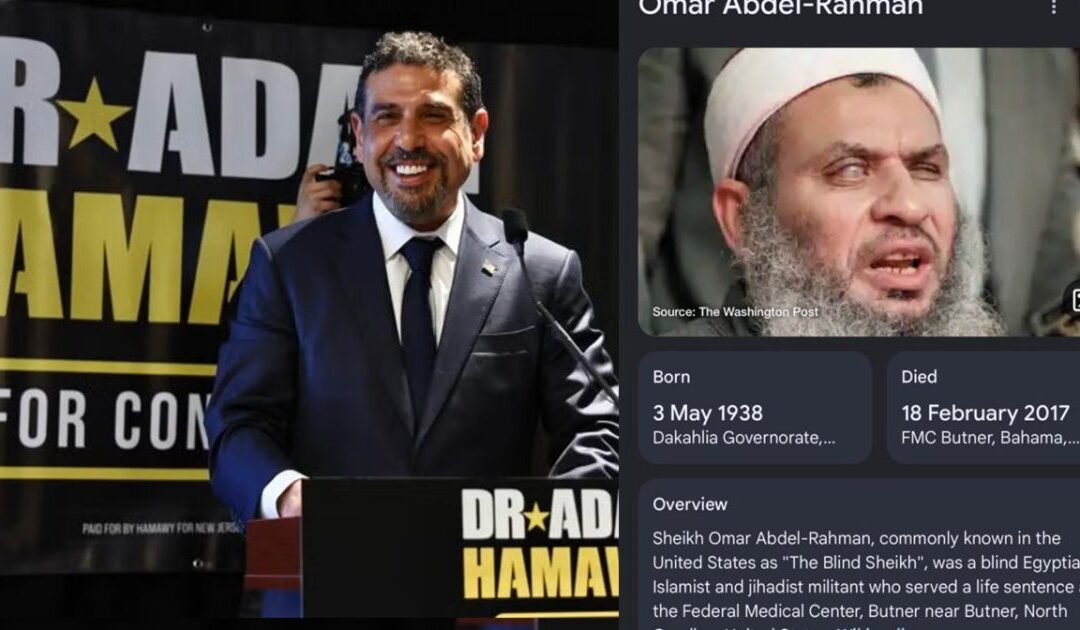
Democrat Congressional Nominee Adam Hamawy Has al-Qaeda and 9/11 Ties
June 3, 2026

New Jersey Democrats have nominated a man who traveled with Omar Abdel-Rahman, the mastermind of the 1993 World Trade Center bombing, testified in his defense at the largest terrorism trial in American history, and volunteered with an organization the U.S. Treasury Department and the 9/11 Commission identified as part of Osama bin Laden’s covert financial network.
The candidate is Dr. Adam Hamawy, a plastic and combat surgeon from Princeton, New Jersey, who won a crowded Democratic primary in the heavily Democratic 12th Congressional District, where Rep. Bonnie Watson Coleman is retiring. He will face Republican Gregg Mele in the November 3, 2026, general election in a district Democrats have held comfortably for years. If elected, Hamawy would be New Jersey’s first Muslim member of Congress.
Hamawy has been endorsed by Senators Tammy Duckworth and Bernie Sanders and Representatives Ro Khanna, Ilhan Omar, Alexandria Ocasio-Cortez, and Rashida Tlaib, as well as leftist organizations including Justice Democrats and Our Revolution.
Omar Abdel-Rahman, known as the “Blind Sheikh,” obtained a doctorate in theology from Al-Azhar University in Cairo and co-founded al-Jama’a al-Islamiyya in the 1970s to advocate militant action against the Sadat regime.
Al-Jama’a al-Islamiyya militants participated in the 1981 assassination of Egyptian President Anwar Sadat, whose killing Abdel-Rahman had legitimized by issuing a fatwa.
He was arrested but acquitted of direct involvement. Despite being on U.S. terrorist watch lists, Abdel-Rahman entered the United States in 1990 through a combination of bureaucratic incompetence, name-transliteration errors, and Cold War-era intelligence priorities that had not yet fully pivoted to Islamist threats.
He settled in the New York area, preaching at mosques in Brooklyn and Jersey City. He issued a fatwa declaring it lawful to rob banks and kill Jews, and his sermons condemned Americans as “descendants of apes and pigs.” An FBI informant recorded him stating that acts of violence against civilian targets in the U.S. were not illicit.
The network that supported the 1993 World Trade Center bombing, the men who mixed the chemicals, rented the van, and scouted the target, were Abdel-Rahman’s devoted followers who attended his sermons and viewed him as their spiritual guide.
He was never charged with the bombing itself but was its ideological engine. In 1995, he and nine followers were convicted of conspiring to wage “a war of urban terrorism against the United States,” including plots against the George Washington Bridge, the Lincoln and Holland Tunnels, and the United Nations.
Abdel-Rahman subsequently forged an alliance with Osama bin Laden and Ayman al-Zawahiri. The fatwa he smuggled out of prison, calling on Muslims to destroy American, Jewish, and Christian economies, burn corporations, sink ships, and shoot down planes, was later credited by bin Laden as theological justification for the September 11 attacks.
At sentencing, Abdel-Rahman declared: “This is an infidel country. It has an infidel White House. It has an infidel Congress. It has an infidel Pentagon. And this is an infidel courthouse.” He died on February 18, 2017, at FMC Butner, North Carolina, serving life imprisonment plus 15 years.
Hamawy met Abdel-Rahman in 1991 and, according to a 1995 court transcript, visited him at his home and accompanied him on a 13-hour van trip to a conference in Detroit, sharing a hotel room with the sheikh at the destination.
The presiding judge later stated that Hamawy “was more than a casual traveling companion of Abdel-Rahman,” noting he had met the sheikh after Abdel-Rahman had already been charged with providing spiritual authority for the Sadat assassination, attended several of his sermons, visited him at home before trial, and provided translation services.
Hamawy served as Abdel-Rahman’s translator at a 1993 press conference in which the cleric denied involvement in the World Trade Center bombing.
The November 29, 1991, conference in Detroit, the First Annual Conference of the Islamic Charity Project International, held at the Westin Hotel, was titled “Towards a Global Islamic Economy.”
The speakers were not economists. The featured speakers were leaders of jihadist organizations: Abdel-Rahman, head of Egypt’s Gamaa Islamiya; Ahmed Nofal, a leader of Hamas; and Hassan al-Turabi, leader of Sudan’s National Islamic Front.
Abdel-Rahman’s address, entered into evidence at trial as Government Exhibit GX-388, was titled “The Best Way on Supporting Jihad.” Its opening sentence declared jihad “the pinnacle of Islam.” Eleven minutes in, Abdel-Rahman described Egyptian President Hosni Mubarak as “the loyal dog of America.” The U.S. government successfully argued this was a solicitation to murder.
Four years later, Hamawy took the stand for the defense at that terrorism trial. He greeted Abdel-Rahman in the courtroom with “Asalam Alaykum,” receiving a reciprocal greeting.
On direct examination by defense attorney Lynne Stewart, Hamawy described the Detroit conference as “an economy conference.” Prosecutor Patrick Fitzgerald then began cross-examination. When asked whether he recalled Abdel-Rahman discussing Mubarak that weekend, Hamawy answered: “No. Not really.”
Fitzgerald then asked whether he recalled the sheikh calling Mubarak “the loyal dog of America in the Middle East.”
Hamawy answered: “He referred to him that way several times, yes,” but said he did not recall it happening that weekend. Fitzgerald handed him Government Exhibit 388T, the official conference transcript. Hamawy confirmed the passage. Forty seconds earlier he had answered “no, not really.”
According to Steven Emerson of the Investigative Project on Terrorism, the only thing that had changed was the document in front of him.
Fitzgerald pressed further. When asked whether Abdel-Rahman spoke about jihad rather than economics, Hamawy replied: “it wasn’t jihad in specific.” The speech opens on waging jihad as an obligation, returns to it mid-speech as the only cure, and closes with a Quranic verse threatening divine punishment on Muslims who decline jihad. When shown the passage about conquering “the land of the infidels.”
When asked whether the transcript refreshed his recollection, Hamawy responded: “Yes, but you’re kind of taking it out of context.” Fitzgerald then asked the most direct question: “Was this a trade war, or was it jihad?”
Hamawy answered: “It was a struggle in the sake of God, yes. It was a jihad.” The witness called to portray the conference as an economics event had told the jury, in his own words, that its main address was a jihad speech.
Fitzgerald turned to the second speaker. When asked whether he had ever heard Ahmad Nofal affiliated with Hamas, Hamawy answered “No” and then “Never.”
Nofal was known internationally as a Hamas leader. His Detroit speech, which Hamawy admitted personally observing, defended Hamas in its clash with the PLO and called Jews “Shylocks” and “the sons of Satan.”
Emerson notes that Hamawy’s memory failures followed a consistent pattern: he recalled granular detail about the van trip to Detroit, who was driving, what vehicle, whose homes they stopped at, what each passenger wore, where each one sat, but could not recall the substantive content of a forty-minute religious speech at the destination, with every failure running in the defendant’s favor.
When Fitzgerald asked whether Abdel-Rahman gave speeches on tolerance toward Jews and Christians, Hamawy acknowledged: “usually when he spoke in public he spoke about jihad, that’s what he spoke about.” Abdel-Rahman was convicted on every count, including seditious conspiracy and soliciting the murder of Mubarak, the count Hamawy had been called to rebut.
One year before taking the witness stand, Hamawy traveled to Bosnia in the summer of 1994 and volunteered with the Benevolence International Foundation (BIF), a Chicago-based nonprofit. Jewish Insider recovered this from a 1996 Newark Star-Ledger interview through a print archive, unreported for thirty years.
BIF was formed in 1992 when a Philippine-based group founded by bin Laden’s brother-in-law Mohammed Jamal Khalifa merged with a Saudi charity.
While BIF publicly described its mission as humanitarian relief, its Arabic-language fundraising appeals characterized it as a “trustworthy hand for the support of both the mujahideen and refugees” fighting in Bosnia.
In May 1993, Saudi Arabia, wary of BIF’s Al-Qaeda ties, shut down the foundation’s operations in the kingdom and detained its leader, Adel Batterjee, in what was reportedly the only pre-9/11 instance of the Saudis closing an Islamic charity.
According to FBI agent Robert Walker’s court testimony, BIF operated in tandem with Al-Qaeda across multiple nations, providing “logistical support,” and bin Laden used it in the early 1990s to transfer money to bank accounts held by purported relief organizations in countries where Al-Qaeda members were conducting operations.
The 9/11 Commission identified BIF’s Sarajevo base as part of an “impressive array of offices” that covertly provided financial and other support for terrorist activities established by bin Laden.
When Bosnian and American authorities raided BIF’s offices in 2002, they found weapons, correspondence between chief executive Enaam Arnaout and bin Laden, an organizational chart of Al-Qaeda, and the “Golden Chain,” a handwritten list composed by bin Laden in 1988 naming Al-Qaeda’s 20 main financiers. The U.S. Treasury Department and the United Nations Security Council continue to list BIF among entities sanctioned for terrorist connections.
Zenica, where Hamawy reported working, was where the Bosnian Army had recently established its “El Mujahedin” unit for foreign fighters.
The European Court of Human Rights found that BIF was among the organizations providing funds and assistance to that unit. Federal prosecutors accused BIF of funneling funds and weapons to Bosnian fighters and foreign mujahideen groups active near Zenica.
In May 1995, the Military Security Service of the Bosnian Muslim Army warned its own superiors that known Arab-Afghan mujahideen in the Balkans were connected with BIF activists, and that BIF had abused its humanitarian role by making conversion to Islam a precondition for receiving aid.
The federal indictment against Arnaout alleged that Al-Qaeda’s goal in Bosnia was to establish a base for operations in Europe against the United States.
Hamawy told the Star-Ledger he found BIF through the “Bosnian mission to the United States.” Records indicate the counselor at that mission was New Jersey native Saffet Catovic, who later became public spokesman for BIF when federal agents first raided its offices in December 2001.
FBI affidavits linked BIF’s Bosnian director to Afghan militant commander Gulbuddin Hekmatyar, who was in turn linked to Abdel-Rahman, another ally of bin Laden who allegedly encouraged his followers to wage jihad in Bosnia. Last fall, Catovic hosted Hamawy on a YouTube panel about Gaza, and members of Catovic’s family have donated to Hamawy’s congressional campaign, per FEC records.
Hamawy has not been accused of terrorism-related wrongdoing in connection with the Bosnia trip. At the time of his work with BIF, the organization had not yet been publicly identified as having ties to Al-Qaeda, U.S. terror designations came years later, after September 11.
Beyond the Blind Sheikh record, Hamawy’s endorsement and funding network is concerning. CAIR Action endorsed him alongside the New Jersey Muslim Civic Coalition Action and Americans for Justice in Palestine Action. The FBI has suspended all formal contacts with CAIR due to evidence of a relationship between CAIR and Hamas, a U.S.-designated foreign terrorist organization.
CAIR was named an unindicted co-conspirator in the 2007 Holy Land Foundation terrorism financing trial. CAIR’s executive director Nihad Awad, who endorsed Hamawy, said he was “happy to see” the October 7 Hamas massacre; the Biden White House condemned his statements.
American Priorities PAC, a newly formed super PAC positioned as a counter to AIPAC, committed to spending up to $2 million on Hamawy’s behalf and had already spent more than $1.5 million in television and digital advertising by primary day.
The PAC raised $3.8 million from just 12 donors in its first three months, with every contributor giving at least $50,000. Its largest donations came from Omer Hasan and Mohammed Waqas, two tech workers who both made six-figure donations to a super PAC backing Zohran Mamdani during the 2025 New York City mayoral election.
Other funders include Silicon Valley angel investor Tariq Afaq Ahmed and Amir Nathoo, a Tech for Palestine board member who was once banned from LinkedIn after comparing Israel to Nazi Germany.
American Priorities has pledged to spend $10 million throughout the 2026 midterms installing pro-Palestinian candidates in Congress.
Despite this record, Hamawy won Tuesday’s primary with 27.4 percent of the vote in a field of 13 candidates. He will face Republican Gregg Mele in November in a district that Democrats have held comfortably for years, making his nomination consequential well beyond New Jersey.
The post Democrat Congressional Nominee Adam Hamawy Has al-Qaeda and 9/11 Ties appeared first on The Gateway Pundit.
Go to Source
Author: Antonio Graceffo