
Faith and Freedom Conference: Why Communism Hates Christianity
June 27, 2026

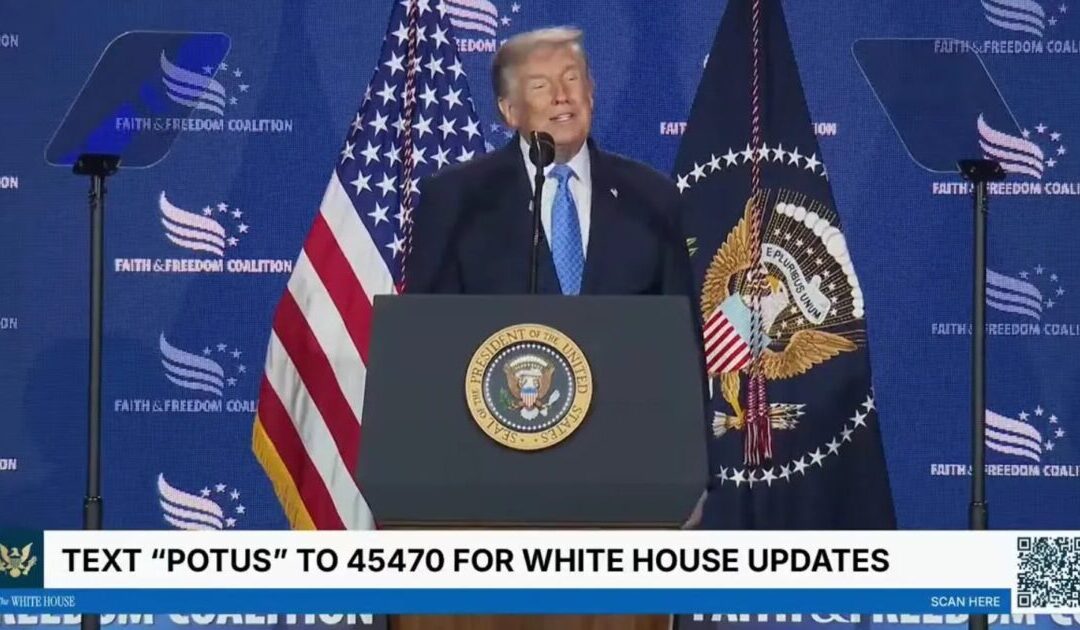
Speaking at the Faith and Freedom Coalition’s 2026 Policy Conference in Washington, D.C., on Friday, President Trump called communism the “most serious threat to our Country since its existence 250 years ago,” warning that “ruthless Communists will attack all Religions but, in particular, Christianity. They always do. All Communist Countries attack Religions violently.”
From Moscow to Beijing to Phnom Penh, every communist government that has come to power has moved against religion as a matter of doctrine.
Opening his remarks, Trump declared that both America and religion are “back like never before,” citing the creation of the White House Faith Office. He traced America’s faith tradition from the Jamestown settlers, who “got off their ship, raised up a cross, and bowed down to the Lord in prayer,” through the Minutemen at Lexington and Concord.
Trump described the prior administration as having carried out “a reign of persecution and repression against Christians,” citing the FBI targeting of Catholics, the jailing of pro-life activists for praying, and the discharge of military members over religious beliefs.
He pointed to the recent U.S. strike on Nigeria as evidence of his administration protecting Christians abroad, saying “I am saving Christians throughout the World, even though we are not in those various Countries, by hitting these Terrorists violently and hard.”
On communism, he characterized the Zohran Mamdani-backed winners in this week’s New York City elections not as socialists but as “hardcore, godless communists” and warned that communism, while easy to sell with promises of free rent, food, and housing, ends in squalor, collapse, and death, “Third World in every way.”
Trump is correct that Communism hates Jesus. To understand why communism targets Christianity specifically, the conflict must be understood as structural. Communism requires the state to be the supreme authority in all aspects of life, economic, social, moral, and ideological. Christianity directly contradicts that by placing God above the state.
The first point of conflict is party supremacy. In both Russia and China, a constitution exists on paper, but the Party is paramount over the constitution itself. By that same logic, the Party cannot accept citizens who place Jesus, or any God, above the Party.
Loyalty compounds the problem. Christianity demands a higher allegiance than any earthly government. “Render unto Caesar” explicitly limits Caesar’s authority, and communist states cannot tolerate that limit. Moral authority follows from the same root. The Church provides an independent framework for right and wrong that the Party did not create and cannot control. If people derive their understanding of truth from Scripture rather than the state, the Party loses its monopoly on defining reality.
Churches also organize people outside state structures. Any independent organization, even a prayer group, is a potential node of resistance, which is why communist states move to absorb or destroy all independent institutions. Karl Marx called religion the opium of the people precisely because it gives the poor meaning and consolation independent of material conditions, making them harder to mobilize through class struggle alone.
Faith, by definition, is hope, and hope prevents people from being defeated. Communism seeks to destroy the individual and replace him with the collective, but Christians who believe they are made in God’s image and possess an immortal soul know the individual cannot be dissolved into the collective. They draw their strength from God, not the Party, which makes them permanently resistant to the total psychological domination communism requires.
Finally, in Russia, China, Vietnam, and elsewhere, the Church predated the communist state by centuries and carried deep cultural authority. That authority had to be broken before the Party could fill the vacuum.
The Russian Communist Party formalized its anti-religious policy at its Eighth Congress in 1920. What followed in the Soviet Union was systematic persecution. During the first five years of Soviet rule, the Bolsheviks executed 28 Russian Orthodox bishops and more than 1,200 priests. By the end of 1923, some 2,700 priests, 3,400 nuns, and 2,000 monks had been killed.
The campaign escalated under Stalin. Between 1927 and 1940, the number of Orthodox churches in the Russian Republic fell from 29,584 to fewer than 500, a 98 percent decline caused by systematic demolition. By 1941, only one-twelfth of the church’s priests remained active in their parishes. Across the Eastern Bloc after World War II, Christian churches, Jewish synagogues, and Islamic mosques were forcibly converted into museums of atheism.
In the People’s Republic of China, Red Guards destroyed religious objects, texts, temples, and other places of worship during the Cultural Revolution as part of the campaign against the “Four Olds.” The persecution adapted rather than ended after Mao. Since Xi Jinping took power in 2012, authorities have intensified restrictions, leading to an overall increase in religious persecution.
Thousands of churches have been demolished, while crosses have been removed from many of those permitted to remain. Thousands of Christians and clergy have been imprisoned. At least half a million predominantly Muslim Uyghurs, Kazakhs, Kyrgyz, and other Turkic minorities remain imprisoned or held in internment facilities in Xinjiang. Authorities have also cracked down on Tibetan Buddhist monasteries, disappeared and imprisoned monks who honored the Dalai Lama, and intensified the targeting of independent Protestant leaders and house church congregations.
In 1999, the CCP banned Falun Gong, which by that point had at least 70 million practitioners, more than the Communist Party’s own membership of 63 million. In September 2019, the UN Human Rights Council was told that the Chinese government “is harvesting and selling organs from persecuted religious and ethnic minorities on an industrial scale.”
In Cambodia, the Khmer Rouge seized power in 1975 and modeled its revolution on Mao’s China. Religion was banned outright along with music and radio. Christian, Buddhist, and Muslim citizens were all specifically targeted. The Cham Muslim population suffered the most: as many as 500,000 people, or 70 percent of the total Cham population, were exterminated. Between 1975 and 1979, the Khmer Rouge killed between 1.5 and 3 million people, nearly a quarter of Cambodia’s population.
In Vietnam, after the communist victory in 1975, schools, hospitals, and institutions run by religious organizations were seized, land was confiscated, religious leaders were sent to reeducation camps, and proselytizing was severely restricted. In November 1975, 12 Buddhist monks and nuns immolated themselves in Cần Thơ in protest.
The Unified Buddhist Church of Vietnam refused to pledge allegiance to the communist regime and was banned. Christians formed 75 percent of the Vietnamese refugees who fled the country after 1975. The communist governments of Vietnam and Laos conducted state-sponsored campaigns to force ethnic Hmong Christians and Montagnards in the Central Highlands to renounce their faith.
In May, President Trump organized the Rededicate 250 event on the National Mall, rededicating the United States as one nation under God. In a video message to the crowd, Trump read from 2 Chronicles 7: “If my people, which are called by my name, shall humble themselves, and pray, and seek my face, and turn from their wicked ways, then will I hear from heaven, and will forgive their sin, and will heal their land.”
House Speaker Mike Johnson delivered the formal rededication prayer, declaring: “Just as we in the beginning dedicated this land to your most holy name, today, here, Lord, in this 250th year of American independence, we hereby rededicate the United States of America as one nation under God.”
Biden marked Transgender Day of Visibility at the White House on Easter Sunday. Kamala Harris scolded Americans, saying, “How dare we say ‘Merry Christmas’?” The Fauci-Biden COVID policies kept people out of church and restricted the celebration of Christmas and Easter. This week, one of the three socialists elected in New York belongs to an organization that calls for the destruction of Western civilization. By contrast, Trump is encouraging Christian values while warning against communism.
The post Faith and Freedom Conference: Why Communism Hates Christianity appeared first on The Gateway Pundit.
Go to Source
Author: Antonio Graceffo