
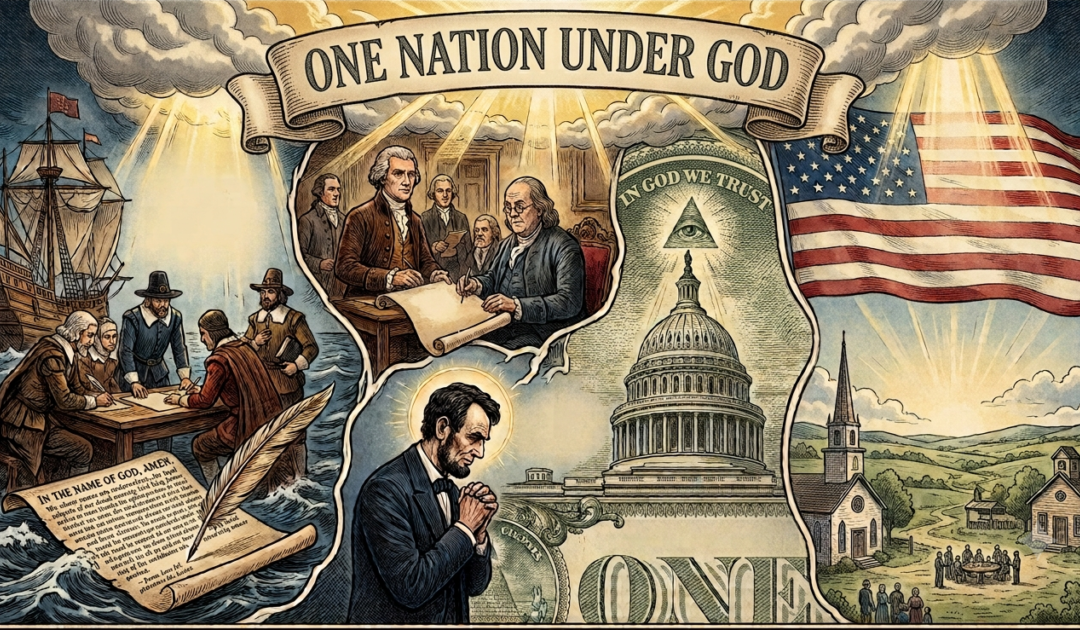
From the Mayflower Compact to Trump: America Has Always Been “Under God”
June 30, 2026

At the Faith & Freedom Coalition’s “Road to Majority” Policy Conference at the Washington Hilton on June 26, 2026, President Trump repeated the “one nation under God” framing that has been at the center of a conflict between Republicans and Democrats and attempts by the liberal left to claim that the U.S. was not founded as a Christian country.
In his remarks, Trump framed the political left in explicitly anti-communist and religious terms, telling the audience the Democratic Party “is becoming a communist party,” adding that “these are not social Dumocrats, these are hardcore, God-less communists.” He called this the most serious threat “to our country since its existence,” and argued that communists attack all religions, “but in particular, Christianity,” asserting they target Christianity “more than any other religion.”
Tying this to the nation’s identity, Trump declared the United States will always remain “one nation under God: We’re not changing. And we always have been and we always will be. We’re not going to let him take it away.”
He also referenced the approaching 250th anniversary of American independence, saying that the country’s enemies “would have loved nothing more than to mark America’s 250th anniversary by driving God from our public square once and for all,” and accused the prior administration of having carried out a reign “of persecution and repression against Christians and people of faith like America has never seen before.”
That same day, the Justice Department’s Religious Liberty Commission delivered its final report to the president, building on the broader religious-liberty push his administration has pursued.
Despite liberal claims to the contrary, American founding documents support the idea that the U.S. was founded on religious principles.
The term “one nation under God” was never adopted as the national motto. That distinction belongs to the separate phrase “In God We Trust,” officially declared by Congress in 1956, though the phrase had already appeared on U.S. coins since the Civil War era.
“One nation under God” instead entered American life through the Pledge of Allegiance, signed into law by President Eisenhower on Flag Day, June 14, 1954. The phrase itself, however, predates that insertion, appearing well before 1954 in American political language, most famously through Lincoln’s Gettysburg Address.
The Pledge into which it was inserted was written in 1892 by Francis Bellamy, a Baptist minister, and contained no reference to God; Congress officially recognized its wording in 1942. The campaign to add “under God” began with the Knights of Columbus, the world’s largest Catholic fraternal organization, which on April 30, 1951, adopted a resolution to add the words after “one nation” in the Pledge as recited at its own meetings. The practice spread through Knights of Columbus chapters nationwide, and on August 21, 1952, the Supreme Council formally urged the change be made universal.
Representative Louis C. Rabaut (D-MI), a devout Catholic, sponsored a resolution in 1953, one of seventeen introduced in the House for the same purpose. The decisive push came in February 1954, when President Eisenhower attended a sermon by Reverend George Docherty, who argued that omitting “under God” meant omitting the definitive factor in the American way of life.
Congress passed the joint resolution amending the Flag Code, and Eisenhower signed it into law, stating the change reaffirmed “the transcendence of religious faith” in America’s heritage and future. The addition came amid the Cold War, intended to distinguish the United States from the atheistic ideology promoted by the Soviet Union.
Seventy-two years later, at the Faith & Freedom Coalition’s Road to Majority Conference, Trump invoked the same battle line, warning that today’s Democratic Party is becoming a communist party that “doesn’t believe in God.” The current political moment, he argued, is a continuation of a similar fight against atheistic ideology that drove the 1954 amendment.
“In God We Trust” survived a 1970 Ninth Circuit challenge ruling that references to God in the motto were ceremonial and patriotic rather than religious. While the Pledge phrase was not the direct subject of those early lawsuits, the Supreme Court repeatedly defended it in passing. In cases like Abington v. Schempp (1963), Marsh v. Chambers (1983), and Wallace v. Jaffree (1985), various justices noted in their opinions that “under God” was a permissible form of patriotic, ceremonial expression rather than a violation of the Establishment Clause.
The phrase faced its first direct, major threat when the Ninth Circuit declared it unconstitutional on June 26, 2002. That ruling was stayed amid public backlash, declined for review in April 2003, and ultimately overturned by the Supreme Court on Flag Day, June 14, 2004, on standing grounds rather than the merits.
In 2002, President George W. Bush signed Public Law 107-293, which reaffirmed both the Pledge’s “under God” language and the 1956 “In God We Trust” motto in the same act, likely the source of confusion between the two phrases.
The invocation of God in American governing documents predates the American Revolution by more than a century. The Mayflower Compact, signed November 11, 1620, is generally regarded as the first governing document of European settlement in what became the United States. Its text reads: “Having undertaken for the Glory of God, and Advancement of the Christian Faith, and the Honour of our King and Country, a Voyage to plant the first Colony in the northern Parts of Virginia; Do by these Presents, solemnly and mutually, in the Presence of God and one another, covenant and combine ourselves together into a civil Body Politick.”
The document opens “In the name of God, Amen,” and is dated “Anno Domini” 1620. It is described as “America’s first great experiment,” a precedent for self-government that influenced later colonial charters, holding that the people derived their right to govern from God.
The Fundamental Orders of Connecticut, adopted 1638–39 and often called the first written constitution in the colonies, state in their preamble that “the word of God requires that to maintain the peace and union of such a people there should be an orderly and decent Government established according to God.”
Unlike the Mayflower Compact, the Fundamental Orders recognized no earthly authority other than the free consent of the people, omitting any mention of the king or Crown. Magistrates swore an oath “by the great and dreadful name of the everliving God, to promote the public good and peace… according to the righteous rule of God’s word; so help me God.”
The same pattern recurred elsewhere in New England: justice in Massachusetts Bay, as in Connecticut, was to be administered “according to the laws established by the new government, and for want thereof according to the rule of the word of God,” and similar language appeared in the Rhode Island settlements of Providence and Portsmouth in the 1630s.
The Christian foundations of the United States began even before independence was declared. The official status of Christian language and references to God in government documents has continued to be reaffirmed by all three branches of government, executive, judicial, and legislative, throughout the 20th and into the 21st century. More than 400 years of written records support the Trump administration’s assertion that the United States is, and always has been, a Christian nation. To claim otherwise is to reject centuries of documented evidence.
The post From the Mayflower Compact to Trump: America Has Always Been “Under God” appeared first on The Gateway Pundit.
Go to Source
Author: Antonio Graceffo