MUSKEGON UPDATE: How the Massive Michigan Democratic Voter Registration Fraud Operation Was Ignored, Buried, and Shut Down by Unscrupulous Biden FBI and DOJ Hacks
July 20, 2026

President Trump brought up the MUSKEGON, MICHIGAN 2020 coordinated election fraud scheme – buried by Biden admin – during his address to the country on Thursday.
This massive ballot registration scandal was first reported by The Gateway Pundit in August 2023 thanks to Michigan activists who tipped us off to this massive voter registration scandal.
The Gateway Pundit showed that a left-wing outfit named GBI Strategies was attempting to fraudulently register up to 10,000 voters in a city with only 30,000 people.
This report on systemic voter fraud in the 2020 election has never been refuted or debunked; it was simply ignored and suppressed by legacy media. The blithe answer from Michigan’s corrupt far-left Attorney General is that they ‘referred it to the FBI.‘
Yet all the information is there in the Muskegon Police report, as well as another police report from the Michigan State Police, and yet there have been zero prosecutions of those involved.
The Muskegon fraudulent ballot registration case was not in suspended animation, and it certainly didn’t close itself.
It was deliberately buried under layers of AUSAs, FBI supervisors, DOJ Public Integrity Section (PIN) officials, redactions, and bureaucratic fingerprints.
The case agent objected, cited DOJ’s own election-crimes manual, and kept dragging the file back out of the grave. Everyone above him seemed determined to bury it again, only this time with a bigger shovel.
Investigators Internally Objected to Closing the Muskegon Case. We know this from a document released last week by the Trump Administration.
On page 1, an FBI agent writes:
“I’m not really comfortable closing the case at this point without raising these issues.”
On pages 1–2, the agent cites DOJ’s Federal Prosecution of Election Offenses manual. He argues that submitting false voter-registration information may be a prosecutable election offense even without proof that fraudulent votes were cast or that the election’s outcome was affected.
On page 2, he concludes:
“I wanted to raise my concerns before closing the case.”
The same page contains a November 3, 2021 email from DOJ’s Public Integrity Section stating that PIN would memorialize its agreement with the USAO and FBI decisions “not to seek prosecution.”
The objection is also documented in:
“FBIMichigan Four Year Case Timeline RELEASE MARKED.pdf”
Page 1 records:
November 2, 2021: An AUSA advised that the Western District portion of the investigation could be closed.
November 11, 2021: The special agent emailed the AUSA “with concerns about closing investigation.”
January 4, 2022: Further discussions were held with PIN.
February 2, 2023: PIN finally authorized a full field investigation.
So the objection was not just philosophical. The investigation later expanded and continued for several more years.
The Case Ultimately Closed Without Charges
The definitive closure document is:
“265_0000001 – RELEASE MARKED.pdf”
It’s dated September 25, 2025, and states that:
the FBI Detroit, Grand Rapids Resident Agency closed the investigation;
logical investigative leads had been exhausted;
the investigation hadn’t identified a criminal violation;
no further investigation was warranted; and a redacted AUSA concurred with closing the investigation.
The timeline shows that closure wasn’t a single, clean decision. There were at least three separate closure or declination stages:
November 2021: An AUSA advised that the Western District portion could be closed. The case agent objected.
July 17, 2024: The United States Attorney announced that there would be no prosecution. By October 8, however, the same U.S. Attorney was reportedly reconsidering prosecution.
September 25, 2025: The FBI formally closed the investigation with AUSA concurrence.
That’s less of an investigative timeline and more of a federal version of:
Typical fed political BS, close it, reopen it, reconsider it, consult headquarters, request another memorandum, and hope everyone eventually forgets why the file existed in the first place.
We also know that 65% of GBI Strategies registrations that were turned into the Muskegon clerk were fraudulent registrations.
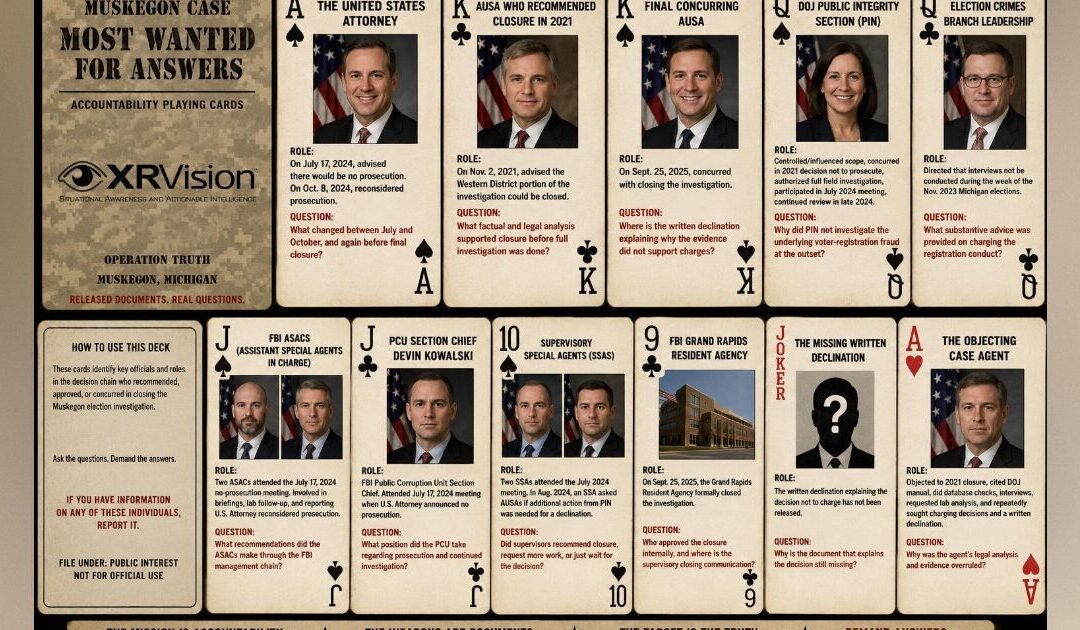
Here is Our Muskegon “Most Wanted” Playing-Card Deck

Ace of Spades: The United States Attorney
Documented role: At the July 17, 2024 senior-level meeting, the redacted United States Attorney advised that there wouldn’t be a prosecution.
Plot twist: On October 8, 2024, an ASAC reported that the U.S. Attorney was reconsidering prosecution.
My question: What changed between July and October, and what changed again before the case was finally closed?
King of Clubs: The AUSA Who Recommended Closure in 2021
Documented role: On November 2, 2021, an AUSA advised that the Western District portion of the investigation could be closed.
Question: What factual and legal analysis supported closure before the later database reviews, canvasser interviews, handwriting examination, and full field investigation?
King of Spades: The Final Concurring AUSA
Documented role: The September 25, 2025 closure memorandum states that a redacted AUSA concurred with closing the investigation.
Important caution: The record doesn’t establish that this was the same AUSA involved in the 2021 recommendation.
Question: Where’s the final written declination explaining why the admissions and interview evidence didn’t support charges?
Queen of Spades: DOJ Public Integrity Section (PIN)
Documented role: PIN controlled or influenced the scope of the election-crimes investigation, concurred with the 2021 decision not to prosecute, later authorized a full field investigation, participated in the July 2024 meeting, and continued reviewing the matter in late 2024.
Question: Why did PIN initially authorize an investigation into prepaid cards but not the underlying voter-registration fraud, and what legal standard ultimately governed the declination?
Queen of Clubs: Election Crimes Branch Leadership
Documented role: The timeline identifies consultation with the Director of the Election Crimes Branch and Deputy Chief of the Public Integrity Section. That official directed that interviews not be conducted during the week of the November 2023 Michigan elections.
Question: Apart from the election-timing restriction, what substantive advice did the Election Crimes Branch provide about charging the registration conduct?
Jack of Spades: The FBI ASACs
Documented role: Two Assistant Special Agents in Charge attended the July 17, 2024 no-prosecution meeting. Other timeline entries show ASAC involvement in case briefings, laboratory follow-up, and reporting that the U.S. Attorney was reconsidering prosecution.
Note that the released timeline doesn’t show either ASAC personally announcing or signing the final declination...
Question: What recommendations did the ASACs make through the FBI management chain?
Jack of Clubs: PCU Section Chief Devin Kowalski
Documented role: The timeline specifically names FBI Public Corruption Unit Section Chief Devin Kowalski as attending the July 17, 2024 meeting where the U.S. Attorney announced that there wouldn’t be a prosecution.
Attendance doesn’t prove that he recommended closure, but all of the CI indicators do.
Question: What position did the FBI Public Corruption Unit take regarding prosecution and continued investigation?
Ten of Spades: The Supervisory Special Agents
Documented role: Two SSAs attended the July 2024 meeting. In August 2024, an SSA asked the AUSAs whether additional action from PIN was needed to obtain a declination.
Question: Did FBI supervisors recommend closure, request further work, or simply wait for the prosecutorial decision?
Nine of Clubs: FBI Grand Rapids Resident Agency
Documented role: The September 25, 2025 memorandum states that the Grand Rapids Resident Agency formally closed the investigation.
Question: Who approved the FBI closure internally, and where’s the supervisory closing communication?
The Joker: The Missing Written Declination
The case agent specifically requested a written declination in March 2024. The timeline records repeated efforts to obtain one.
Yet the released materials don’t include the full written prosecutorial analysis explaining!
1. which statutes were considered;
2. which elements couldn’t be proved;
3. how the canvasser admissions were evaluated;
4. how the alleged supervisory instructions were evaluated;
5. what the FBI laboratory examination found; and
6. why the final memorandum says no criminal violation was identified.
The most important player in the deck may be the document that still hasn’t been released.
-Ace of Hearts: The Objecting Case Agent
- challenged the proposed 2021 closure;
- cited DOJ’s own election-offense manual;
- conducted database checks;
- pursued interviews;
- requested laboratory analysis;
- repeatedly sought charging decisions;
- asked for a written declination; and
- continued requesting guidance while the prosecutorial position remained unresolved.
This agent spent four years trying to move the investigation forward while the supervisory and prosecutorial machinery repeatedly kept driving stakes in its heart.
The post MUSKEGON UPDATE: How the Massive Michigan Democratic Voter Registration Fraud Operation Was Ignored, Buried, and Shut Down by Unscrupulous Biden FBI and DOJ Hacks appeared first on The Gateway Pundit.
Go to Source
Author: Jim Hoft