
Northern Ireland: Historic Catholic Convent Near St Patrick’s Tomb Destroyed in Deliberate Fire as Christian Europe Burns
June 30, 2026
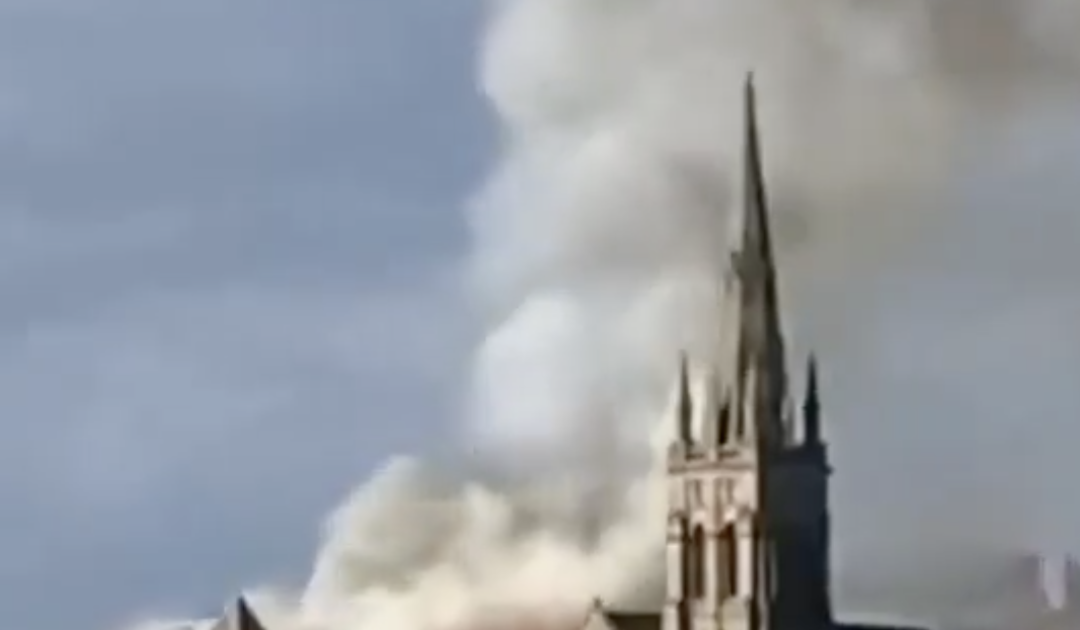
A historic former Catholic convent near the burial place of Saint Patrick in Northern Ireland was devastated by a deliberate fire Sunday night, forcing more than 70 firefighters into an overnight battle to save the adjacent parish church.
The blaze, according to a report from Life Site News, broke out at the former Convent of Mercy in Downpatrick, County Down, at around 7 p.m. on June 28. By the time emergency crews arrived, the building was already engulfed in a well-developed fire.
The Northern Ireland Fire & Rescue Service said the cause is believed to have been deliberate. No injuries were reported, but the damage to one of Downpatrick’s most recognizable Catholic landmarks was severe.
Former convent destroyed as over 60 firefighters battle huge blaze in Downpatrick
@Kscott_94 https://t.co/67qD9hekjp pic.twitter.com/yMoymA86OD
— Belfast Telegraph (@BelTel) June 28, 2026
At the height of the emergency, roughly 70 firefighters were on the scene. Ten appliances responded, backed by aerial ladder units, a command support unit and a water tanker.
Crews used breathing apparatus, firefighting jets and aerial ladder jets to bring the inferno under control. Their most urgent task was not only to contain the fire, but to prevent it from reaching St Patrick’s Church.
The former convent was attached to the church, immediately raising fears that the flames could spread to one of the town’s most important Catholic sites. Firefighters worked through the night to stop that from happening.
The Downpatrick Family of Parishes expressed relief that St Patrick’s Church had been saved. The parish said the fire had been prevented from reaching the church by the “heroism and skill” of the Fire Service.
“Fire fighters worked through the night to protect St Patrick’s and to them we owe an enormous debt of gratitude,” the parish wrote. The statement captured the community’s gratitude, but also the deeper grief of seeing a Catholic landmark destroyed.
CONVENT AND ST PATRICK BURIAL SITE BURN DOWN IN DOWNPATRICK, MEDIA SAYS NOTHING
Yesterday the convent and the burial place of Saint Patrick himself in Downpatrick was reduced to ashes.
Locals say it was arson. The resting place of the patron saint of Ireland set on fire, and… pic.twitter.com/TcXyYM4EDT
— British Intel (@TheBritishIntel) June 29, 2026
The timing made the fire even more painful. Just hours before the blaze, the parish had celebrated the ordination to the priesthood of Fr Thomas Hampton inside St Patrick’s Church.
“Coming at the end of a wonderful day in the life of the parish family — the Ordination to the Priesthood of Fr Thomas Hampton—when the parish came together in a tremendous act of hospitality and welcome, it is particularly sad that so beautiful a building has been destroyed,” the parish said.
The parish also honored the Mercy Order’s long service in Downpatrick. The sisters, it said, had left an “indelible influence for good” after more than 150 years of presence in the parish.
The former Convent of Mercy was built in the 19th century and had long formed part of Downpatrick’s Catholic skyline. Although the building had not recently been in use, it remained a visible symbol of the town’s religious memory and Catholic charitable life.
Local politicians described the scene as devastating. SDLP councillor Conor Galbraith said it was deeply sad to see a fire in “such a historical part of our town.”
South Down MLA Colin McGrath said many locals would remember the convent and the role it played over the years. “Even in recent times, it has remained a familiar part of the Downpatrick skyline, so seeing it go up in flames is upsetting,” he said.
The fire occurred in one of Ireland’s most spiritually significant towns. Downpatrick is closely associated with Saint Patrick, Ireland’s patron saint, whose reputed burial place is nearby at Down Cathedral.
That symbolism cannot be brushed aside. A former convent burning near the resting place of Saint Patrick is not merely a local property loss, it is another wound to the Christian inheritance of Ireland and the wider West.
Authorities have not announced a suspect or motive. There is currently no confirmed evidence linking the Downpatrick fire to immigration, Islam or any organized anti-Christian campaign.
But the destruction comes at a time when Catholic and Christian sites across Europe are being vandalized, desecrated, neglected and, in too many cases, burned. The public is expected to treat every incident as isolated, even as the pattern becomes harder to ignore.
France has become one of the clearest warning signs. Church fires, vandalism and anti-Christian property attacks have become a recurring feature of public life in a country that once called itself the eldest daughter of the Church.
In 2024, the Church of the Immaculate Conception in Saint-Omer was ravaged by fire, with its bell tower collapsing. A suspect was later detained in what investigators treated as a likely arson attack.
Nantes Cathedral was also set on fire in 2020 by a Rwandan national who had been serving as a church volunteer. The same man later stood trial for the killing of Father Olivier Maire, the Catholic priest who had sheltered him after his release from detention.
Not every major church fire has been criminal. Notre-Dame de Paris in 2019 and Rouen Cathedral in 2024 were treated by authorities as likely accidental or renovation-related incidents, not confirmed religious attacks.
But even those distinctions do not calm Christian communities. The sight of ancient churches in flames—whether through arson, negligence, decay or official failure—reinforces the sense that Europe is losing the will to defend its own sacred patrimony.
This is why Downpatrick matters beyond Northern Ireland. It is one more image in a wider civilizational crisis: convents burning, churches emptying, Catholic memory being left to rot while Western governments pour energy into progressive causes, migration systems and bureaucratic social engineering.
Ireland has been especially shaken by rapid demographic and cultural change. The country has faced rising pressure over asylum, accommodation centers and the transformation of local communities without meaningful democratic consent.
The issue, for many Irish Catholics, is not simply numbers. It is whether a historically Christian nation can survive when its ruling class treats borders, faith, memory and national continuity as obstacles to be overcome.
Large-scale immigration from societies with very different religious and cultural foundations has intensified that debate. Ordinary citizens are told to celebrate diversity while watching their own churches close, their towns change and their heritage treated as disposable.
That concern is not hatred. It is the instinct of a people who understand that a nation without a defended faith, a defended border and a defended memory will eventually become little more than an administrative zone.
For the growing number of right-wing Catholics, the answer must be renewal rather than apology. Ireland and the rest of the West must restore respect for the Church, defend Christian holy places, enforce borders and reject the globalist lie that nations have no right to preserve themselves.
St Patrick’s Church still stands because firefighters held the line through the night. But the destruction of the old Mercy convent is another warning that Catholic Europe cannot survive on nostalgia alone — it must be defended with faith, borders, law and courage.
The post Northern Ireland: Historic Catholic Convent Near St Patrick’s Tomb Destroyed in Deliberate Fire as Christian Europe Burns appeared first on The Gateway Pundit.
Go to Source
Author: Robert Semonsen