
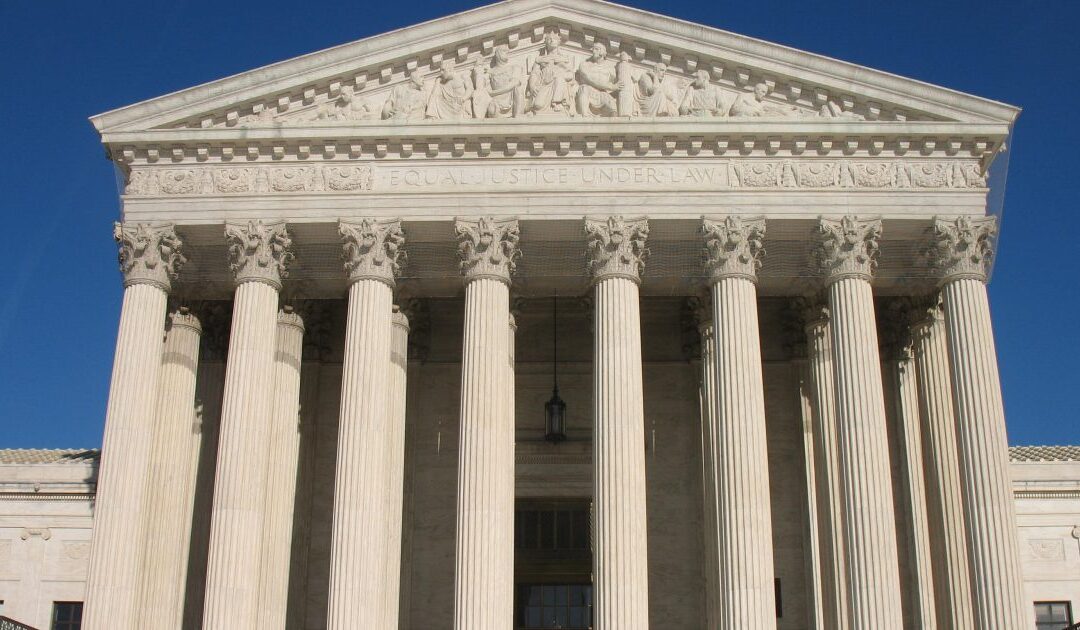
Supreme Court Rules Police Conduct a Fourth Amendment “Search” When Grabbing Your Google Location History Data Through Geofence Warrants
June 29, 2026

The U.S. Supreme Court held Monday that law enforcement officers conduct a Fourth Amendment search when they obtain cell phone users’ precise Location History data from Google using a geofence warrant.
In a 6-3 decision in Chatrie v. United States, the Court ruled that Americans have a reasonable expectation of privacy in their cell phone location information, even when that data is stored by a third-party technology company such as Google. The ruling represents one of the Court’s most significant digital privacy decisions since its 2018 Carpenter decision involving historical cell-site location data.
Justice Elena Kagan authored the majority opinion, joined by Chief Justice John Roberts and Justices Sonia Sotomayor, Brett Kavanaugh, Ketanji Brown Jackson, and Jackson separately concurring.
Justice Neil Gorsuch concurred only in the judgment, while Justice Samuel Alito dissented, joined in part by Justices Clarence Thomas and Amy Coney Barrett. Justice Barrett also filed a separate dissent.
This builds directly on the landmark Carpenter v. United States (2018) decision, which already required warrants for cell-site location information (CSLI).
The Court made clear that Google’s even more precise and sweeping Location History data — which logs a user’s location every two minutes or so, within about 20 meters, and can even reveal elevation and which floor of a building someone is on — deserves at least the same protection.
The case, Chatrie v. United States (No. 25-112), arose from a May 20, 2019, armed robbery of a credit union in Midlothian, Virginia. Police had surveillance footage and witness statements but no suspect. On June 14, they obtained a Virginia magistrate’s geofence warrant directed at Google.
The warrant targeted a 150-meter radius around the credit union. It used Google’s infamous three-step process:
- Step 1: Google hands over anonymized location data for all devices inside the geofence for 30 minutes before to 30 minutes after the robbery.
- Step 2: Officers narrow the list; Google then provides more anonymized data (inside and outside the geofence) for a longer two-hour window.
- Step 3: Officers narrow again; Google turns over names, phone numbers, and identifying info for the final short list.
Google ultimately produced three users’ identifying information. One was petitioner Okello Chatrie, whose data showed him entering the geofence area about ten minutes before the robbery and heading toward a residential area right after.
Chatrie was later charged federally with robbery and firearms offenses. He moved to suppress the Google data, arguing the geofence warrant violated the Fourth Amendment.
The district court agreed the warrant “plainly violates” the Fourth Amendment but denied suppression under the good-faith exception. A divided Fourth Circuit panel and then the en banc court affirmed on different grounds, with judges splitting evenly on whether a search even occurred.
The Supreme Court granted certiorari only on the search question and left the warrant’s validity (particularity and probable cause at each step) for the Fourth Circuit to decide on remand.
The Court systematically rejected the government’s arguments:
Location History is more revealing than the CSLI at issue in Carpenter. It is finer-grained, more frequent, and can show elevation. It creates an “encyclopedic” and “detailed” portrait of a person’s movements and associations — familial, political, professional, religious, and sexual.
Even “short-term monitoring” (here, just two hours) can reveal a “wealth of detail” about a person’s life, the Court noted, citing Justice Sotomayor’s Jones concurrence. The government cannot claim a free pass for limited-duration data when it can cherry-pick exactly which hours it wants from Google’s all-encompassing database.
The third-party doctrine does not save the government. As in Carpenter, this information is not “truly shared” in any normal sense. Google users turn on Location History for their own benefit (Timeline, recommendations, personal journal), often after repeated prompts warning that devices “will not work correctly” otherwise. They do not expect Google to hand it over to police on demand.
The post Supreme Court Rules Police Conduct a Fourth Amendment “Search” When Grabbing Your Google Location History Data Through Geofence Warrants appeared first on The Gateway Pundit.
Go to Source
Author: Jim Hᴏft