U.S. Marine Accused of Stealing Javelin Missile System and Large Quantities of Ammo from California Base
March 30, 2026
Javelin and Ammo stolen Via DOJ
A 23-year-old U.S. Marine is in federal custody after allegedly stealing and selling military equipment from Camp Pendleton in California.
A grand jury has indicted Corporal Andrew Paul Amarillas for stealing and selling weapons of war, which include a Javelin missile system and over 2 million rounds of M855 ammunition.
Court documents alleged Amarillas stole the weapons from Camp Pendleton while he served as an ammunition technician specialist at the School of Infantry-West from 2022 to 2025.
AZ Family reported that Amarillas allegedly stole the weapons and proceeded to sell them to co-conspirators in his home state of Arizona.
A U.S. Marine formerly stationed at Camp Pendleton is now in federal custody, charged with stealing weapons of war — including a shoulder-fired missile system — with the intent to resell them in Arizona, according to court documents.
Cpl. Andrew Paul Amarillas is accused of using his position as an ammunition technical specialist at the School of Infantry West at the San Diego base to access and steal military property, including at least one Javelin missile system, military-grade ammunition and other weapons-related material, between February 2022 and November 2025. Investigators say he transported the stolen weapons and ammunition to his home state of Arizona, where he sold them to a network of co-conspirators, who then resold the equipment to others.
Authorities described the items as strictly controlled and dangerous, posing a threat to civilians and law enforcement. Some but not all of the stolen material has been recovered.
“The objects of the conspiracy were to steal property and ammunition from the U.S. military and sell stolen U.S. military property and ammunition to others to earn money,” read the complaint filed in the U.S. District Court for the District of Arizona in March.
The theft comes just weeks after The Gateway Pundit reported that officials at U.S. Army Fort Campbell revealed that four Skydio X10D Drone Systems were stolen from the 326th Division Engineer Battalion building.
Officials at Fort Campbell announced that the suspects behind the drone theft have been identified and had access to the building where the drones were stored at the base.
High Court Set To Hear Oral Argument This Week On Birthright Citizenship Case
March 30, 2026
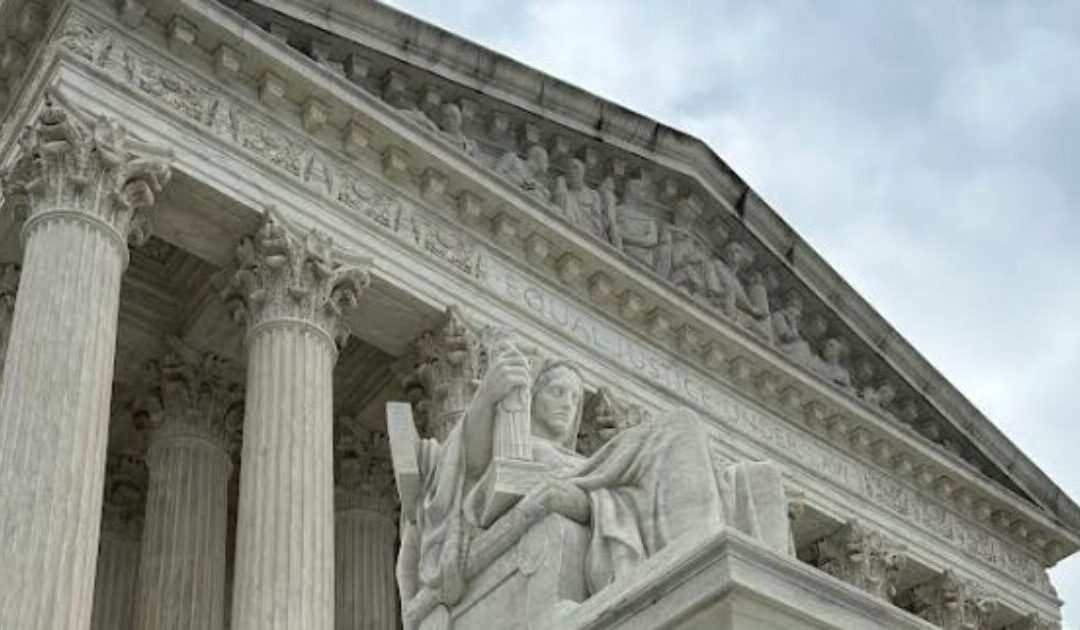
US Supreme Court Credit: The Gateway Pundit Photo
On Wednesday, the Supreme Court will have the opportunity to hear oral arguments on a case which turns directly on the question of birthright citizenship. Specifically, the Court will determine whether the Fourteenth Amendment’s naturalization provision, which states “[a]ll persons born or naturalized in the United States, and subject to the jurisdiction thereof, are citizens of the United States and of the State wherein they reside,” mandates an automatic grant of citizenship upon anyone, including the children of illegal aliens, born on U.S. soil – or if the clause, more sensibly read, applies to children born of citizens only (with limited exceptions). The case, which is being filed under the name Trump v. Barbara, is one of potentially groundbreaking import – poised to be potentially among the most important decisions, with far-reaching political ramifications, in generations.
The case arose in the aftermath of the Trump administration’s adoption of Executive Order No. 14,160 (“Protecting the Meaning and Value of American Citizenship”), which was issued on the first day of the President’s second term in January of last year. Immediately, that executive order was challenged by liberal-leaning district courts, resulting in a nationwide preliminary injunction which never allowed the order to go into effect. Last year, in the case Trump v. CASA, the Supreme Court ruled in a 6-3 judgment split along party lines that nationwide injunctions, at least tailored to the kind of policy underlying this particular EO, were unconstitutional. In that regard, the Court struck down part of a legal stopgap which indirectly affected the policy of birthright citizenship without having to confront the underlying issue on the merits head on. This hedge strategy has been typical of the Roberts
Court, which, despite having a putative Republican-majority, has chosen to repeatedly avoid addressing what it considers “hard-charging” or “politically controversial” questions on the merits. The politics underlying this strategy are interesting: though conservatives have a hard-lock on the Supreme Court for the first time in decades, they have generally shirked from “rocking the boat” on major policy questions.
Unlike their liberal counterparts, conservative judges in the vein of John Roberts have justified their obsequiously deferential approach under the pretext of stare decisis, even though much of the precedent that approach necessarily upholds is foundationally liberal precedent, and thus in the final analysis does not pass true constitutional scrutiny based on the original meaning, intent, and plain meaning of the law. As a result, major constitutional problems – such as the issue of birthright citizenship – are often kicked down the road, sometimes for generations, rather than squarely addressed upfront in a decisive and expeditious manner. The problem with this reticent approach is that it allows problems, such as the issue of birthright citizenship, to suppurate – only creating more problems over the course of time. Judges must realize that choosing not to opine on an important policy question is itself a decision of policy: neutrality is no magic substitute that allows judges to escape politics forever. Case in point: the President’s Executive Order has been in limbo for well over a year now. Without a decision on the merits, the law becomes murky and unclear. In these scenarios, judges and legislators are forced to then guess what the law is supposed to mean, which rarely leads to desirable outcomes. The failure to provide clarity in the law and act with decisiveness thus creates a negative feedback loop: rather than go away, small problems compound into bigger problems. And opponents who stand on the other side of the issue begin to sense that uncertainty. This unduly gives them more opportunities to exploit pitfalls while sowing even further doubt into the constitutional process itself. Doubt and confusion alienate would-be supporters while strengthening the resolve of opponents, who rightly deem indecision as weakness.
This, in a nutshell, elaborates a fundamental philosophical distinction in the general approach between conservatives and liberals. Liberal-majority courts historically have ruled on the merits of an issue, resulting in landmark decisions that have engineered the law in a leftward direction, as so many Warren Court decisions – named after the most impactful Chief Justice of the twentieth century – have borne out, each decision building off the last.
Conservatives, as regularly exemplified by the Roberts court era, tend to uphold the overwhelmingly liberal precedent on which the major canons of modern constitutional law are grounded. It has been the Roberts’ court modus operandi to pass the buck rather than rule squarely on major constitutional questions. If it absolutely must confront an issue, it tends to limit its ruling to the case at hand rather than make a dispositive judgment for all similar cases and controversies. And although that posture has softened a bit over the last several years, bolstered by President Trump’s three nominations from the first administration, which paved the way for Roe v. Wade’s overturn, something that would have been unthinkable just a decade ago, the institutional prejudice towards inertia and tepidity remains strong.
This tepidity explains why the birthright citizenship question, which is a straightforward constitutional analysis, has remained adrift in a sea of doubt for nearly a century and a half. The Fourteenth Amendment was one of three post-Civil War amendments designed to confer constitutional rights upon newly emancipated slaves. Its originators surely were not contemplating giving additional rights to tens of millions of illegal aliens from all over the world when they drafted its naturalization provision. If the framers of the Fourteenth Amendment had known that their handiwork would, a century and a half later, be manipulated by political opportunists to grant the privilege of citizenship to anyone under the sun, including violent criminals and hordes of individuals who did not speak the English language and had no desire to assimilate into the American way of life, there is no doubt that they would have made the clause airtight to prevent those exploitations from later springing up.
Having said that, the intent of the Fourteenth Amendment’s architects is derived by the language in the provision which expressly states that those rights are contemplated only for those individuals subject to the jurisdiction of the laws of the United States. This is not a partial grant of jurisdiction, as in the cases of foreign visitors to the United States, whether on work visas or simply here for travel. No, the clause envisioned that individuals born on American soil must be fully (not partially) within the jurisdiction of American laws already. This is only possible if those contemplated persons’ parents were fully within the ambit of American law and hence were citizens before the fact – through naturalization or birthright.
So, the relevant legal question is not whether or not the Fourteenth Amendment grants birthright citizenship. But whether individuals born on American soil ought to be automatically granted citizenship on the basis of birthright, regardless of their parentage. In other words, it presents a constitutional inquiry that turns on the core meaning of citizenship by birthright. Wong Kim Ark, an over century-old case that is often claimed by liberal critics as a purported justification to keep the status quo, does not address the core question of birthright citizenship as applied to illegal aliens, and is bad law either way. In Wong Kim Ark, the High Court declared that children born on U.S. soil of lawful resident aliens may be accorded citizenship under the Fourteenth Amendment. However, the case did not consider whether children born of individuals who circumvented the laws of the United States could be automatically granted citizenship. That distinction between lawful and unlawful residents is key: the landmark decision that supposedly is the be and end all ace-in-the-hole supporting liberal critics’ objections to the President’s Executive Order even outlines that its ruling applies to lawful residents only, excluding unlawful residents from the process entirely. That said, there are also plenty of reasons to consider that decision outdated or even bad law too, offering additional support for the argument that the original intention of the Fourteenth Amendment was not designed to confer birthright citizenship automatically.
No other first world nation automatically gives citizenship by birthright, bolstering the historical and legal arguments in support of the President’s position. What is more, practical necessities dictate a dramatic course correction in policy: at no other point in American history, nor perhaps in the history of the modern Western world, has any country ever been asked to absorb as many migrants as America has – somewhere between 13 and 50 million – at once. The logistics make this assignment near-impossible. It is downright impractical to expect that America’s institutions – from public welfare programs to hospitals, roadways, and schools – could withstand taking on this extreme burden without buckling under the pressure. The institutions simply lack the bandwidth to take these people on, even if there was a desire to do it. But there is no desire. This brings us to the most important factor in a democratic system: the will of the People. And, overwhelmingly, majorities in both parties have made clear that they do not want this policy. In an age of extreme polarization, a hardline stance against illegal aliens is remarkably one such policy that enjoys wide-ranging support among large swaths of the electorate, as revealed in far too many public polls to count.
In short, birthright citizenship – at least in its revisionist construction – is something that the Constitution’s founders never contemplated. It is also not supported by the text of the naturalization clause of the Fourteenth Amendment, nor even Wong Kim Ark supports. The people do not want it; the Constitution patently forbids it. The Supreme Court must therefore strike it down, and uphold the President’s Executive Order, lest it wish to also have its legitimacy further eroded by once again sadly hedging and thereby, handing its moral authority over to the Left – at which point it will have no authority left to either preserve the Constitution or its own institutional integrity, the two reasons it recurrently and meekly cites as the basis for pursuing its disreputable strategy of appeasement.
Zohran Mamdani Calls To Abolish ICE As Illegal Aliens Murder New Yorkers | Drew Hernandez
March 30, 2026
At a March news conference on so called “street safety”, NYC Mayor Zoran Mamdani told reporters the city was “making clear that no one is above the law” even as he called ICE “an entity that should be abolished,” denouncing it as “rogue” and “reckless” and saying it “delivers nothing toward the furthering of the cause of public safety.”
Mamdani has also backed “No Kings” protests against the Trump administration, portraying them as a way for New Yorkers who believe “ICE has no place in our city” to show they are part of a growing coalition demanding “decency, dignity and humanity” in immigration policy.
The comments come while on March 8th, 83‑year‑old Air Force veteran Richard Williams was shoved from a platform onto the tracks at Manhattan’s Lexington Avenue–63rd Street station and later died of his injuries on March 17, according to police and local reports.
Authorities say the suspect, 34‑year‑old Honduran national Bairon Posada‑Hernandez (also reported as Bairon Hernandez), has been deported from the United States four times, was in the country illegally, and has a lengthy criminal record that includes numerous prior charges.
He was arrested on March 10 and initially charged with attempted murder and assault, but prosecutors in Manhattan later upgraded the case to second‑degree murder after the medical examiner ruled Williams’ death a homicide.
The killing has sparked anger on social media and among Republican lawmakers, who accuse New York’s sanctuary policies and Mamdani’s refusal so far to comment directly on the case of enabling a “serial criminal.”
Sponsor | https://www.purgestore.com | Use promo code DREW for 20% off and support The Gateway Pundit today!
President Trump Reveals Military Building “Massive Complex” Under Ballroom
March 30, 2026
President Donald J. Trump spoke to reporters on Air Force One Sunday night on his return trip to Washington, D.C. from a working weekend in Florida. One subject Trump spoke about was the White House ballroom, apparently in response to a hit piece by the New York Times attacking the ballroom’s design. Trump held up several large photo representations of the updated ballroom design while also telling reporters that the military is building a “massive complex” under the ballroom.
The East Wing of the White House, which Trump had demolished last year to make way for the ballroom, sat atop the underground Presidential Emergency Operations Center, also referred to as the bunker, that was built in the 1940s during World War II and has been periodically upgraded.
Trump said the new military construction was revealed as a result of a lawsuit opposing the construction of the ballroom, something Trump spoke about earlier in a Truth Social post on January 25. At that time, Trump blamed the lawsuit for forcing the revelation that the military was involved, but did not get into details (excerpt):
I’m building, on top of everything else that I am doing, one of the greatest and most beautiful Ballrooms anywhere in the World, with more than 300 Million Dollars of Great American Patriots’ money, and working closely with, right from the beginning, the United States Military and Secret Service.
…Additionally, in this instance, it is being done with the design, consent, and approval of the highest levels of the United States Military and Secret Service. The mere bringing of this ridiculous lawsuit has already, unfortunately, exposed this heretofore Top Secret fact. Stoppage of construction, at this late date, when so much has already been ordered and done, would be devastating to the White House, our Country, and all concerned. Thank you for your attention to this matter! President DONALD J. TRUMP
Reuters White House reporter Steve Holland posted a photo from Air Force One:
“Now, the military is building a a big complex under the ballroom, which has come out recently because of a stupid lawsuit that was filed, but the military is building a massive complex under the ballroom and that’s under construction and we’re doing very well. So, we’re ahead of schedule. It’s part of it. And the ballroom essentially becomes a shed for what’s being built under the military, including from drones and including from any other thing. the glass uh on the windows, you see the big windows, the glass is uh extremely thick. It’s high grade bulletproof glass. So, all of the windows are bulletproof. Uh I think the Times wrote to you some of the windows are fake. We have no fake windows. They said they talked about a stairway in the south. We don’t have a stairway in the south. That was replaced a long time ago. But this is a a view of it from the north. And that’s if you see it, it fits in with the White House. It’s almost a twin to the White House. It’s uh something we just wanted to pay tribute to the White House. And so that fits in beautifully…”
In an acknowledgment of the new era of warfare, Trump also told reporters that in addition to being bulletproof, the ballroom is designed to be drone proof.
White House Press Secretary Karoline Leavitt ripped the New York Times earlier Sunday about the hit piece on the ballroom, “The New York Times had three random people who have “studied fine arts,” “long written about urban planning,” and never built anything to write an article criticizing the new White House ballroom. President Trump and his lead architect have built world-class buildings around the world, and they are ensuring the People’s House finally has a beautiful ballroom that’s been needed for decades — at no expense to the taxpayer.”
The New York Times had three random people who have “studied fine arts,” “long written about urban planning,” and never built anything to write an article criticizing the new White House ballroom.
Seat to Watch: Connecticut’s 5th District Erupts in Firestorm Over GOP Ben Proto’s Embattled Leadership
March 30, 2026
Seat to Watch: Connecticut’s 5th District Erupts in Firestorm Over GOP Ben Proto’s Embattled Leadership A Friday night clash inside Connecticut’s Republican Party has erupted into a story with national … Read more
We use technologies like cookies to store and/or access device information. We do this to improve browsing experience and to show (non-) personalized ads. Consenting to these technologies will allow us to process data such as browsing behavior or unique IDs on this site. Not consenting or withdrawing consent, may adversely affect certain features and functions.
Functional
Always active
The technical storage or access is strictly necessary for the legitimate purpose of enabling the use of a specific service explicitly requested by the subscriber or user, or for the sole purpose of carrying out the transmission of a communication over an electronic communications network.
Preferences
The technical storage or access is necessary for the legitimate purpose of storing preferences that are not requested by the subscriber or user.
Statistics
The technical storage or access that is used exclusively for statistical purposes.The technical storage or access that is used exclusively for anonymous statistical purposes. Without a subpoena, voluntary compliance on the part of your Internet Service Provider, or additional records from a third party, information stored or retrieved for this purpose alone cannot usually be used to identify you.
Marketing
The technical storage or access is required to create user profiles to send advertising, or to track the user on a website or across several websites for similar marketing purposes.