Rededicate 250 Was a Complete Success as the USA Rededicated to God

Rededicate 250 Was a Complete Success as the USA Rededicated to God

Rededicate 250 Was a Complete Success as the USA Rededicated to God
May 18, 2026

Washington Monument surrounded by American flags with people enjoying a sunny day on the National Mall, highlighting a patriotic atmosphere.


Rededicate 250 was a complete success as the USA rededicated itself to God. FULL PERFORMANCE: Chris Tomlin Delivers Massive Performance to Close Rededicate 250 – 05/17/26 FULL PERFORMANCE: Chris Tomlin … Read more


The post Rededicate 250 Was a Complete Success as the USA Rededicated to God appeared first on The Gateway Pundit.

Go to Source
Author: Joe Hoft

AOC Gets Savagely Mocked After Making This Embarrassing Gaffe During Race-Baiting Speech in Alabama (VIDEO)

AOC Gets Savagely Mocked After Making This Embarrassing Gaffe During Race-Baiting Speech in Alabama (VIDEO)

AOC Gets Savagely Mocked After Making This Embarrassing Gaffe During Race-Baiting Speech in Alabama (VIDEO)
May 18, 2026

Rep. Alexandria Ocasio-Cortez (D-NY) delivers a speech in Montgomery, Alabama, on Saturday, May 16. Credit: Alexandria Ocasio-Cortez Facebook

Rep. Alexandria Ocasio-Cortez (D-NY) is going viral for all the wrong reasons after delivering a crazy, race-baiting speech in Alabama over the weekend.

As Al.com reported, AOC joined several of her left-wing comrades in Montgomery on Saturday to whine about redistricting changes in the South that would eliminate heavily gerrymandered Democratic districts. Most of these are Black-majority seats.

These bold moves could give Republicans an outside shot at keeping the House of Representatives this Fall, despite President Trump’s low approval ratings. Naturally, desperate Democrats are pulling out the race card and stoking fires.

AOC was no exception as she delivered her speech to a boisterous audience behind bulletproof glass. Pay close attention to what she says toward the end.

“It is time for the North to pull up to the South. It is time for New York to pull up to Alabama. It is time for all of us to come to Georgia, to Louisiana, to Tennessee, to Mississippi, and let them know exactly what they have on court with this injustice,” AOC yelled.

“They think they can draw us out of power. They do not know the sleeping giant that they just awakened, because it is not a coincidence,” she continued. “And our whole country must understand that it was not until voting rights were ratified in this country that we got the Great Society, because when black Americans have the right to vote and that vote is protected, our schools get funded, when voting rights are health care gets expanded, when voting rights are protected, our country moves forward.”

“And Montgomery, that’s what they’re actually afraid of…What they thought was the final blow is actually just the opening silo.”

Did you catch that? AOC is too dimwitted to understand the difference between “salvo” and “silo.”

Does she want to start a war involving grains like corn, wheat, and soybeans?

WATCH:

Unsurprisingly, X users had plenty to say about AOC’s embarrassing gaffe. Many also wondered why she was hiding behind bulletproof glass while delivering her speech.

The post AOC Gets Savagely Mocked After Making This Embarrassing Gaffe During Race-Baiting Speech in Alabama (VIDEO) appeared first on The Gateway Pundit.

Go to Source
Author: Cullen Linebarger

West Virginia Governor Morrisey Hopes to Lure Businesses Strangled by Radical VA Gov. Spanberger’s Overreach

West Virginia Governor Morrisey Hopes to Lure Businesses Strangled by Radical VA Gov. Spanberger’s Overreach

West Virginia Governor Morrisey Hopes to Lure Businesses Strangled by Radical VA Gov. Spanberger’s Overreach
May 18, 2026

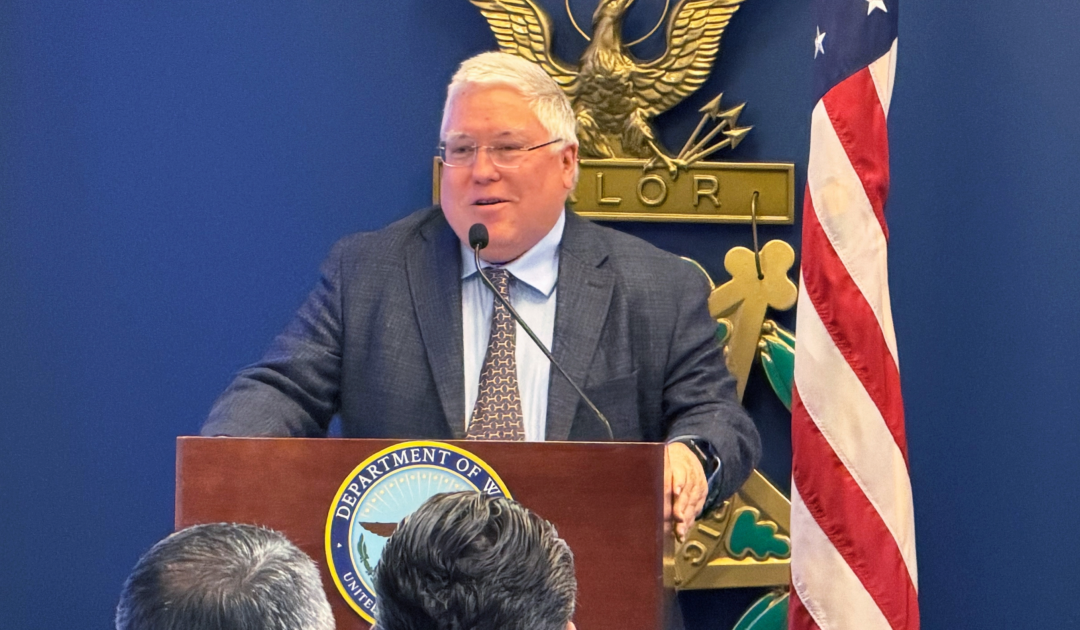
West Virginia Governor Patrick Morrisey/Image: @wvgovernor/X

After only a few months in office, Virginians are expressing displeasure with Virginia’s Democrat Gov. Abigail Spanberger’s tenure thus far.

A Washington Post–George Mason University Schar School poll shows Spanberger with the highest disapproval rating at this point in her term than any Governor, from either party, since 1994.

Under Spanberger’s leadership, Democrats have championed a slew of leftist policies, including political indoctrination in public schools, pushing sweeping new gun control laws, a radical congressional redistricting referendum, and soft on crime polices.

Spanberger is also hampering residents and businesses with a flurry of new taxes proposed to increase revenue, including levies on everything from car ownership to dog walking to gym memberships, as well as regional sales tax increases and delivery taxes in certain areas.

Spanberger’s tax increases are part of broader efforts to expand Virginia’s sales tax base from goods to services, thus raising compliance costs, operating expenses, and prices for small businesses and their customers.

HB243 increases taxes on large employers, proposing a tax equal to 100% of qualified employee benefits for large employers
Regional sales tax increases and delivery taxes in certain areas.

While not all of the bills have passed or reached her desk, Spanberger’s intent is clear: she wants to tax residents and businesses into oblivion.

West Virginia Governor Patrick Morrisey (R) sees Spanberger’s overreach as a prime opportunity to woo VA-based businesses across state lines, saying his state is “open for business.”

Per Fox News:

“We’re going to be spending some time in Loudoun County and all across Virginia on making the pitch and the comparison of the direction that West Virginia is moving in [and] the direction Virginia is going in,” Morrisey told Fox News Digital on the sidelines of the announcement of a new 275-acre commercial tax district he said will bring $200 million in economic investment to the three-county Eastern Panhandle region.

“The backyard brawl for our state’s future is being won both at the kitchen table and in the marketplace,” Morrisey said, noting that the Tabler Station project he unveiled is just one of many similar plans-in-action around the state.

The area is home to West Virginia’s nationally-prevalent apple industry — to the point the local high school team is the “Musselman Applemen.” The area also boasts major industrial plants including a major Clorox facility that is advertising job openings to passersby on Interstate 81.

“While Virginia chooses to burden its citizens and job creators with higher taxes, West Virginia is choosing freedom, fiscal responsibility, and a tax climate that makes our state more competitive for business than our neighbor.”


The post West Virginia Governor Morrisey Hopes to Lure Businesses Strangled by Radical VA Gov. Spanberger’s Overreach appeared first on The Gateway Pundit.

Go to Source
Author: Margaret Flavin

BALTIC DRONE SCARE: After the Whole Latvian Government Collapsed Over Stray Ukrainian Drone Strikes, Lithuania Is Also Finding Crashed Craft From Kiev

BALTIC DRONE SCARE: After the Whole Latvian Government Collapsed Over Stray Ukrainian Drone Strikes, Lithuania Is Also Finding Crashed Craft From Kiev

BALTIC DRONE SCARE: After the Whole Latvian Government Collapsed Over Stray Ukrainian Drone Strikes, Lithuania Is Also Finding Crashed Craft From Kiev
May 18, 2026

Ukrainian Raybird drone getting launched – Wiki Commons

Stray Ukrainian drones everywhere.

In the last weeks, an uptick in Ukrainian drone attacks has battered several Russian regions, including Moscow.

But these massive attacks are creating a parallel effect of stray Kiev regime drones straying into allied Baltic nations and crashing there.

Whether this happens because of Russian electronic warfare or some other factor, these wayward drones are starting to cause trouble to the struck nations.

Three days ago, Latvian Prime Minister Evika Silina ended up resigning following a political crisis over Russia-bound Ukrainian drones straying into their territory.

And yesterday (17), a ‘suspected’ Ukrainian military drone ​was found crashed in Lithuania, the Tallinn ‌government’s National Crisis Management Centre said.

Reuters reported:

“The drone was not detected when it entered Lithuania, and was not armed with explosives, the chief of the ​center Vilmantas Vitkauskas told reporters.

The drone was found crashed ​at the village of Samane, the center said, which is ⁠40 kilometers from the Latvian border and 55 kilometers from ​Belarus. Kyiv has not yet commented on the issue.”

“Since March, several stray Ukrainian drones ‌have ⁠entered the air space of NATO members Latvia, Lithuania and Estonia which border Russia and its ally Belarus.

Kiev consistently said the stray drones were launched to strike military targets in Russia, ​but confused by ​Russian interference. Some of ⁠the drones crashed and exploded, including two drones which hit and caused fire at a Latvian oil ​storage facility on May 7.”

Read more:

TRUMP TO OIL TANKERS: “SHOW SOME GUTS!” – President Says Iran’s Navy Is Finished, Urges Ships to Sail Through Strait of Hormuz

The post BALTIC DRONE SCARE: After the Whole Latvian Government Collapsed Over Stray Ukrainian Drone Strikes, Lithuania Is Also Finding Crashed Craft From Kiev appeared first on The Gateway Pundit.

Go to Source
Author: Paul Serran

Former EU Foreign Policy Chief Admits Bloc “Not Very Relevant” on World Stage

Former EU Foreign Policy Chief Admits Bloc “Not Very Relevant” on World Stage

Former EU Foreign Policy Chief Admits Bloc “Not Very Relevant” on World Stage
May 18, 2026

In an exceedingly rare moment of candor from within Europe’s own political establishment, former EU foreign policy chief Josep Borrell has stated that the European Union is quickly losing relevance on the geopolitical stage.

Speaking in a recent interview, Borrell warned that the bloc’s current structure is simply not equipped to handle the pace and complexity of modern geopolitics.
“This European Union… was not designed for the world in which we live today,” he said, highlighting a growing gap between institutional design and geopolitical reality.

At the heart of the problem, according to Borrell, is the EU’s cumbersome decision-making process. The requirement for unanimity among 27 member states—something some inside the EU are working on doing away with—has repeatedly paralyzed the bloc in moments of crisis.

“The decision-making rules are not compatible with the acceleration of history,” he said, noting that major global events unfold faster than the EU can respond.
The result, he admitted, is a bloc that is “not very relevant to international politics.”

Borrell’s remarks, for critics of EU’s current trajectory, confirm that Brussels has become more reactive than strategic, more divided than decisive.
From Ukraine to the Middle East, and from energy policy to dealing with mass migration and cultural integration, the EU has often struggled to present a unified front. Internal disagreements have frequently overshadowed external challenges.

Borrell pointed directly to these divisions, arguing that the inability to reach consensus has weakened Europe’s voice on the world stage.
While some EU leaders, including Commission President Ursula von der Leyen, have pushed for majority voting to bypass national vetoes, Borrell offered a more radical alternative.

He proposed the creation of a “union within the union”—a smaller, more tightly integrated core group of countries capable of acting quickly and decisively.
“With 27, we won’t accomplish much,” Borrell said. “We need to find another core group… a few who truly want to move forward.”

The suggestion, unsurprisingly, has ignited lively discussion across Europe, raising fundamental questions about sovereignty, democratic legitimacy, and the future direction of the bloc.

The idea of a smaller decision-making core, for some, risks creating a two-tier Europe, where some nations, namely larger Western European states, drive policy while others, generally smaller Central and Eastern European states are totally sidelined.

For others, however, it reflects a growing frustration with a system that appears increasingly unable to act in moments that demand clarity and strength.
Germany has already signaled support for reforms. Foreign Minister Johann Wadephul has backed the idea of shifting toward qualified majority voting, arguing it would allow the EU to act where it currently stalls.

As of now, a least a dozen member states say they’re open to such changes, suggesting that momentum for reform is building, even as pockets of resistance remains.

Still, critics warn that these proposals may not address the deeper issue: a lack of political cohesion and shared strategic vision within the EU.
The bloc’s struggles are not limited to procedure. They reflect broader tensions over identity, priorities, and the balance between national interests and collective action.

In foreign policy, these tensions are particularly visible. Member states often pursue divergent approaches, complicating efforts to present a unified European stance.

Borrell’s own tenure was marked by such challenges. From disagreements over sanctions to differing views on military engagement, the limits of consensus politics were repeatedly exposed.

His latest remarks suggest that those limitations have only become more pronounced. The question, for many across Europe, is no longer whether the system needs reform, but whether it can be reformed in such a way that it does not fundamentally alter the nature of the union.

The idea of deeper integration among a select group may appeal to some policymakers and liberal cosmopolitan voters, but it also risks further alienating countries like Hungary, Poland, Czechia, Slovakia, and others that already feel marginalized within the EU framework.

At the same time, the alternative—continued paralysis—carries its own risks, particularly in a world where geopolitical competition is intensifying.
As global powers move quickly to assert influence, Europe’s slow and fragmented response risks leaving it increasingly sidelined.

Borrell’s warning is therefore both a diagnosis and a challenge. The EU, as it stands, may no longer be fit for purpose in a rapidly changing world. Whether or not those who are presently at the helm the EU are willing—or able—to confront that reality that is a rapidly changing world order remains entirely to be seen.

The post Former EU Foreign Policy Chief Admits Bloc “Not Very Relevant” on World Stage appeared first on The Gateway Pundit.


Go to Source
Author: Robert Semonsen