PURE EVIL: Deranged Thug Beats Elderly “Trump House” Owner and Army Veteran Within an Inch of His Life
May 22, 2026
On Left: “Trump House” owner Kerry Sheron. On Right: Thomas Caleb Butler. Credits: Kerry Sheron Facebook and Thomas Butler Linkedin
A man in Escondido, California, who owns what locals describe as the “Trump House,” is facing death after a savage beating by a wicked man earlier this week.
As The New York Post reported, a man known for decorating his home with Trump flags and MAGA memorabilia is fighting for his life following a brutal attack by a deranged thug. The incident occurred on Wednesday on the corner of East Mission Avenue and Buchanan Street in Escondido around 2:15 p.m.
Video obtained by The California Post shows the aftermath of a confrontation outside the property, with police tape blocking off the street.
Officers reportedly arrived to find a man restraining the alleged attacker while the victim lay nearby with severe injuries.
A witness who attempted to stop the confrontation was also injured.
The Post has identified 69-year-old Army veteran Kerry Sheron as the victim. Police say he suffered significant injuries and is now in hospital in a critical condition.
Sharon’s wife has revealed to the Post through tears that her husband is not expected to survive the attack.
Following the incident, the police arrested 32-year-old Thomas Caleb Butler. He fled the scene when police arrived, but was found about a half mile away.
Butler lives just around the corner from the Sheron. Butler’s family says he is a Navy veteran with severe PTSD and mental health issues.
Authorities have charged Butler with first-degree attempted murder and booked him into the Vista Detention Facility. He faces life in prison if convicted.
Before this likely fatal attack, Sheron had faced past complaints and illegal actions from woke locals regarding his passionate support for Trump.
“My buddy lived down the street from him,” one nasty leftist wrote on social media. “Whenever I went to visit, I made sure to swing by that place and shout stuff at them.”
A March video obtained by the Post shows Sheron fuming after someone vandalized his property.
“Somebody decided that our stuff is not good. Incredible, look at this,” he said. “They even ripped up the American flag, how f**ked up is that?”
AfD Surges to 42% in East German State, Closing In On Absolute Majority
May 22, 2026
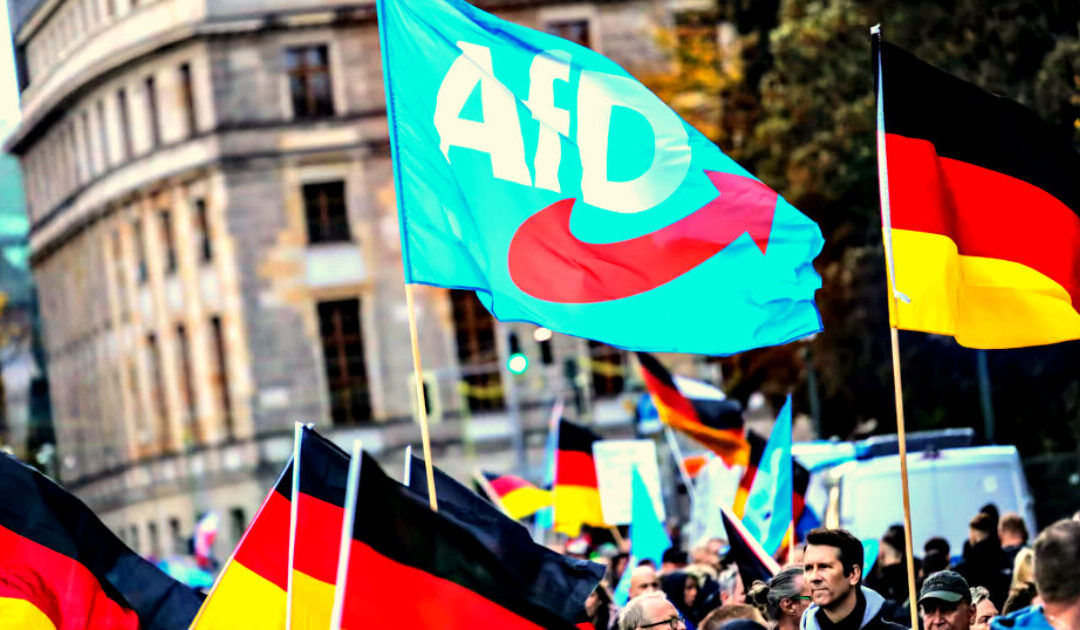
AfD supporters rally in Germany
The Alternative for Germany (AfD), the country’s sole right-wing, anti-globalist party, has surged to a record 42% in the eastern state of Saxony, putting the party within striking distance of an outright majority and raising the real possibility it could soon govern alone if it gains just a few more percentage points.
With analysts estimating that around 46% would be enough to secure a single-party government, the latest polling data suggests that threshold is now within reach. The development marks a potential political shift that could reshape Germany’s power structure.
The numbers place the AfD far ahead of its nearest competitor. The establishment, globalist Christian Democratic Union (CDU), led nationally by Chancellor Friedrich Merz, trails at mere 21%.
The gap is striking. In practical terms, the AfD now commands roughly double the support of the CDU in Saxony.
The polling data appears to reflect more than a temporary polling fluctuation, instead signalling a deeper realignment in voter sentiment across eastern Germany.
The AfD’s rise has been rapid. The party gained seven percentage points compared to the previous survey conducted roughly a year ago.
At the same time, traditional parties are losing ground. The CDU’s result represents one of its weakest performances in the region.
Other establishment, globalist parties, on the left and the right, are also struggling to maintain relevance. The Social Democrats and Greens hover at around six percent, while the Left Party remains in single digits.
Taken together, the data points to a collapse of the political center. Voters appear increasingly unwilling to support established parties.
In the neighboring state of Saxony-Anhalt, the trend is similar. There, the AfD has also reached 42%, reinforcing its momentum across eastern Germany.
With elections approaching, the implications are significant. The party is now positioned to challenge the long-standing political order.
Public dissatisfaction appears to be a key driver. According to the survey, 58% of respondents are unhappy with the current government.
Only a minority expressed satisfaction. The figures suggest a growing disconnect between voters and those in power.
Trust in federal leadership has also eroded sharply. A large majority of respondents say their confidence in political institutions has declined.
The issue, for many voters, is not just policy but direction. They feel that Germany is moving away from its core priorities.
Economic concerns are a major factor. Rising living costs and uncertainty about energy policy are weighing heavily on households.
Migration policy remains another flashpoint. It continues to dominate public debate and influence voting behavior.
Cultural and social questions are also shaping the landscape. Issues tied to identity, national cohesion, and social policy are increasingly prominent.
Polling data reveals a widening openness to alternatives. Nearly half of respondents said they have either voted for the AfD or could imagine doing so.
Only 39% categorically ruled out supporting the party. This suggests further growth potential remains.
At the same time, the political establishment remains resistant. All major establishment parties have pledged not to cooperate with the AfD.
This creates a structural dilemma. Forming governments without the leading party, depending on how much support that party has, will of course become increasingly difficult—if not impossible.
For the CDU, the situation is particularly challenging. Even with allies, it would likely require a broad coalition with all of the leftist parties—even the communists—to secure a majority.
Such coalitions are often unstable. They also risk further alienating voters who already feel disconnected and ignored.
The broader political environment is shifting rapidly. Traditional party loyalties are weakening across the electorate.
Instead, voters are seeking alternatives that they believe better reflect their concerns. This trend is especially pronounced in eastern Germany.
For critics of the current system, of which there doesn’t seem to be a shortage, the surge reflects accumulated frustration. They argue that key issues have been ignored for too long.
The coming elections will be a decisive test. Polling trends will soon be measured against real-world outcomes.
Trump has repeatedly clashed with Powell over his refusal to cut interest rates, and he has said he would be disappointed if Warsh does not cut rates immediately upon taking over at the Fed.
Pressure from the President is expected to have a strong influence over the Federal Reserve under Warsh's chairmanship. Though Warsh may be unable to slash interest rates immediately, as he will need a buy-in from other members of the Board.
The next Federal Open Market Committee meeting, at which a decision on interest rates will be made, is scheduled for June 16-17, about three weeks from now.
The ceremony is scheduled to begin at 11:30 am ET.
Iran Rapidly Restoring Industrial Base & Military Strength, US Intel Says, Presenting Strategic Challenge for Trump
May 22, 2026
Iranian Shahed 121 and Shahed 129 drones via Wikimedia Commons
New U.S. intelligence assessments are raising serious questions about the outcome of the recent conflict with Iran, suggesting that despite weeks of intense military strikes and claims of its industrial base being ‘obliterated, Tehran has been able to rapidly rebuild key elements of its arsenal.
The findings, according to various reports, complicate the strategic picture for Donald Trump, who now faces mounting pressure over whether to escalate the conflict again or risk losing whatever gains were achieved.
According to multiple intelligence sources, Iran has been rebuilding its military capacity far faster than initially expected. Officials say the timeline for recovery has exceeded prior estimates.
“The Iranians have exceeded all timelines the [intelligence community] had for reconstitution,” one U.S. official said.
The rebuilding effort took place during a six-week ceasefire that followed a major American-Israeli bombing campaign earlier this year. That pause appears to have given Tehran critical time to regroup.
American and Israeli forces launched strikes beginning in late February, targeting missile infrastructure, military facilities, and defense production sites. The goal was to significantly degrade Iran’s ability to project power in the region.
While the strikes caused damage, intelligence assessments now indicate the impact may have been limited. Analysts say Iran’s core capabilities were reduced—but far from totally eliminated.
In particular, Iran has already restarted parts of its drone production. Officials estimate that full drone capability could be restored within six months.
Missile capabilities also appear to remain largely intact. Some estimates suggest that Iran retained around 60 to 70 percent of its pre-war missile stockpile.
In addition, Iran has regained access to a majority of its missile launch sites. Intelligence reports indicate that many of these facilities are once again operational.
Satellite imagery and surveillance data suggest that underground storage and launch infrastructure has also been restored. In some cases, facilities are described as “partially or fully operational.”
The strategic implications are exceedingly significant. Iran remains capable of targeting American assets and regional allies across the Middle East.
Shipping lanes are also at risk. Control over key chokepoints such as the Strait of Hormuz remains a critical factor in the broader conflict, with oil prices remaining around 100$/barrel—up significantly from prior to the conflict.
The intelligence findings challenge earlier public statements from the White House. Trump had previously suggested that Iran’s military capabilities had been “decimated.”
Internal assessments now paint a more complex picture. The damage inflicted appears to have delayed Iran’s capabilities by months rather than years.
At the same time, Tehran has reportedly benefited from external support. Intelligence sources say both Russia and China have provided assistance during the rebuilding phase.
According to some reports, China has supplied components used in missile production. These claims have been denied by Beijing.
Iranian officials, for their part, have acknowledged efforts to rebuild. Parliamentary speaker Mohammed Bagher Ghalibaf said the country used the ceasefire to restore its military strength.
The situation presents a difficult choice for the Trump administration. If Iran can fully reconstitute its capabilities in a short time frame, the strategic advantage gained from the conflict may be temporary.
That raises the question of whether further military action would be required to maintain pressure. At the same time, renewed escalation carries significant risks.
Regional stability remains fragile. Previous Iranian retaliation included strikes on American bases and allied infrastructure in the Gulf.
Intelligence reports suggest that any renewed conflict could see increased use of drones. These systems are seen as a cost-effective way to offset losses in other areas.
The broader geopolitical context adds another layer of complexity. Involvement from major powers increases the risk of escalation beyond the immediate region.
For President Trump, the situation presents a strategic dilemma with no clear resolution. Escalation could deepen the conflict, while restraint could allow Iran to regain strength, and walking away entirely would be seen by some as a humiliating defeat.
Analysts say the current trajectory reflects a familiar pattern. Military strikes can degrade capabilities, but long-term outcomes depend on sustained pressure.
At the same time, public messaging and intelligence assessments are not always aligned. This gap can complicate both domestic and international perceptions.
The ceasefire itself may prove temporary. Trump recently suggested he was prepared to resume bombing operations on short notice.
That statement underscores the uncertainty surrounding the next phase of the conflict. Decisions made in the coming weeks could shape the trajectory for years.
For now, the intelligence picture remains fluid. Assessments continue to evolve as new information becomes available.
What is clear is that the conflict has not reached a definitive conclusion. Iran’s ability to recover has introduced new variables into the equation.
As policymakers weigh their options, the margin for error appears increasingly narrow. The challenge is not just military—but strategic, political, and global.
British Police Handcuffed Stabbed 18-Year-Old Student After Suspect Claimed “Racism” as Teen Bled to Death in Southampton
May 22, 2026
The death of 18-year-old university student Henry Nowak in Southampton, England, has sparked outrage after court testimony revealed police officers allegedly handcuffed the bleeding teenager while responding to claims of “racism” made by his attacker.
According to reports presented before Southampton Crown Court, Nowak had been stabbed multiple times during an altercation on December 3 while returning home after a night out with university football teammates.
Prosecutors stated that one of the stab wounds pierced his lung, ultimately causing him to choke on his own blood before he could receive emergency medical treatment.
Court proceedings identified the suspect as Vickrum Digwa, who allegedly told responding officers that he had been attacked and subjected to racist abuse by a “drunk man.”
There were massive international protests over George Floyd and those police involved were severely punished with long prison sentences, yet the police responsible here did not even lose their jobs!
Prosecutors argued that police initially accepted Digwa’s account and restrained Nowak despite his critical injuries. Witness testimony indicated the teenager lost consciousness shortly afterward and died at the scene.
The prosecution further stated that Digwa aggressively pursued Nowak before the fatal stabbing and was later found carrying the victim’s cellphone when arrested.
Jurors also heard that recordings taken inside a police van allegedly captured Digwa admitting to the stabbing without mentioning self-defense or racial abuse claims during the private conversation.
The case has fueled broader debate online regarding perceived double standards in media and political coverage surrounding race-related incidents in Europe and the United Kingdom.
Commentators have compared the relatively limited international attention surrounding Nowak’s death to the massive global protests that followed the death of George Floyd in the United States in 2020, which resulted in widespread demonstrations and severe legal consequences for the officers involved.
The controversy also comes amid broader scrutiny of policing and race issues across Europe. In Germany earlier this year, protests erupted after the fatal police shooting of Lorenz A., a Black man killed outside a nightclub in Oldenburg, prompting demands for an independent investigation into possible institutional racism within German law enforcement.
As the Southampton trial continues, Henry Nowak’s family has described the tragedy as the loss of a promising young man who had only recently begun studying accounting and finance at the University of Southampton.
Prosecutors said the teenager had been celebrating the completion of his first university semester shortly before the fatal attack occurred.
We use technologies like cookies to store and/or access device information. We do this to improve browsing experience and to show (non-) personalized ads. Consenting to these technologies will allow us to process data such as browsing behavior or unique IDs on this site. Not consenting or withdrawing consent, may adversely affect certain features and functions.
Functional
Always active
The technical storage or access is strictly necessary for the legitimate purpose of enabling the use of a specific service explicitly requested by the subscriber or user, or for the sole purpose of carrying out the transmission of a communication over an electronic communications network.
Preferences
The technical storage or access is necessary for the legitimate purpose of storing preferences that are not requested by the subscriber or user.
Statistics
The technical storage or access that is used exclusively for statistical purposes.The technical storage or access that is used exclusively for anonymous statistical purposes. Without a subpoena, voluntary compliance on the part of your Internet Service Provider, or additional records from a third party, information stored or retrieved for this purpose alone cannot usually be used to identify you.
Marketing
The technical storage or access is required to create user profiles to send advertising, or to track the user on a website or across several websites for similar marketing purposes.