ABLECHILD: Florida’s “No Psych Drugs for Kids” Policy Collides With Billion‑Dollar School Mental Health Machine
August 3, 2026

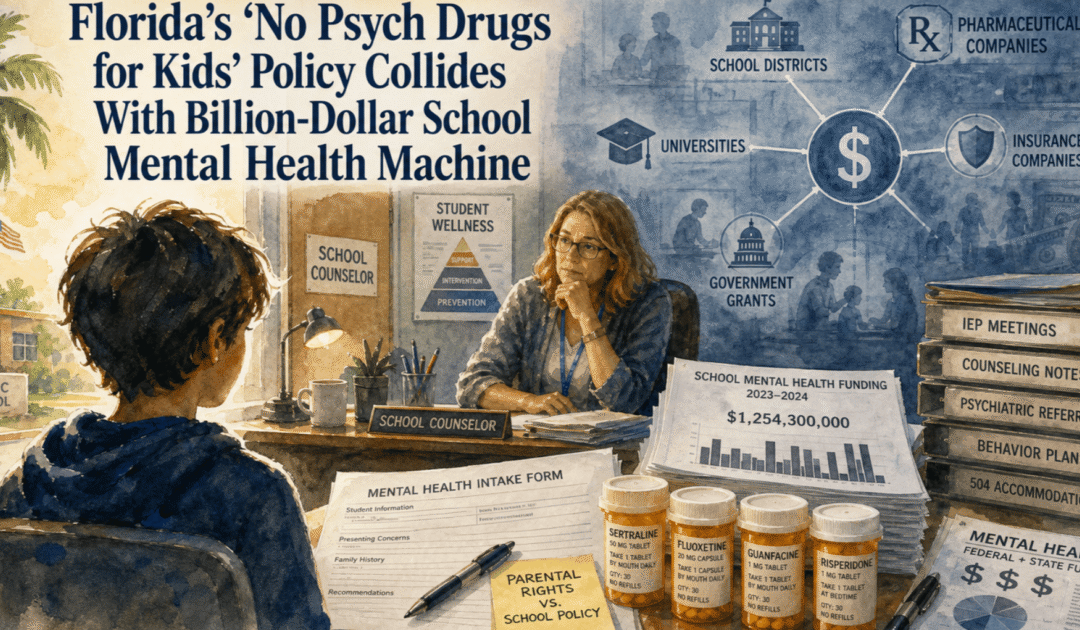
Florida’s “No Psych Drugs for Kids” Policy Collides With Billion‑Dollar School Mental Health Machine
Republished with permission from AbleChild.
The State of Florida Surgeon General, Joseph Ladapo, announced last week a major change in Florida mental health policy in the form of making a state-wide recommendation “against the use of psychotropic drugs in children, 5-17, for treatment of mental health conditions such as depression, anxiety, or attention-deficit related disorders.”
In a word, this is an astounding policy recommendation but, as is usually the case, the recommendation doesn’t go far enough. One of the biggest problems with this very welcomed mental health recommendation is that the State hasn’t made recommendations to reduce mental health intervention in the state’s schools.
In other words, State Surgeon General Ladapo clearly believes that too many of the state’s children are being drugged and is recommending that mind-altering psychiatric drugs not be prescribed to children, while at the same time spending enormous amounts of state and federal funds on mental health in Florida schools. How is it possible to reduce the drugging of the state’s school-age children, while at the same time allowing mental health to intervene in those same schools?
And beyond just suggesting saying no to drugs, as part of this new mental health recommendation, the Surgeon General is further suggesting that other strategies be utilized before a rush to mind-altering drugs. For example, Ladapo recommends a “comprehensive evaluation,” “full physical exam,” “psychotherapy” and “evidence-based behavior management.” It isn’t clear how much these therapies will cost the state compared to simply writing a prescription, but hundreds of millions already are utilized for mental health services in the state.
For example, the Mental Health Assistance Allocation (MHAA) has $180 million allocated directly to school districts, funding school psychologists, social workers and mental health awareness training. There also is nearly $42 million appropriated to Community Action Treatment (CAT) Teams that reportedly provide intensive, community-based psychiatric, clinical and mentoring services to youth in the state. And of course, the above funds don’t include the billions provided by the federal Medicaid mental health budget to the state.
Surgeon General Ladapo is clearly aware of the problems surrounding the drugging of the state’s school-age children reporting that, according to a national health survey, nearly 15% of children aged 5-17 years received mental health treatment in the past 12 months, 8% were taking a medication as “treatment” and nearly 12% received therapy/counseling as mental health treatment.
The prevalence of ADHD is approximately 1 in 9 children in the United States (roughly 11%) and, according to the CDC, Florida currently has nearly 250,000 children being medicated for ADHD. It’s important to understand that ADHD is a behavioral diagnosis, not a neurological deficit and, therefore, the mind-altering drugs prescribe are not “treating” a neurological or biological problem.
In fact, according to the Food and Drug Administration (FDA), how ADHD prescribed drugs (Ritalin, Adderall, Vyvanse, Concerta, and Strattera) “work” as “treatment” is “not known.” On the other hand, the known adverse side effects associated with the ADHD mind-altering drugs are substantial, including suicidality, psychosis, hallucinations, aggression, hostility, paranoia, manic symptoms, depression, stroke, heart attack, heart disease, heart defect and sudden death to name a few.
Taking into consideration that the federal drug approval agency has no clue how the ADHD treatments “work” and given the known possible side effects associated with the drugs, one can certainly understand the Florida Surgeon General’s desire to try and reduce the number of the state’s children taking the drugs.
Ironically, while some in the medical establishment in the U.S., like Surgeon General Ladapo are trying to reduce the number of ADHD prescriptions, over the pond, the British appear to be throwing care to the wind when it comes to ADHD drugs. According to the British Medical Journal (BMJ) ADHD medications for adults have risen sharply with the number of ADHD prescriptions for adults rising almost 40% between 2024-25 and 2025-26 from 190,000 to 267,000.
There are just over 46 million adults in England, meaning that about one in 200 adults there take ADHD medications. And the British are drugging its children as freely as the US with the number of prescriptions for ADHD medications rising 17% from 135,000 to 158,000 or one in 100 children during the same period.
The US estimates that 1 in 9 or about 7 million U.S. children have received and ADHD diagnosis and more than half of those were on some form of ADHD drug. So, while AbleChild applauds the State of Florida’s leadership for this brave mental health recommendation, it would seem that more needs to be done in the way of recommendations to reduce the number of mental health services in the state’s schools.
It can’t be halfway in to be an effective policy. Further, nothing in the recommendation discusses whether the state’s doctors are on board with the Surgeon General’s recommendations. At the end of the day, reducing psychotropic drug use among children is a breath of fresh air but unless all the components are working in tandem, it seems doomed to fail. Future data will tell whether the recommendation has been effective. AbleChild will be watching.
AbleChild is a 501(3) C nonprofit organization that has recently co-written landmark legislation in Tennessee, setting a national precedent for transparency and accountability in the intersection of mental health, pharmaceutical practices, and public safety.
What you can do. Sign the Petition calling for federal hearings!
Donate! Every dollar you give is a powerful statement, a resounding declaration that the struggles of these families will no longer be ignored. Your generosity today will echo through generations, ensuring that the rights and well-being of children are fiercely guarded. Don’t let another family navigate this journey alone. Donate now and join us in creating a world where every child’s mind is nurtured, respected, and given the opportunity to thrive. As a 501(c)3 organization, your donation to AbleChild is not only an investment in the well-being of vulnerable children but also a tax-deductible contribution to a cause that transcends individual lives.
The post ABLECHILD: Florida’s “No Psych Drugs for Kids” Policy Collides With Billion‑Dollar School Mental Health Machine appeared first on The Gateway Pundit.
Go to Source
Author: Joe Hoft