
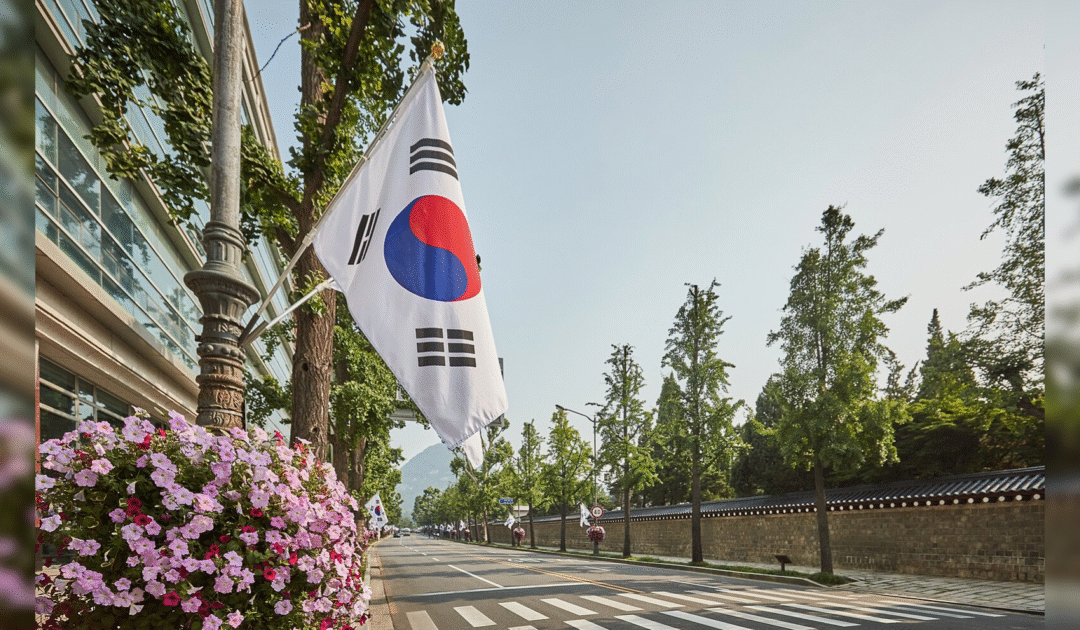
As Trump Confronts China, Is South Korea Moving in the Opposite Direction?
August 13, 2026

Guest post from South Korea
At a time when the United States is increasingly treating Communist China as its principal strategic competitor and moving to restrict Chinese military-linked companies and protect critical AI and technology supply chains, there are growing reasons to question whether South Korea is moving in the opposite direction.
The latest case is particularly striking.
South Korea’s National Pension Service (NPS), which manages the retirement assets of millions of Korean citizens, reportedly made a new investment in Zhongji Innolight, a major Chinese AI data-center technology company, after the U.S. Department of Defense had already formally designated the company as a Chinese Military Company under Section 1260H.
Here is the report from Korea.
The timeline matters.
June 8, 2026: The Pentagon designates Zhongji Innolight a Chinese Military Company.
July 20, 2026: South Korea’s National Pension Service reportedly enters into a cornerstone investment agreement involving the company, Zhongli.
Only 42 days separated the Pentagon designation and the South Korean investment.
This was not an old investment later caught by a new American designation.
The U.S. national-security warning came first. South Korea’s public investment came afterward.
This should be viewed in the context of the larger U.S.-China confrontation
The United States and China are no longer competing simply over trade.
They are competing over artificial intelligence, semiconductors, communications infrastructure, data, advanced manufacturing, critical supply chains, military technology and ultimately strategic power in the Indo-Pacific.
The Trump administration has been moving aggressively in many of these areas.
Washington has expanded scrutiny of Chinese companies connected to the PLA and China’s military-industrial system.
The Pentagon expanded its Section 1260H list of Chinese Military Companies in June.
The Trump administration is also reportedly preparing additional restrictions on Chinese components used in American data centers, including optical transceivers — precisely the technology produced by Zhongji Innolight.
And the Trump administration has publicly raised the issue of Chinese involvement in U.S. election-related activities, releasing and declassifying materials concerning foreign election interference and China’s acquisition and exploitation of American voter data.
Whatever one thinks about each individual policy or intelligence assessment, the strategic direction in Washington is unmistakable:
China is increasingly being treated not merely as a trading partner, but as a long-term economic, technological, intelligence and military competitor.
Yet developments in South Korea increasingly raise the opposite concern
That is why this NPS investment should not be examined in isolation.
South Korea is not simply another country doing business with China.
It is a treaty ally of the United States.
Approximately 28,500 American troops are stationed on the Korean Peninsula, and the U.S.-ROK alliance remains the foundation of South Korea’s national defense.
South Korea also occupies an extraordinarily important position in the global semiconductor, battery, telecommunications and advanced-technology supply chains that are central to U.S.-China strategic competition.
Against that backdrop, the question becomes much larger than whether one pension-fund investment will make or lose money.
Where is South Korea strategically heading as the confrontation between Washington and Beijing intensifies?
That question deserves serious attention.
When Washington is trying to reduce exposure to companies connected to China’s military-industrial system, why is a South Korean public pension institution committing new capital to a company after the Pentagon placed it on its Chinese Military Companies list?
When Washington is attempting to secure AI infrastructure and technology supply chains from Chinese strategic dependence, why is Korean public capital flowing into a Chinese company operating directly inside that critical infrastructure?
And if the U.S.-China competition continues to intensify, how will South Korea reconcile deeper economic and institutional exposure to China with an alliance system that remains overwhelmingly dependent on the United States?
Zhongji Innolight makes this contradiction impossible to ignore
Zhongji Innolight is not an ordinary consumer company.
It manufactures high-speed optical transceivers used inside AI data centers — components responsible for moving enormous amounts of data among servers, GPUs and networking systems.
AI infrastructure is rapidly becoming one of the central battlegrounds of U.S.-China technological competition.
The company also reportedly derives more than 60 percent of its revenue from the United States.
Yet the Pentagon has now identified it as a Chinese Military Company, while Washington is considering further restrictions involving Chinese data-center technology.
Despite those warning signs, South Korea’s national pension fund reportedly participated in its Hong Kong IPO.
According to the Korean report, the NPS joined BlackRock-related funds and other institutional investors in a cornerstone investment arrangement totaling approximately $250 million, although the NPS’s individual allocation has not been disclosed.
The shares are reportedly locked up until January 29, 2027.
This means Korean retirement capital could remain exposed while Washington continues tightening its China policy.
The lack of transparency makes this even more concerning
Korean media asked the NPS whether it knew about Zhongji Innolight’s Pentagon designation and whether the designation had been considered before the investment.
The NPS reportedly declined to disclose details regarding the individual investment.
That is not a satisfactory answer.
This is not private capital.
It is the retirement money of the Korean people.
The public deserves to know whether the Pentagon designation was identified during the investment review, whether geopolitical and regulatory risks were evaluated, who approved the investment, and whether the NPS has additional exposure to companies identified by Washington as part of China’s military-industrial system.
But there is an even more important question for Americans:
Are major South Korean institutions still moving strategically in the same direction as the United States?
Americans should pay attention to the direction of South Korea
For decades, Washington largely viewed South Korea through the framework of North Korea.
That framework may no longer be sufficient.
The U.S.-China struggle is reshaping the entire Indo-Pacific.
China’s economic influence, technology networks, supply chains, capital, political influence operations and military-civil fusion strategy cannot be separated from the broader regional security environment.
South Korea sits directly in the middle of that competition.
That is why developments that might once have been dismissed as ordinary commercial or investment decisions deserve a different level of scrutiny today.
A single investment does not prove that South Korea has chosen China over the United States.
But neither should individual developments be dismissed without examining whether they form part of a broader pattern.
And the pattern is precisely what I believe American journalists and policymakers should begin examining more closely.
As the Trump administration moves to confront China’s military, technological and economic expansion, is South Korea gradually becoming more economically and institutionally aligned with Beijing?
If so, what does that ultimately mean for the U.S.-ROK alliance?
That is the larger story.
The National Pension Service investment in Zhongji Innolight may be one important piece of it.
The Pentagon designated the company on June 8.
South Korea’s national pension fund invested on July 20.
Only 42 days later.
At a moment when Washington is attempting to reduce strategic dependence on China, Americans deserve to know why institutions in one of America’s most important Asian allies appear, in cases like this, to be moving in the opposite direction.
The post As Trump Confronts China, Is South Korea Moving in the Opposite Direction? appeared first on The Gateway Pundit.
Go to Source
Author: Guest Contributor