
Bounties on Trump Continue Amid Iran’s Rising Tensions with the U.S.

Bounties on Trump Continue Amid Iran’s Rising Tensions with the U.S.

Bounties on Trump Continue Amid Iran’s Rising Tensions with the U.S.
July 19, 2026

Image: Iran International English Screenshot (https://x.com/IranIntl_En/status/2077306164967018694)

Bounties and incentives for the assassination of former President Donald Trump have emerged as a significant concern amid escalating tensions between Iran and the United States, which are increasingly veering toward a larger conflict.

The Wall Street Journal reported that Israel has recently provided the U.S. with new intelligence indicating that Iranian regime is formulating a new scheme to assassinate the President of the United States. This revelation adds to a series of previous threats from Iran regarding Trump’s assassination.

In the face of such threats, President Donald Trump, undeterred, took a significant step forward in diplomacy in the region. On July 14, 2026, he welcomed Iraqi Prime Minister Ali Zaidi to the White House.

At the meeting, Trump commented on the January 2020 U.S. drone strike that resulted in the deaths of Iranian IRGC Quds Force Commander Qassem Soleimani and former Deputy Chief of the Popular Mobilizations Units (PMU) Abu Mahdi al-Muhandis.

As reported by The Associated Press, al-Zaidi avoided addressing Trump’s comments, stating, “At that time, I wasn’t involved in politics. Let’s talk about the future.”

Following Trump’s comments, the Islamic Resistance in Iraq, a coalition of Iran-aligned militants, responded via social media, asserting that his statements reflect the arrogance and moral decay of the U.S. government. This group, part of Iran’s “Axis of Resistance,” aligns with many of the regime’s ideological goals.

A report by the Middle East Media Research Institute (MEMRI) verifies that a short announcement on Telegram declared the group is offering a $10 million reward for the assassination of “criminal Trump.”

In another provocative move, a billboard depicting Donald Trump in a coffin, accompanied by the phrase “We Kill Trump,” has recently emerged in central Tehran. This display follows the funeral of Ayatollah Ali Khamenei and coincides with renewed promises of retaliation from Iran’s new Supreme Leader, Mojtaba Khamenei.

Alongside these threats and propaganda, earlier this month, Amir-Hossein Sabeti, a member of the Islamic Consultative Assembly representing Tehran, called on lawmakers to “prioritize” the consideration of a bill titled “Revenge on Trump and Other U.S. and Israeli Leaders” in Parliament’s agenda.

This legislative push comes amid a broader context of escalating tensions and aggressive rhetoric directed at U.S. officials. In May, the Islamic Republic began reviewing a bill that would provide a substantial financial reward for anyone who assassinated President Donald Trump, Prime Minister Benjamin Netanyahu, and/or CENTCOM commander Brad Cooper.

The proposal stipulates that the government must set aside the equivalent of $57.9 million for any person or group that successfully carries out the assassination of President Donald Trump and the others.

As tensions between the U.S. and Iran remain elevated, the strong rhetoric from Iran and its affiliated factions, coupled with the financial incentives being proposed, underscore the persistent hostilities and the potential for further escalation.

The repeated calls for Trump’s assassination continue to cast significant doubt on the viability of diplomatic solutions and the future of international stability in the region.

The post Bounties on Trump Continue Amid Iran’s Rising Tensions with the U.S. appeared first on The Gateway Pundit.

Go to Source
Author: J.M. Phelps
(VIDEO) John Fetterman Suggests He May Leave Democratic Party Then Trashes Trump for Talking About 2020 Election, Says “No Evidence” of Illegal Voters

(VIDEO) John Fetterman Suggests He May Leave Democratic Party Then Trashes Trump for Talking About 2020 Election, Says “No Evidence” of Illegal Voters

(VIDEO) John Fetterman Suggests He May Leave Democratic Party Then Trashes Trump for Talking About 2020 Election, Says “No Evidence” of Illegal Voters
July 19, 2026

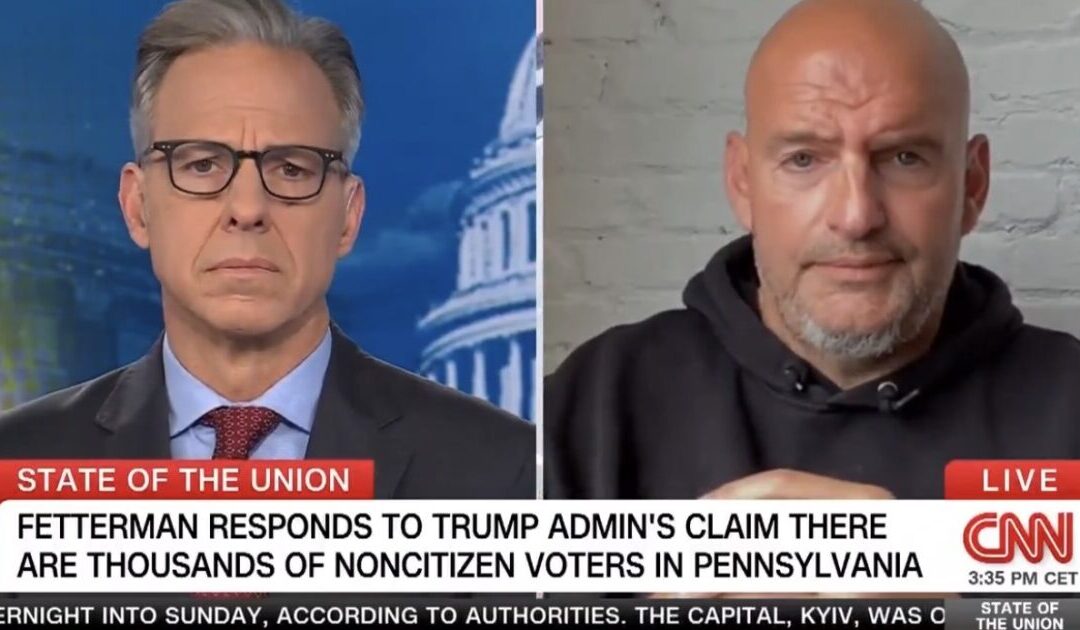
Democratic Senator John Fetterman threatened to leave the Democratic Party again during a Sunday appearance on CNN’s State of the Union and then lashed out at President Trump over his speech on election fraud. 

CNN’s Jake Tapper asked about far-left candidates like Abdul El-Sayed in Michigan, and Fetterman slammed the Democrats for voting against aid to Israel and the anti-Israel views becoming more mainstream in the party.

“I think it’s entirely appropriate to be pro-Palestinian,” Fetterman said. “And, of course, I’m deeply sympathetic to many of innocent Palestinians as well over, but where we have become parts in our party now, describing Israel as genocidal state or apartheid state, and now we’re not going to vote for any kind of aid.”

“And now even people like the J Street organization are going to vote against basic things like the Iron Dome, and it’s getting more and more incredibly hostile towards Israel. Israel is our important, key ally,” he continued.

When asked about his past comments on potentially leaving the Democratic Party if they become “an anti-Israel party,” Fetterman confirmed that he is questioning his alignment with the party.

“if that becomes the Democratic platform that we will now ever vote for any aid and will turn our back on Israel, then that makes — that makes me to make that decision as really what a Democrat should stand for, or being a part of my party for me,” Fetterman said.

“If I change my party spontaneously right now, my views and my votes aren’t going to change,” he continued.

“If you believe the Democratic Party’s future is rooted in describing Israel as apartheid state or genocidal, and they don’t deserve to have our support, that forces me to say, i this really make sense for me as a Democrat with these views are continue to actually intensify?”

WATCH:

Fetterman was later asked about President Trump’s address to the nation last week, where he revealed that 278,000 illegal voters had been discovered on state voter rolls across just four states whose voter registration files were reviewed, and he claimed “there’s no evidence” of Trump’s statements.

“Well, I was lieutenant governor during the 2020 election, and I have appeared on your network and many other networks at that time. That election was absolutely secure, fair, and accurate,” Fetterman claimed, further slamming Trump for talking about the rigged elections.

“until I see evidence that over a quarter-million migrants that are voted — are registered to vote, then, yeah, that would make me reconsider some of these things. But there’s no evidence, and I don’t expect that we will see any of that,” Fetterman said.

“I don’t know why the president is dragging up all of this stuff. You’re the president. Do something positive, and you are talking about 2020, that’s been settled over six years ago,” he continued. “It’s deeply unhelpful, and that distracts important things, especially like the Iranian war right now.”

WATCH:

The post (VIDEO) John Fetterman Suggests He May Leave Democratic Party Then Trashes Trump for Talking About 2020 Election, Says “No Evidence” of Illegal Voters appeared first on The Gateway Pundit.

Go to Source
Author: Jordan Conradson

Hawaii Supreme Court Orders Office of Elections to Answer Petition Over Refusal to Support Elections Commission

Hawaii Supreme Court Orders Office of Elections to Answer Petition Over Refusal to Support Elections Commission

Hawaii Supreme Court Orders Office of Elections to Answer Petition Over Refusal to Support Elections Commission
July 19, 2026

Hawaii Supreme Court Orders Office of Elections to Answer Petition Over Refusal to Support Elections Commission

Court gives state agency until July 24 to explain why it would not help the Commission meet; petitioners may reply by July 29

HONOLULU, Hawaiʻi — The Hawaiʻi Supreme Court has ordered the State Office of Elections to respond, by Friday, July 24, 2026, to a petition alleging the agency unlawfully refused to provide administrative support to the Hawaiʻi Elections Commission — support the Commission needed to convene a meeting and elect a chairperson.

The July 17, 2026, order, issued in Cushnie & McKay v. Nago (SCPW-26-0000498), directs Respondents Scott T. Nago, Chief Election Officer, and the Office of Elections to address two questions:

  1. Whether the Office of Elections failed or refused to provide staff support to the Elections Commission as required under Hawaiʻi Revised Statutes § 11-1.5(b); and
  2. Whether that failure prevented the Elections Commission from meeting to elect a chairperson.

The order was signed by Acting Chief Justice Sabrina S. McKenna, Justices Todd W. Eddins and Lisa M. Ginoza, and Circuit Judges Peter T. Cahill and Dyan M. Medeiros, sitting by assignment.

Background

Petitioners Ralph S. Cushnie and Tamara McKay, Commissioners of the Hawaiʻi Elections Commission representing Kauaʻi and Maui counties respectively, filed an emergency petition for writ of mandamus on July 8, 2026. The petition states that the Commission — which has lacked a chairperson since June 30, 2026 — could not lawfully notice or convene a meeting because the Office of Elections declined to provide basic administrative support, including a remote-meeting link and distribution of meeting notices, despite HRS § 11-1.5(b)’s requirement that the Office “shall provide staff support to the elections commission, as requested by the elections commission.”

The petition further states that the Department of Accounting and General Services confirmed in writing that the statutory support obligation rests with the Office of Elections, and that the Department of the Attorney General is not authorized to convene Commission meetings on the agency’s behalf.

What Happens Next

Under the Court’s order, Respondents must file their answer by July 24, 2026. Petitioners may then file a reply of no more than ten pages by July 29, 2026.

We’ve been reporting on this for a long time.

Four Years Later, Hawaii’s Fundamental Election Certification Question Remains Unresolved

The post Hawaii Supreme Court Orders Office of Elections to Answer Petition Over Refusal to Support Elections Commission appeared first on The Gateway Pundit.

Go to Source
Author: Joe Hoft

NEW: Trump Administration Uses Alien Terrorist Removal Court for the First Time

NEW: Trump Administration Uses Alien Terrorist Removal Court for the First Time

NEW: Trump Administration Uses Alien Terrorist Removal Court for the First Time
July 19, 2026

The commonality among deportees is that they are in the country illegally. Many of those whom the media claim have status actually lost that status due to violations of the terms of their visas. Photo courtesy of the Department of Homeland Security.

The Trump Administration has activated the Alien Terrorist Removal Court for the first time ever, testing a new deportation process to swiftly deport aliens deemed to be terrorists.  

According to the Federal Judicial Center,

In 1996 Congress created the Alien Terrorist Removal Court as a special court and authorized the Chief Justice of the United States to designate five U.S. district court judges to review applications for the removal from the United States of alien terrorists. Judges serve for staggered, renewable five-year terms and must be drawn from different judicial circuits. The Chief Justice may appoint to the court the same judges designated to serve on the Foreign Intelligence Surveillance Court. The provisions for the court were part of the Antiterrorism and Effective Death Penalty Act of 1996 (110 Stat. 1214), a broad legislative effort to combat international terrorism.

The statute authorized the Attorney General to draft an application for removal of a suspected alien terrorist, and to submit the application to the removal court under seal. A single judge may grant the application upon a finding that the alien in question has been identified correctly as an alien terrorist present in the United States and that removal under other available legal means would pose a risk to national security. Upon granting a removal application, the court must hold a public removal hearing at which the accused has the right to be represented by counsel and the government bears the burden of proving that the accused is an alien terrorist. To avoid the disclosure of classified information, the government must prepare an unclassified summary of such information which the judge must find to be sufficient for the alien to prepare a defense. If the government meets its burden of proof at the hearing, the court will order the alien removed from the United States.

A July 16 order from the Alien Terrorist Removal Court reveals that the United States filed the first-ever application to the court to remove an unnamed respondent on July 15.

A hearing was held on July 16, during which the court was persuaded that “the Government could benefit from the opportunity for more thoughtful consideration,” Chief Judge Joan Eriksen wrote.

Previously, the use of the court was suggested to the Department of Justice by Obama Judge James Boasberg, who previously barred Trump from invoking the Alien Enemies Act to carry out mass deportations.

More from Politico:

The activation of the court is another indication of the Trump administration seeking to maximize its deportation authority in unprecedented ways. Though the court has never been used, its existence became an obstacle for the administration last year, when the administration sought to abruptly deport more than 100 Venezuelan nationals by labeling them members of Tren de Aragua, a transnational gang that Trump deemed a terrorist organization.

At the time, U.S. District Judge James Boasberg noted that the existence of the court seemed to suggest the administration could not simply deport people it labeled terrorists without the involvement of any court.

“In fact, Congress has an answer for us, doesn’t it? Because they created the Alien Terrorist Removal Court,” he said. “You can always go to the ATRC, which would be a first, but that’s what it’s there for, right?”

Trump administration attorney Drew Ensign responded that just because the administration could use the court doesn’t mean Trump was prohibited from using a different power — the Alien Enemies Act — to deport people without court proceedings.

Under the law establishing the court, applications to remove an “alien terrorist” must be approved by the attorney general or deputy attorney general — in this case, acting Attorney General Todd Blanche — and backed by a statement of facts describing the reason for the designation and certifying that the person’s presence is a threat to national security.

The post NEW: Trump Administration Uses Alien Terrorist Removal Court for the First Time appeared first on The Gateway Pundit.

Go to Source
Author: Jordan Conradson

Woke U: University at Buffalo Funds Research on ‘Queer Theory,’ ‘Racial Capitalism’

Woke U: University at Buffalo Funds Research on ‘Queer Theory,’ ‘Racial Capitalism’

Woke U: University at Buffalo Funds Research on ‘Queer Theory,’ ‘Racial Capitalism’
July 19, 2026

Participants at a UC Berkeley rally hold signs advocating for equity, diversity, and inclusion, alongside a prominent display of the Black Lives Matter movement.

In the latest example of DEI (Diversity, Equity, and Inclusion) and wokeness at educational institutions, Campus Reform reports that the University of Buffalo is funding research on ‘queer theory’ and ‘racial capitalism.’

“The University at Buffalo’s Gender Institute will fund grant projects with up to $7,000 to advance scholarship related to women, gender, and sexuality.”

In January 2025, President Trump signed the Executive Order ‘Ending Illegal Discrimination and Restoring Merit-Based Opportunity.’

It targets DEI and DEIA programs across the federal government, private sector, and institutions of higher education.

The University of Buffalo’s grants seem to fly in the face of the order.

“Funding, which ranges from $1,000 to $7,000, can support “data collection, archival research, fieldwork, research assistance, supplies, books, software, travel integral to the development of the project, and other forms of research support and curriculum development expenses.”

“A grant from fall 2025 supported a monograph about Shakespeare’s Macbeth and abortion. The project was titled “Queering Birth, Queering Death: The Problem of Life in Early Modern Literature.”

This should all be unacceptable at an institute of higher learning, but sadly, many just view these types of projects as normal.

“Another project from last fall, “Gendered Labor and Racialized Capital in Contemporary Rap Music,” argued that “capitalism consumes Blackness in gendered ways.”

In other words, racialization and balkanization are being funded at Buffalo.

“I position these patterns as technologies of racial capitalism that operate despite claims of colorblindness and highlight the ways that these artists use technical communication to provide strategies for survival as a Black person in the United States,” the description states.

“This project trace[s] how feminine, masculine, queer, and nonconforming embodiments of Blackness are differently commodified and therefore consumed under late‑stage capitalism in contemporary America,” it continues.”

Buffalo is hardly alone in teaching these courses on DEI. We have covered numerous colleges that continue to engage in wokeness and DEI.

Places of higher learning are now in many cases incubators of wokness and PC garbage instead of education.

The post Woke U: University at Buffalo Funds Research on ‘Queer Theory,’ ‘Racial Capitalism’ appeared first on The Gateway Pundit.

Go to Source
Author: Seth Segal