California Taxpayers Are Funding Free Crack Pipes, Needles and Narcan for Drug Users
November 20, 2026

In Santa Clara County, California, a drug user can walk up to a vending machine at a county health center, enter a personal code, and receive free supplies for smoking, snorting or injecting drugs, along with naloxone, the overdose-reversal drug sold as Narcan. The machines are run by the county’s Public Health Department and sit outside the Lenzen Health Center and the Gilroy Valley Health Center. If a user forgets the code, the machine will still release naloxone in an emergency.
California law prohibits drug paraphernalia but carves out an exception for syringe services programs. A January 2026 state health department fact sheet lists the items those programs may hand out, including cookers for mixing injectable drugs, tourniquets and “pipes and foil suitable for smoking opioids or methamphetamine.” Since 2015, the state has supplied these programs through a supply clearinghouse paid for out of the state’s general fund.
Los Angeles County’s Skid Row Care Campus grew out of a $60 million state grant awarded in 2023. The campus began providing services in April 2025 and costs about $26 million a year in local, state and federal money. During several visits in July 2026, City Journal reporters picked up syringes, drug-testing strips and crack pipes at a walk-up counter. A worker told them drug use was prohibited on campus but that they “wouldn’t be bothered” if they got high just outside. The campus also distributes condoms.
While filming a Los Angeles street outreach team in February 2026, independent journalist Nick Shirley spoke with a social worker who showed him three doses of Narcan and explained that outreach teams also hand out needles. Shirley summed up the policy in a post on X, saying the state revives users with Narcan and then gives them “the supplies to kill yourself again.”
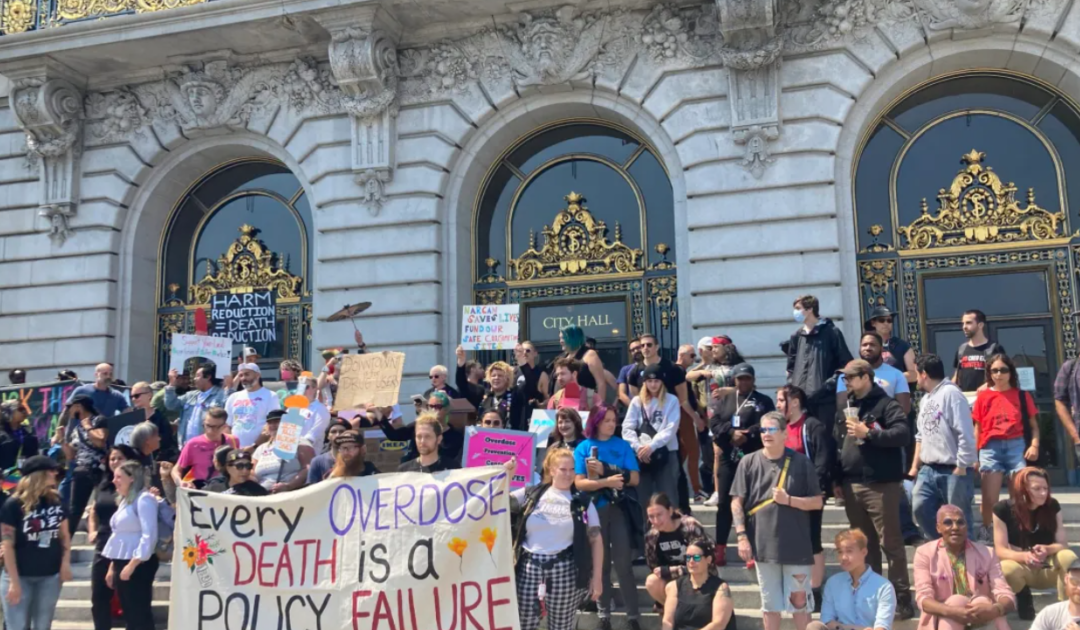
California lawmakers have also pushed for supervised drug-use sites, where people bring their own drugs and use them while staff stand by with naloxone. San Francisco’s Tenderloin Center, which opened in January 2022, let people use drugs in its courtyard and reversed more than 300 overdoses.
Later that year, the legislature passed Senate Bill 57, which would have allowed such sites in San Francisco, Oakland and Los Angeles. Governor Gavin Newsom vetoed the bill, warning that an unlimited number of sites “could induce a world of unintended consequences.” The Tenderloin Center cost the city $22 million before closing in December 2022.
San Francisco has since restricted distribution. In April 2025, Mayor Daniel Lurie ordered city-funded programs to stop giving out syringes and smoking kits unless they also offered counseling or connections to treatment. The city later barred programs from handing out pipes, foil and straws in streets, parks and on sidewalks.
Overdose deaths climbed during the first part of the Biden administration even as Narcan became more widely available. Deaths hit a record of more than 108,000 in 2022. From late 2020 to mid-2023, the CDC found that emergency room visits for nonfatal fentanyl overdoses rose from 1.4 to 3.5 per 10,000 visits, an increase of 150%.
Death counts capture a fraction of the total overdoses. Nonfatal overdoses have soared, and Narcan and similar drugs allow users to survive overdoses that might otherwise have killed them, sometimes more than once in a matter of weeks.
In 2020, emergency rooms treated more than 926,000 nonfatal overdoses, about 10 for every death. In a study of people who inject drugs in Oakland and San Francisco, those who had used naloxone reported reversing overdoses a median of four times in the previous three months.
The Biden administration made naloxone the centerpiece of its national drug policy. In December 2024, the White House claimed credit for a 17% drop in overdose deaths, and its drug policy office called naloxone a critical element in that decline. By January 2025, the White House said states had bought more than 10 million overdose-reversal kits with federal State Opioid Response grants.
California’s 2023 budget set aside $61 million for overdose prevention and harm reduction. In July 2025, President Trump signed Executive Order 14321, which directs that federal grants not fund “harm reduction” or “safe consumption” programs that only facilitate illegal drug use.
Narcan keeps drug users alive, but it does nothing to get them off drugs. By reducing the risk of a fatal overdose, it weakens one of the deterrents for first-time users. Economists Jennifer Doleac and Anita Mukherjee examined how overdose deaths, emergency room visits and theft changed after states expanded naloxone access. Their study, published in the Journal of Law and Economics, found that broader access led to more opioid-related emergency room visits and more opioid-related theft, with no net reduction in opioid deaths. In the Midwest, opioid deaths rose 14%, and the authors found suggestive evidence that naloxone access increased fentanyl use. By handing out Narcan alongside pipes and needles, California extends the lives of drug users while doing nothing to discourage drug use itself.
The post California Taxpayers Are Funding Free Crack Pipes, Needles and Narcan for Drug Users appeared first on The Gateway Pundit.
Go to Source
Author: Antonio Graceffo