
Christian Faith and Patriotism at the 2026 FIFA World Cup
June 29, 2026

The 2026 FIFA World Cup, the largest in the tournament’s history with 48 nations competing across the United States, Canada, and Mexico, has drawn a global audience of billions. What many of those billions have witnessed, alongside the football, is something they may not have expected: open, unashamed declarations of faith and love of country from athletes and fans.
At a moment when American patriotism and Christian identity have returned forcefully to public life, the world’s most-watched sporting event has become their most visible international stage.
Not all American athletes respond to their national anthem the same way. The divergence between those who embrace that moment and those who do not has rarely been more visible than during the 2026 FIFA World Cup and the Winter Olympics that preceded it.
At the 2026 Winter Olympics in Milan-Cortina, Jack Hughes scored the game-winning goal 1:41 into overtime to defeat Canada 2-1, giving the United States its first men’s hockey gold in 46 years. Hughes had lost two teeth after taking a high stick during the game, brushing it off with characteristic bravado: “I’m from the best country in the world. We’ve got great dentists there, too. So I’m lucky I’m American.”
Captain Brady Tkachuk, draped in the American flag, told reporters: “This is all about our country right now. I love the USA. I’m so proud to be American today.” President Trump called into the locker room celebration via speakerphone, invited the team to the State of the Union, and offered to send a military plane, an offer met with raucous cheers.
The men’s team attended the State of the Union, where Trump announced he would award goalie Connor Hellebuyck the Presidential Medal of Freedom. The U.S. women’s hockey team, which had also won gold, declined the White House invitation.
The contrast extends to the soccer pitch. While tens of thousands of fans sang the Star-Spangled Banner in unison at the 2026 men’s World Cup, at the 2023 Women’s World Cup a majority of USWNT players did not sing the national anthem or place their hands over their hearts. They stood in silence as the Star-Spangled Banner played, while the opposing Vietnamese team sang their anthem passionately in unison, every player with her hand over her heart. That image captures something important about what is at stake.
For most of the world, the FIFA World Cup is the single greatest expression of national identity available to them. Many nations will never land on the moon, dominate global military or economic affairs, or top the Olympic medal table, yet every one of them can field a soccer team. Americans, accustomed to leading in all of those arenas and carrying the weight of the world’s reserve currency, have little frame of reference for what this tournament means to a Senegalese or Honduran or Croatian fan.
When American athletes refuse to sing the national anthem, decline to place their hands over their hearts, or publicly distance themselves from their country on that stage, they are broadcasting national ingratitude to a global audience of billions for whom representing their country here is the highest honor their sport can bestow.
The patriotism on display at the 2026 men’s World Cup has been a different story entirely. Country duo Dan + Shay performed the national anthem before the USMNT’s opening match against Paraguay, and the Fox Sports clip went viral within hours, racking up more than 700,000 views in three hours. Tom Cruise was caught on camera singing along in the crowd. At the Turkey match, players and fans sang the Star-Spangled Banner in unison.
Perhaps the most striking patriotism story of the tournament has been “Take Me Home, Country Roads.” After the U.S. team’s 2-0 win over Australia in Seattle, 66,925 fans belted out the John Denver classic with players joining in on the pitch. Midfielder Sebastian Berhalter said: “Singing that song was one of the highlights of this whole tournament so far. Belting that out, it just felt so American in that moment.”
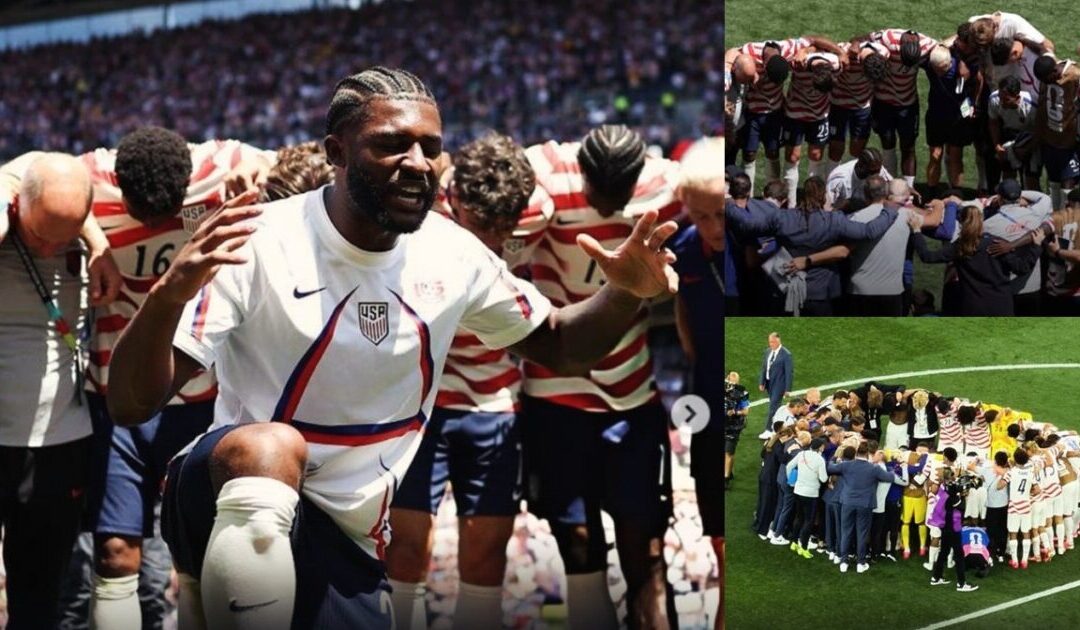
Christian faith has been an equally defining storyline. After the USMNT’s 4-1 opening victory over Paraguay at SoFi Stadium, defender Mark McKenzie led the entire squad in a post-match prayer circle on the pitch in front of more than 70,000 fans. Weston McKennie points skyward after every goal, wears cross earrings on the field, and keeps “All glory to God” at the top of his social media profile.
Defender Chris Richards helps run Bible studies at Crystal Palace. Christian Pulisic has shifted the cultural dynamic of the USMNT locker room by hosting a player-led men’s Bible study he calls “Bible Time,” with teammates including Richards and goalkeeper Matt Freese participating. Freese told the Sports Spectrum podcast: “God’s given me so many opportunities within this game and within my career. I still have a role to play in that. I still have to do my part and take that opportunity and do something with it.” He also follows Father Mike Schmitz’s “Bible in a Year” podcast. Seattle-born midfielder Cristian Roldan summed up his faith in three words: “Jesus is everything.”
That witness has extended well beyond the American squad. Following Germany’s 7-1 opening win over Curaçao in Houston, German midfielder Felix Nmecha and teammate Jonathan Tah joined several Curaçao players at the center circle for a post-match prayer. Nmecha said afterward: “During the game, we are opponents. But after the game, we are all Christians and we are brothers. We simply prayed together because we all believe that Jesus is glorified through the game.” Before their opening match against England, Croatian players Kristijan Jakić and Igor Matanović used their official FIFA press conference to speak about their Catholic faith. Matanović told reporters: “When you pray to God, it’s like a feeling that someone is listening to you, and that gives me a lot of strength.” The team celebrated Mass together in the days before traveling to North America. Jakić added: “Faith simply means everything in our lives. I think faith represents the entire national team.”
Before the tournament, Lionel Messi had his special-edition Adidas boots taken to the Basilica of Our Lady of Luján in Argentina, where they were blessed by a priest. Wearing them on June 16, he scored his first-ever World Cup hat trick against Algeria, making the Sign of the Cross after each goal.
Portugal’s Cristiano Ronaldo also makes the Sign of the Cross as he steps onto the pitch. England’s Bukayo Saka, Marc Guéhi, and Eberechi Eze, nicknamed the “Bible Brothers” by the British press, have spoken openly about their faith throughout the tournament. Guéhi said, “My faith is the most important thing in my life.”
Mexico striker Santiago Giménez, Belgium’s Jérémy Doku, and France debutant Maxence Lacroix have all spoken about praying before matches. One of the tournament’s most remarkable faith stories belongs to Iraq. Its squad includes several Assyrian Christian players, members of one of the world’s oldest Christian communities. Although Christians make up less than one percent of Iraq’s population, they account for roughly one-fifth of the national team.
Brazil goalkeeper Alisson Becker, a devout Pentecostal nicknamed the “Holy Goalie,” has hosted baptisms in his own swimming pool. Teenage forward Endrick has said that, above all, God is his psychologist.
That outpouring of Christian witness has unfolded against a backdrop of anti-religious, woke controversy. Seattle designated the June 26 match between Egypt and Iran, two nations where same-sex relations are criminalized or penalized, as a “Pride Match” coinciding with the city’s annual Pride weekend. Both federations formally objected and requested that no Pride-related symbols or activities appear inside the stadium.
FIFA overrode both objections, confirming that rainbow flags would be permitted under its stadium code of conduct. In the history of the men’s World Cup, no publicly out LGBTQ player has ever competed, and none are on any of the 48 teams in this tournament. As a result, FIFA overrode the objections of two participating federations to accommodate 0 percent of players and likely 2 percent or fewer of fans.
The breadth of Christian witness at this World Cup, from prayer circles across national lines to blessed boots and locker-room Bible studies, reflects a broader moment in America. Faith and national pride are being reclaimed openly and unapologetically.
The post Christian Faith and Patriotism at the 2026 FIFA World Cup appeared first on The Gateway Pundit.
Go to Source
Author: Antonio Graceffo