
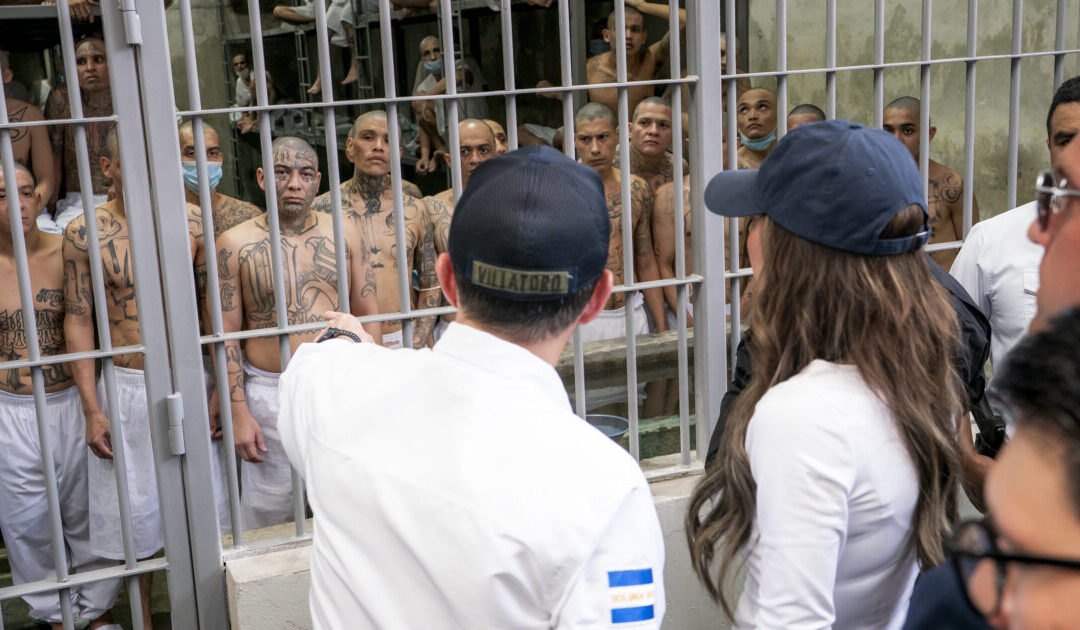
Democrats Criticized the Megaprison That Broke the Gangs’ Hold on El Salvador. Now Latin American Countries Are Building Their Own
November 27, 2026

Peruvian Justice Minister Ernesto Álvarez announced Nov. 19 that President Keiko Fujimori’s government will build two megaprisons in the Sayán district of Huaura province, north of Lima, with room for about 24,000 inmates. Álvarez said one of the two facilities, a maximum-security prison designed to hold about 10,000 inmates, would be built “with support from the United States.” He said Peru wants to “imitate El Salvador” by putting inmates to work.
Governments in 10 Latin American countries have proposed 16 megaprisons since Salvadoran President Nayib Bukele opened his Terrorism Confinement Center (CECOT) in 2023.
Democrats in Washington attacked Bukele’s prison after the Trump administration deported Venezuelans to El Salvador in March 2025 and Salvadoran authorities incarcerated them there. House Judiciary Committee Democrats called CECOT a “Salvadoran Torture Prison,” and Sen. Tim Kaine (D-Va.) accused Bukele of rounding up tens of thousands of Salvadorans and having “jammed them indefinitely into overpopulated torture centers.” Kaine and Sens. Chris Van Hollen (D-Md.) and Alex Padilla (D-Calif.) introduced a bill to freeze the assets of Bukele and other Salvadoran officials and bar them from entering the United States. The White House praised “President Bukele’s leadership in the region and the example he sets for other nations in the Western Hemisphere.”
Bukele’s crackdown began three years before that fight in Washington. From March 25 to 27, 2022, gangs killed 87 people in El Salvador, including 62 on March 26 alone, according to the National Civil Police. At Bukele’s request, the Legislative Assembly declared a state of exception on March 27, suspending some constitutional guarantees so police and soldiers could arrest suspected gang members.
The government built CECOT in Tecoluca, San Vicente department, to hold people arrested in the crackdown. With room for 40,000 inmates, it is the largest prison in Latin America. By the end of 2025, authorities had arrested 90,844 people under the emergency measure.
El Salvador recorded 6,656 homicides in 2015, a rate of 103 per 100,000 people. Authorities said gangs operated in 90% of the country and collected nearly $2 billion in extortion. Homicides had fallen to 2,383 by 2019. In 2025, the Ministry of Justice and Public Security reported 82 homicides, a rate of 1.3 per 100,000. “For the first time in the history of the country we closed with two digits,” Security Minister Gustavo Villatoro said.
In Gallup’s 2025 survey, 90% of Salvadorans said they felt safe walking alone at night, the same share as in Switzerland and Norway. Across Latin America and the Caribbean, 50% said they felt safe. El Salvador scored 92 out of 100 on Gallup’s Law and Order Index, the region’s highest score. The United States scored 86.
Antonio Ventura, who runs a grocery store in San Salvador, paid gangs $100 a month for nearly 20 years. The demands stopped after the crackdown. “I had to pay up or if not they could make me disappear,” he told the Thomson Reuters Foundation. Aminta Alvarenga, who owns a wholesale store, told AFP in 2024, “We no longer have extortion. The danger has passed.”
Breaking the gangs’ grip on El Salvador has helped businesses grow and drawn more tourists, improving the lives of Salvadorans. The country’s GDP per capita rose from $4,168 in 2019 to $5,767 in 2025 in current U.S. dollars, according to World Bank data. The country received a record 4.12 million international visitors in 2025, and Tourism Minister Morena Valdez said tourism brought in more than $3.6 billion. UN Tourism ranked El Salvador third in the world for growth in tourist arrivals, which were up 92% from 2019.
Costa Rica went furthest in adopting Bukele’s model, building its megaprison from blueprints that El Salvador donated. After the country recorded a historic high of 907 homicides in 2023, President Rodrigo Chaves and Bukele laid the cornerstone for the Centro de Alta Contención contra el Crimen Organizado (High-Containment Center Against Organized Crime), known as CACCO, on Jan. 14, 2026. Laura Fernández, a minister under Chaves, won the February presidential election with 48% of the vote after campaigning on building a megaprison modeled on El Salvador’s.
Fernández opened the prison on Oct. 14. The $35 million facility can hold 5,100 inmates. The first 123 inmates arrived on Oct. 26 with shaved heads and orange uniforms.
In Ecuador, President Daniel Noboa’s government opened the Cárcel del Encuentro (Encounter Prison) in Santa Elena province on Nov. 10, 2025, the year Ecuador’s homicide rate reached a record 50.9 per 100,000 people. Former Vice President Jorge Glas was among the first 300 inmates transferred there.
Noboa and Bukele joined leaders from 10 other countries in Trump’s new anti-cartel alliance at the Shield of the Americas summit in Doral, Florida, on March 7, 2026. “I want to thank members of the coalition, most of whom are friends of mine,” Trump said at the summit, adding that he had endorsed many of them. Mexico, Brazil and Colombia, all led by leftist presidents at the time, were not invited.
Honduras, Panama and Argentina are among the alliance members planning or building maximum-security prisons. In Honduras, Trump endorsed Nasry Asfura before the 2025 election, writing, “The only real friend of Freedom in Honduras is Tito Asfura.” Asfura took office on Jan. 27. In October, the Honduran Congress approved a motion authorizing a search for funding for a new maximum-security prison.
On Nov. 11, Walter Lacayo, director of the National Penitentiary Institute, said the government had received two bids to design and build a prison for more than 13,000 inmates. Honduras recorded 2,332 homicides in 2025.
Panamanian President José Raúl Mulino told the assembly on July 1 that Panama would build a maximum-security prison. In Argentina, Santa Fe province plans to open El Infierno (The Inferno), a maximum-security prison for drug traffickers and hitmen, in May 2027.
The prison-building push also extends beyond the alliance. Colombia, where the homicide rate was 25.8 per 100,000 people in 2025, elected Trump ally Abelardo de la Espriella in June. He pledged to build 10 megaprisons during his campaign and took office on Aug. 7. In Medellín, construction of a 1,339-bed megaprison was 47% complete as of Oct. 19.
In Guatemala, center-left President Bernardo Arévalo laid the cornerstone on March 27 for El Triunfo (The Triumph), the country’s first maximum-security prison, on land once tied to drug trafficking in Morales, Izabal.
Brazil and Mexico, the region’s two largest countries, have retained leftist governments. Brazil’s Luiz Inácio Lula da Silva won a fourth presidential term on Oct. 25, and Claudia Sheinbaum remains in office in Mexico. Organized crime continues to plague both countries, with gangs controlling swaths of Brazil and cartels controlling most of Mexico’s states or federal entities.
Brazil recorded 40,775 violent deaths in 2025, according to the Brazilian Public Security Forum. In a Datafolha survey commissioned by the forum that year, 19% of Brazilians, or about 28.5 million people, said they lived in areas dominated by criminal factions or militias. Express kidnappings, in which criminals hold victims and force them to withdraw or transfer money, rose 14% in São Paulo state in 2025. In June 2026, the State Department designated Brazil’s two largest criminal groups, Primeiro Comando da Capital (First Capital Command) and Comando Vermelho (Red Command), as foreign terrorist organizations.
The Jalisco New Generation Cartel alone operates in 28 of Mexico’s 32 federal entities, according to the Congressional Research Service. A U.S. military estimate put about one-third of Mexico’s territory under cartel control. Mexico recorded 20,677 homicide victims in 2025, and its national registry lists 132,534 people missing. In a February 2025 statement, the White House said Mexican drug trafficking organizations had “an intolerable alliance with the government of Mexico.” Since November 2024, federal authorities have arrested 13 mayors, several of whom are accused of working for the Jalisco New Generation or Sinaloa cartels. When Mexico held its first judicial elections in June 2025, the candidates included a former lawyer for Sinaloa Cartel founder Joaquín “El Chapo” Guzmán.
In 2019, Sinaloa Cartel gunmen besieged Culiacán after authorities arrested El Chapo’s son, Ovidio Guzmán. Then-President Andrés Manuel López Obrador ordered Guzmán’s release. His successor, President Claudia Sheinbaum, has repeatedly rejected Trump’s offers of U.S. military help against the cartels.
Peru is pursuing U.S. cooperation through its prison-building program. The country’s homicide rate rose 6.3% in 2025, to 10.7 per 100,000 people. After Fujimori took office on July 28, the State Department said the Commerce Department would bring U.S. companies to Lima to discuss technology for her broader plan to build nine prisons.
The post Democrats Criticized the Megaprison That Broke the Gangs’ Hold on El Salvador. Now Latin American Countries Are Building Their Own appeared first on The Gateway Pundit.
Go to Source
Author: Antonio Graceffo