The Air Force’s Vindictive War on Lance Castle: Ruthless Retaliation After a COVID Mandate Refusal and Full Acquittal at Court-Martial, Part One
October 22, 2026
Active-duty Staff Sergeant Lance Castle, a decorated noncommissioned officer (NCO), didn’t just refuse the COVID-19 shot on religious grounds—he was severely punished for it.
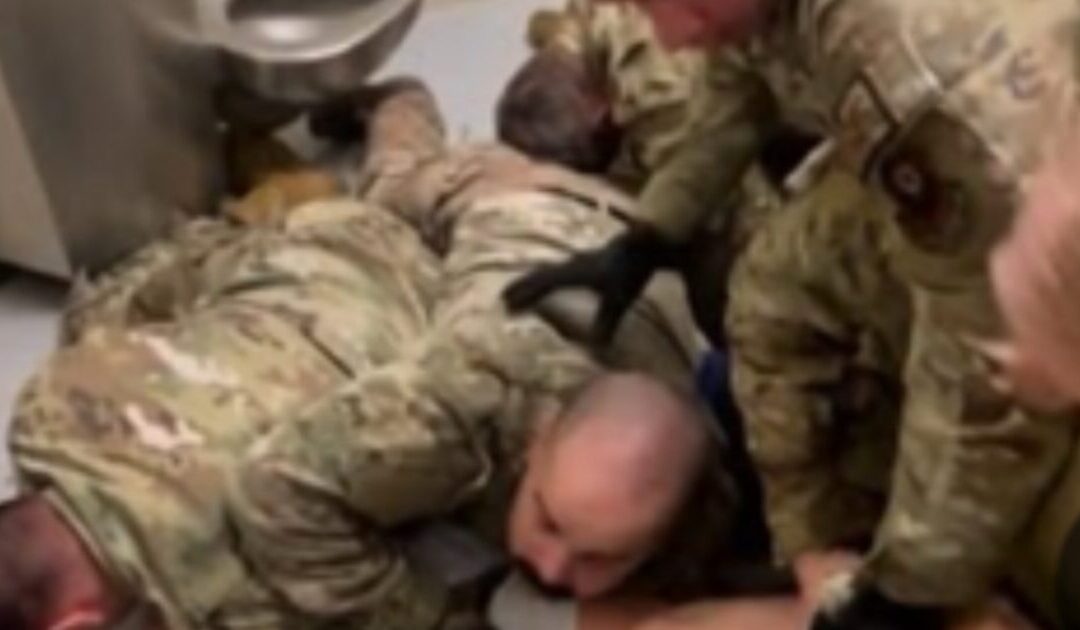
To the world, his story began with the violent extraction from his cell. But that was merely the public overture, the first visible crack in a dam that had been straining for months.
The video, provided by Castle’s defense counsel and later posted to X, amassed 6.4 million views on that platform alone. Reposts across other accounts pushed total viewership exponentially higher. It captured only a single moment of what followed his refusal.
The Saga of USAF Senior Airman Lance Castle, after refusing the CV-19 bio-weapon.
Here’s a video of him being extracted from his cell.
This man was dubbed an “insider threat,” given 60 days pre-trial confinement (missed the birth of 1st born), and sent to a court martial to stand trial on 5 UCMJ Charges.
Guess what!? He was ACQUITTED!!! NOT GUILTY, AKA NO EVIDENCE!
#LanceCastle #USAF— Mark Charles Bashaw (@MCBashaw) April 7, 2024
In an in-depth investigation, J.M. Phelps uncovers a pattern of institutional pressure and brutal retaliation that occurred before and after this incident. The investigation draws on hundreds of pages of court-martial records, his defense attorney’s interview notes regarding Castle’s chain of command, including over 15 under-oath testimonies, internal emails and text exchanges with his superiors, as well as audio recordings now involving multiple squadron, group, and wing commanders from New Mexico’s Cannon Air Force Base (AFB). Communications with Lt. Gen. Tony D. Bauernfeind, commander of Air Force Special Operations Command (AFSOC) at Hurlburt Field, Florida, in 2024, and his senior enlisted leader, Command Chief Anthony W. Green, were also examined.
This is the first installment of a three-part series documenting how a service member was systemically targeted after asserting a protected religious objection to the COVID-19 shot.
Before the shot mandate, Castle’s Personnel Information File (PIF) was untarnished. A 2017 letter of recommendation for retraining into the Pararescue career field, written by his squadron commander from Kirtland Air Force Base, Lt. Col. Deedrick Reese, praised Castle as “a highly motivated and driven NCO,” “one of the top NCOs in the unit,” and “emotionally stable, morally responsible, [and] financially sound.”
In July 2021, one month prior to the shot mandate, his supervisor, Master Sergeant Jenae Bellar, signed mid-term feedback that still marked him at the top of the performance tier. His stated goal on that form was to retrain into a new career field—contingent on his vaccination status. That record was set aside the moment he refused the COVID-19 shot.
When Castle’s squadron commander, Lt. Col. Enrique “Rico” Vazquez, was questioned under oath about Castle’s military record, he agreed that Castle had a fairly good military record. When the military judge, now Col. Vicki Marcus, asked him directly, Vazquez reiterated that Castle “had a decent record.” This is critical to note because after his trial, Vazquez pivoted, launching into his own narrative of how significantly flawed Castle’s conduct and behavior was before, during, and even after his refusal to get injected with the shot.
Wing Commander Col. Jeremy Bergin later testified that he had directed Col. Barry Roche, Vazquez’s superior commander, to open a preliminary inquiry into Vazquez over Castle’s retaliation allegations that he emailed directly to Lt. Gen. Bauernfeind.
Less than three hours after Bergin’s detailed sworn testimony about this, Bergin sent an email to his staff judge advocate, Capt. Katelyn Blackburn, retracting the statement: “I was mistaken today. I cannot find written documentation of an inquiry into Lt Col Vazquez, and I confirmed with Col Roche, that although we discussed his leadership multiple times throughout the progress of this case, an actual inquiry was not accomplished. Col Roche documented all feedback and findings re: Lt Col Vazquez during his feedback sessions with him. I mistook his indication of documentation as an MFR (memorandum for record) in one of our discussions regarding Lt Col Vazquez.”
After the shot refusal, his record swelled to thousands of pages, to include the documentation from not just one, but two, back-to-back courts-martial proceedings within a one-year period.
Throughout this time, he would be subjected to reprisal and relentlessly retaliated against by various commanders and superior leadership in his chain of command who plotted and colluded against him by directly fictitiously labeling him an “insider threat,” “radicalized towards an anti-U.S. Gov group,” a “potential active shooter,” falsely alleging he was “targeting members,” and having his security clearance revoked which would never be reinstated.
According to court documents and military records reviewed for this report, Castle pointed out 24 officers across the chain of command—from flight commander to major command—gave false or misleading testimony under oath and/or were complicit in the multiple charges brought against Castle under the Uniform Code of Military Justice (UCMJ).
Prosecutors at Cannon AFB, led by SJA Lt. Col. Sean McGarvey, manipulated Castle’s Personnel Information File (PIF) by removing thirteen documents before submitting it as evidence to both his defense and the presiding judge, according to Castle. No one caught the omission at trial. Months after his full acquittal, Castle discovered that command had quietly placed the documents back into his PIF. He filed multiple Inspector General complaints about the removal and restoration and raised the issue with AFSOC superiors. Those complaints were ignored, dismissed, or denied.
Throughout Castle’s timeline, he was arrested on two separate occasions, saw his rank demoted in more than one instance, and had his pay repeatedly frozen and reduced.
For three years, Castle’s emails, sent directly to the highest levels of the Air Force—including Chief of Staff (CSAF) Gen. David Allvin and Secretary of the Air Force (SECAF) Frank Kendall, as well as his successor, Melissa Dalton—pleaded for help after his immediate command dismissed his concerns. Those protected communications went unanswered. To date, he has filed more than 70 unique inspector general complaints across multiple agencies, over 15 informal and formal Article 138 complaints seeking redress from over 10 commanding officers, and multiple congressional inquiries, all of which have been ignored, dismissed, or denied.
During this period, he fought back by retaining civilian counsel, Daniel Conway from Daniel Conway & Associates. He proceeded to reject every plea deal offered, not only those presented by his military command but also those recommended by his own legal counsel.
Castle was fully acquitted on September 13, 2023, at his first court-martial, only to have those acquitted dispositions altered and falsely submitted to the Air Force Criminal Justice Information Center (AFCJIC) as “not criminally prosecuted” and “withdrawn and dismissed.”
He would not discover the falsification until October 2025—two years later—when Bexar County denied a job application after the charges appeared on his background check as “withdrawn and dismissed.” Officials there refused to review the entry of judgment he held in his hands, he shared. The same falsified records then blocked him at the San Antonio Police Department after he had already passed every initial testing requirement and reached the background phase. SAPD cited a desertion disposition from his second trial that read “not criminally prosecuted,” even though he was never charged with desertion. These denials came while he was already on non-pay appellate leave status with the Air Force, dating back to May 2025.
The retaliatory campaign implicated a widening circle of senior leadership. It reached the wing commander of Cannon AFB, Col. Jeremy S. Bergin— recently promoted to brigadier general—and his successor, Col. Robert L. Johnston. It extended to the prior three-star AFSOC commanders, Lt. Gen. Tony Bauernfeind and Lt. Gen. Michael Conley, with whom Castle had corresponded directly. Also implicated was CMSgt Anthony Green, then Command Chief to Lt. Gen. Bauernfeind, who has since been convicted on Sep 16, 2026, on federal charges of indecent recording and the possession, viewing and production of child sexual abuse material; he is currently serving a 10-year sentence.
Castle’s medical files were significantly manipulated by CAFB providers working in coordination with his command. He received what he asserts were false and malicious diagnoses solely to aid his command’s narrative against him. He became the subject of a manipulated Office of Special Investigations (OSI) probe and was placed into pretrial confinement for nearly 11 months across four civilian and military detention facilities.
Following the cell extraction, later ruled unlawful by the court, Castle provided The Gateway Pundit with comprehensive documentation of his injuries. This included the initial EMT assessment notes, MRI scans confirming two rotator cuff tears and a torn MCL, as well as the surgeon’s operative reports from both subsequent procedures. Due to his incarceration, he missed the live births of both of his sons.
Before these harrowing experiences, however, lay a deeper chain of events. The origin of Castle’s story lies in a nine-month period when his squadron commander, Vazquez, ordered him three times— in 2022 and 2023— to receive the injection. Without the tyrannical enforcement of the unlawful shot, none of what was to follow would have been set into motion.
Castle had submitted a detailed, personalized accommodation request that included a letter from his pastor. He cited the use of aborted fetal cells in testing, his refusal to line up behind an order he believed was unlawful, and Scripture on not violating your conscience. Cannon AFB chaplain, Father Pedro Jimenez, officially confirmed the sincerity of his beliefs.
Shockingly, his leadership did not process the request. Rather, they moved him to the 26th Special Tactics Squadron and kept his vaccine status quiet from the new commander. Three months later, that commander found out he was not vaccinated and sent him straight back to Vazquez.
Vazquez also confirmed the move himself in an interview with Castle’s defense attorney, “STS approached us about taking on the people who didn’t want the vaccine. They asked if we could take them and so I took him back.” No accommodation was ever in place or would ever be in place. He was back at square one, and now disastrously in enemy territory that was hellbent on getting even with him.
The responses that came back were identical to those received by other airmen on Cannon AFB and across the Air Force. Denial letters were rubber-stamped, blanket denials. A “compelling governmental interest” in mission readiness, unit cohesion, good order and discipline, and health and safety was asserted, while providing no specific evidence and no analysis of less restrictive means. Under Department of the Air Force Instruction (DAFI) 52-201, Department of Defense Instruction (DODI) 1300.17, and the Religious Freedom Restoration Act (RFRA), that burden of proof belonged to the Air Force. By failing to meet it, Castle argued; the command had effectively denied him due process. The order itself created an additional problem. Castle was ordered to receive a COVID-19 shot “with full licensure approval from the FDA.”
The only product available was the Pfizer-BioNTech shot still operating under Emergency Use Authorization (EUA). FDA fact sheets at the time stated that the product “is not an FDA-approved vaccine” and that the recipient had the option to accept or refuse. Comirnaty—the fully licensed version—was not available. A federal judge later described the Department of Defense’s claim that all EUA vials had somehow become Comirnaty as “unconvincing.”
Even the readiness justification did not hold. On February 17, 2021, Maj Gen Jeff Taliaferro told the House Armed Services Committee that unvaccinated service members were already deployable. For a full year, the military had navigated the pandemic’s landscape without the shield of a vaccine.
These are the facts that make all that was to follow a hard pill to swallow. Castle’s request for religious accommodation was denied, as were those of thousands of other service members. AFSOC Commander Lt. Gen. James S. Slife had turned it down. In response, Castle submitted a detailed appeal arguing the mandate was unlawful and that the shot was dangerous. That, too, was rejected—this time by the Air Force’s Surgeon General, Lt. Gen. Robert Miller.
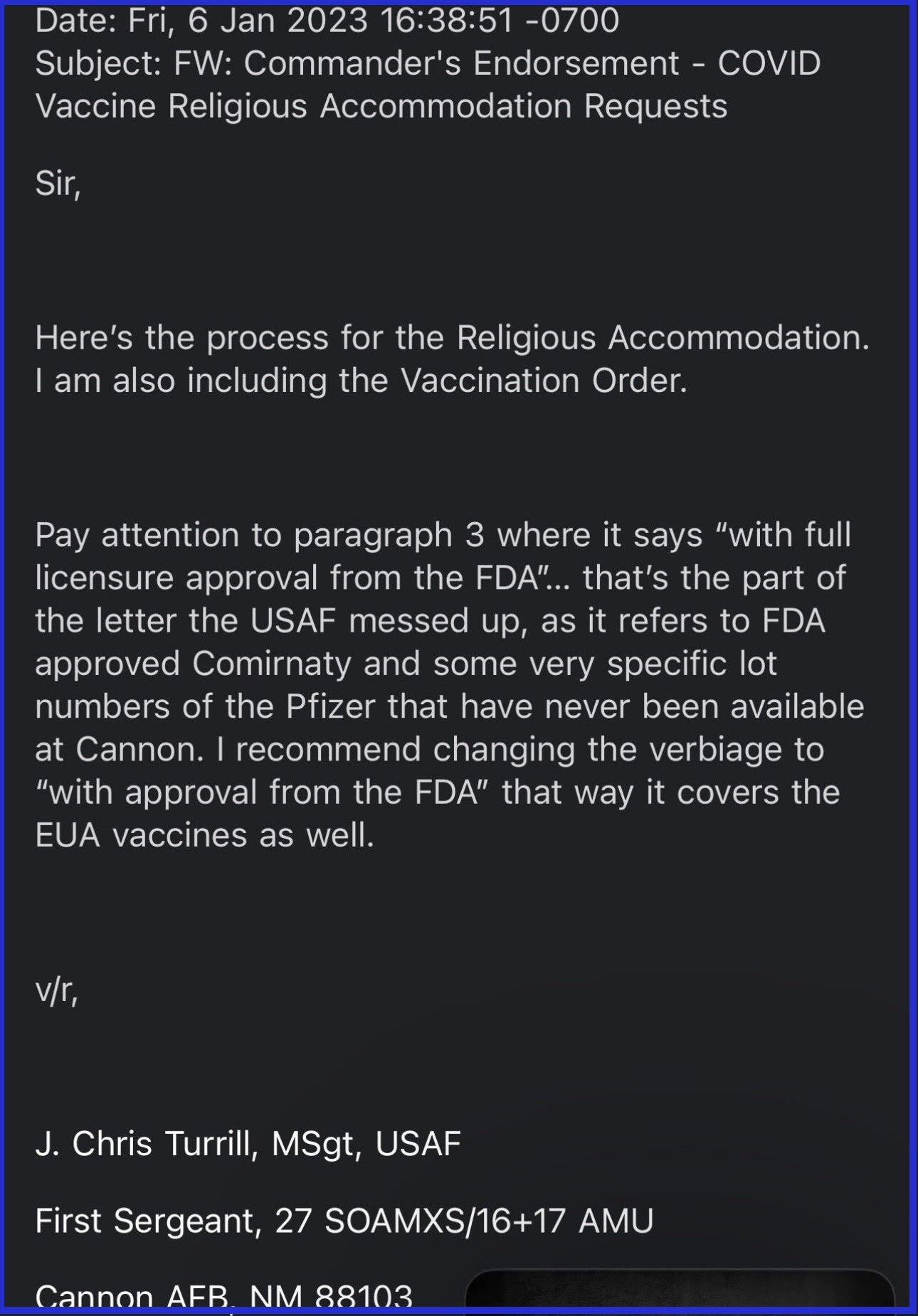
Even as command continued to enforce the policy, internal correspondence revealed officials were aware of procedural flaws. In an email dated Jan. 6, 2023, MSgt. J. Chris Turrill notified first sergeants that the Air Force had “messed up” the language in its standard religious accommodation denial letter.
Turrill pointed out the order required full FDA licensure and referenced Comirnaty lot numbers that were never available at Cannon. He recommended changing the wording so it would also cover the Emergency Use Authorization shots. Leadership knew the paperwork was defective. Yes, the pressure on Castle—and countless others—continued.
The case of Staff Sergeant Lance Castle is not an isolated incident, but a stark illustration of a system that weaponized bureaucracy against conscience. His ordeal exposes a chain of command willing to break its own rules, falsify evidence, and destroy an airman’s career—all to enforce a policy its own officials knew was legally and procedurally flawed.
On September 13, 2023, Castle was fully acquitted. For anyone else, that might have been the final chapter. For Castle, it was just the prologue. An exhaustive trail of documentation and ignored appeals stands as a permanent indictment, not of the man who refused an order, but of an institution that refused to listen. The day after the full acquittal, Castle said, the new First Sergeant, MSgt Clinton Collins, acting as proxy for Lt. Col. Enrique Vazquez, told him he had a “clean slate.”
Castle replied that he “maybe can believe that he has a clean slate… but they don’t have a clean slate with me.” Collins continued that Col. Bergin and Col. Roche both agreed it would be best for Castle to return to the squadron, to a place that’s low threatening so he doesn’t feel like there is any kind of reprisal or retaliation. Collins said working at the Area Defense Counsel (ADC) had been brought up, and the wing commander stated that it wasn’t the best fit. Castle asked what possible reason the wing commander or group commander would have to deny him working at the gym, the chapel, or the ADC. Collins had no answer. He reiterated that after speaking with the command team and MSgt Michael Carey, “you have a clean slate, there is no harm, no foul, and nobody is treating you any differently.”
Months later, in a December 2023 Team Treatment Meeting, SMSgt Tanner Ike (now Collins’s replacement) remarked to Castle’s provider that being found not guilty did not entitle Castle to an expedited transfer or special treatment—rather, he simply “goes back to work” under the same command.
Castle’s provider stated to Vazquez, “Castle is a different circumstance considering he was put under investigation… by you, and he has to work directly under you, and that creates this dynamic.” Vazquez replied, “I understand that, but that is the consequences [sic] of the decisions that he made. I understand that during his court-martial he was found not guilty, but what the judge decided, her reasoning, that is nowhere. I don’t know what was her reasoning… it could have been, hey Castle this serves another opportunity, so maybe that’s why she said he’s not guilty, I don’t know. There are no records; we did not get access to anything or any of the reasoning that the judge had. The reason why he is in the position that he’s had is based on the consequences of his decisions.”
Vazquez’s First Sgt. Tanner Ike continued to Vanessa Ramirez, a therapist from San Antonio’s Laurel Ridge Treatment Center: “As I said, I’m coming into this, I’m learning a lot of different things about this, but the piece is, is that he does still has a job, he still earns a paycheck, and at the end of the day he still needs to earn that paycheck, and just sitting in a quiet corner, or at home, is not gonna [sic] be deserving of truly earning that paycheck, if you will.”
Every avenue of redress has been systematically foreclosed; every protest met with procedural silence. What began as a matter of conscience ended as a demonstration of power—proof that the system could expend limitless resources to break one man while remaining utterly unaccountable. Castle’s case stands not as an anomaly but as a blueprint: a warning of how easily protection becomes persecution when institutions value compliance over conscience.
Part Two will expand on the audacity of the gaslighting that continues to shadow Castle, focusing more on his wrongful classification as an “insider threat”, the brutal cell extraction experience, and much more.
AUTHOR’S NOTE: Should any portion of this three-part account be challenged as inaccurate by the Department of the Air Force or any named party or person, the author commits to publishing rebuttals and supplementary articles to ensure clarity publicly.
The post The Air Force’s Vindictive War on Lance Castle: Ruthless Retaliation After a COVID Mandate Refusal and Full Acquittal at Court-Martial, Part One appeared first on The Gateway Pundit.
Go to Source
Author: J.M. Phelps