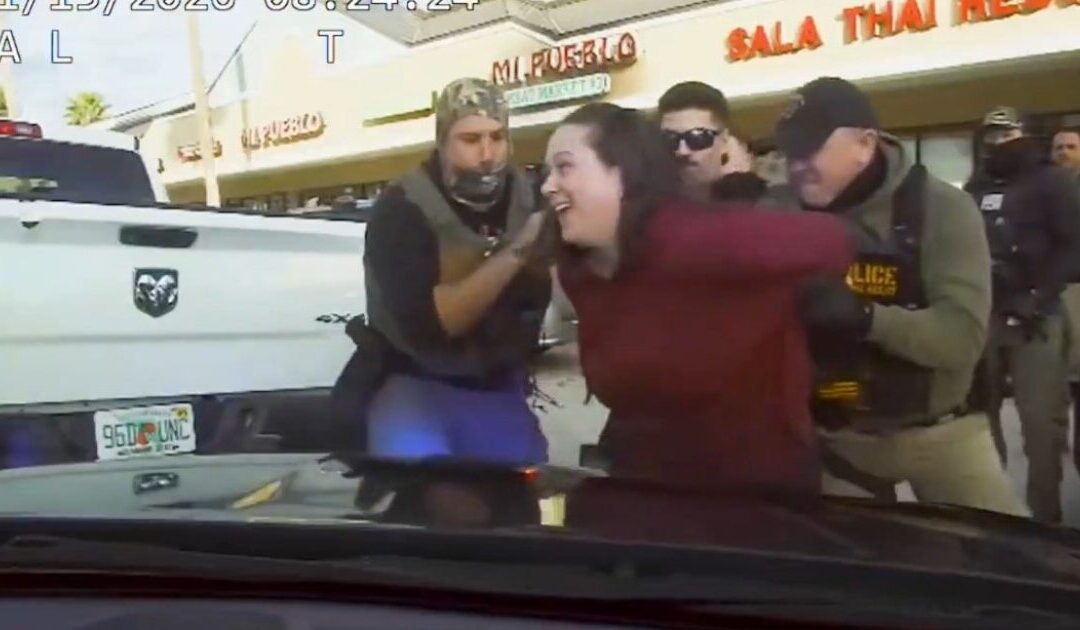
FAFO: Police Cam Footage Shows Moment Anti-ICE Agitator Manhandled After Punching Florida Trooper in the Face (VIDEO)
January 16, 2026
A Florida woman was promptly manhandled after she punched a trooper in the face during an immigration enforcement operation earlier this week.
Police cam footage shows the moment the female anti-ICE agitator, identified as Jennifer Cruz, tried to kick a female police officer after she punched a trooper in the face.
Cruz was immediately thrown on the hood of the police car and cuffed.
Jennifer Cruz continued to kick law enforcement officers after she was placed in the back of the police cruiser.
“This is Jennifer Cruz of Jacksonville. Jennifer disagrees with immigration enforcement and decided to commit a few felonies by getting out of her car and punching a Trooper in the face,” Florida Attorney General James Uthmeier said on X.
“But unlike Minnesota, we don’t put up with this nonsense. Not today, Jennifer,” Uthmeier said.
“Don’t interfere with law enforcement, punch cops, or resist arrest in Florida,” he said. “Don’t be like Jennifer.”
WATCH:
According to News4JAX, Cruz attacked law enforcement during an immigration operation near the Mi Pueblo grocery store.
“ICE agents showed up with the state trooper. They detained the driver,” a local grocery store owner told News4Jax.
“And so yeah, they had an operation going on, and after that, they had detained another person. But it seems they got into an altercation with that person. It turned violent,” he said.
Governor DeSantis taunted Cruz and said ‘This is not Minneapolis.’
“I do know there was a woman who came out and assaulted one of our troopers. Let me just tell you guys, this is not Minneapolis,” Governor Ron DeSantis said of the incident.
Foreign Nationals Account for 79% of Theft Arrests and 40% of Violent Crime Suspects on British Trains, Official Figures Reveal
January 16, 2026
High Speed Train (HST) on British Rail’s Western Region via Wikimedia Commons
Britain’s long-assumed immunity to the migrant crime patterns witnessed across Western Europe for over a decade now is, unfortunately, rapidly evaporating.
Newly released arrest data from the British Transport Police has revealed that the country’s train network—once a symbol of everyday order—has become a frontline in a widening public-safety crisis.
According to figures obtained through a Freedom of Information request by the Centre for Migration Control, foreign nationals now account for an overwhelming share of arrests on Britain’s trains, with 40% of violent crime suspects being non-British.
The figures are stark—and deeply unsettling for a nation that has been told for years by a globalist elite, openly hostile to the interests of English, Welsh, Scots, and Northern Irish, that unrelenting mass migration from culturally alien countries carries no social cost.
In the 2024–2025 reporting year, it has been revealed that a jaw-dropping 80%of all arrests for theft of passenger property on Britain’s trains and subways involved foreign nationals. Across all offenses, migrants made up roughly 38% of arrests, despite representing a far smaller share of the population.
EXC: Data from the BTP shows that foreign nationals accounted for 40% of all railway arrests last year.
This includes:
79% of arrests for theft
40% of arrests for drug offences
37% of arrests for sexual offences
36% of arrests for violent crime
— Centre for Migration Control (@migrationCtrl) January 15, 2026
Meanwhile, foreign nationals accounted for roughly 40% of arrests linked to drug offenses, and more than a third of those arrested for sexual offenses.
The raw numbers reveal the following: nearly 3,700 of the 9,771 arrests recorded across England, Wales, and Scotland involved non-British nationals. These are not marginal figures—they describe a systemic imbalance playing out daily in public spaces used by millions.
Researchers at the Center for Migration Control argue the data reflects policy failure. They note that Britain has imported large numbers of people from high-risk regions while dismantling meaningful border control and deportation enforcement.
Speaking to the press, CMC research director Robert Bates said Britain’s trains have been rendered unsafe by political negligence. He insists that any government serious about protecting its citizens would halt mass immigration and begin large-scale removals of foreign criminals.
Julia Hartley-Brewer BANGS her head on the table in disbelief over the “incompetence” of Britain’s detention facilities.
Migration expert Robert Bates explains that, after a certain period of time, illegal migrants are let out if they can’t be deported.@JuliaHB1pic.twitter.com/TijZQ88HuD
This train snapshot is part of a much broader picture. Separate FOI requests submitted to police forces across England and Wales reveal that nearly 173,000 arrests of foreign nationals were recorded nationwide in the year ending March 2025—equivalent to one arrest every three minutes.
Of those arrests, more than 51,000 were for violent offenses and over 11,000 involved sexual crimes. These are not minor infractions. These are offenses that directly shatter community trust and personal security.
The arrest rate tells an even more troubling story. Migrants are estimated to be around one-third more likely to be arrested than native Brits—a disparity that undermines claims that crime is evenly distributed across society.
Those who have spoken out about mass migration for years say this confirms what ordinary Brits have experienced firsthand. Stations, platforms, and late-night services increasingly feel like zones of heightened risk.
Britain is not an outlier. Across continental Europe, similar patterns have emerged wherever mass migration has been pursued without assimilation or enforcement.
In France, official data shows that a majority of violent robberies and sexual assaults on Paris public transport are committed by foreigners—many from North Africa, despite representing a small fraction of the population.
Germany tells the same story. In multiple federal states, foreigners are responsible for a majority of crimes on trains and at stations, prompting warnings from lawmakers that rail hubs are becoming de facto no-go areas.
Italy has likewise seen a surge in violence and harassment targeting train staff, including fatal attacks and repeated sexual incidents involving migrant offenders. Unions there warn that workers now operate under constant psychological strain.
Back in Britain, policy groups are calling for decisive action rather than further reports. Proposals include a visa “red list” barring high-risk countries and automatic deportation for foreign nationals convicted of crimes.
Advocates argue that policies like these would restore the basic principle that a nation’s first duty is to protect its own people, adding that borders exist to defend a national home, not to dissolve it.
Housing Market Concerns? 367,000 Homes Hit Foreclosure in 2025- Insiders Claim this is Normalization after Years of Artificially Low Foreclosure Rates
January 16, 2026
American Housing via TriCounty Homes
America’s housing market is flashing warning signs—this time not from reckless borrowers, but from a system that has slowly but surely turned the American dream into a financial trap.
New data has revealed foreclosures having risen sharply in 2025, with hundreds of thousands of families now facing the loss of their homes as economic pressure mounts nationwide.
According to newly released figures from ATTOM, a California-based company providing property data services, more than 367,000 US properties entered some stage of foreclosure last year. That represents a 14% uptick compared to the year before—a trend experts say could accelerate further in 2026 if current economic conditions persist or worsen.
Foreclosure, something that made headlines in and around the 2008 crash, appears to be returning to everyday neighborhoods. Banks are again reclaiming single-family homes—this time not because of speculative excesses—but because ordinary Americans continued to be squeezed from every direction imaginable.
High interest rates, steady inflation, rising cost-of-living, and stagnant wages make for a toxic brew that’s seeing people have to leave their homes.
Economist Michael Szanto warned that the situation could deteriorate rapidly if the labor market softens. Job growth in 2025 was the weakest outside a recession in more than two decades, leaving households with little margin for error when monthly bills pile up.
When foreclosures rise, the damage spreads beyond the families that are directly affected. Bank-owned homes are dumped onto the housing market at vastly discounted prices, pulling down property values and eroding equity for entire communities through no fault of their own.
The surge in foreclosures is not an isolated housing issue. It’s a symptom of deeper financial strain. Homeowners who fall behind on mortgages are often already struggling with credit card balances, car loans, and basic living costs that have soared under years of inflation and gross mismanagement under Joe Biden.
The tragic result is an affordability crisis that hits hardest where it hurts most—namely food, transportation, healthcare. In the event that working class families, barely already making it, are forced to choose between groceries, prescription drugs, and mortgage payments, the broader economy inevitably feels the impact.
Florida’s real estate market emerged as the epicenter of foreclosure activity in 2025, with one filing for roughly every 230 homes. The state’s housing stress has been compounded by skyrocketing insurance costs and steep condo assessments following safety crackdowns after the Surfside disaster.
Florida is far from alone, however. Delaware, South Carolina, Illinois, and Nevada also posted alarmingly high foreclosure rates, showing that financial pressure is spreading across regions throughout the country.
Metro-level data reveals a picture that’s even more grim. Cities like Lakeland, Florida; Columbia, South Carolina; and Cleveland, Ohio recorded some of the highest foreclosure concentrations in the country, highlighting the undeniable fact that both Sun Belt boomtowns and America’s legacy industrial cities are under strain.
Major urban markets are no longer insulated either. Jacksonville, Las Vegas, Chicago, and Orlando all saw elevated foreclosure rates, suggesting that size and economic diversity, alone, no longer guarantee stability in a distorted housing market.
Industry insiders, however, insist this is merely a “normalization” after years of artificially low foreclosure levels. Rob Barber described the trend as a return to historical averages.
What today’s data obscures is a larger structural failure. Institutional investors and Wall Street funds have spent years buying up single-family homes, driving up prices, squeezing supply, and turning housing into a speculative asset rather than a place for families to live.
This is where President Donald Trump has drawn a welcome line. Trump, last week, pledged to end institutional investment in single-family homes—aiming to return ownership to working and middle-class American families instead of multinational, ‘too big to fail’ hedge funds and foreign capital.
Just as—or perhaps more—importantly, Trump has called for capping credit card interest rates at 10%, a move that would immediately relieve pressure on households drowning in compounding debt. For millions of Americans, that policy alone could mean the difference between staying afloat and falling behind.
Unlike the globalist consensus that views debt as a permanent condition and housing as a financial instrument, Trump’s approach is rooted in restoring economic fairness. It rightly elevates families, workers, and homeowners over banks, speculators, and corporate landlords.
National Gun Group Estimates Americans Own Over a Combined 500 Million Firearms
January 16, 2026
If guns were votes, America would already be a landslide.
A new estimate from a Second Amendment group suggested that Americans collectively own more than 500 million firearms, a staggering figure that underscores just how deeply embedded gun ownership remains in the national fabric — despite years of political pressure, media panic, and legislative headwinds aimed at shrinking it.
According to estimates analyzed by the Firearm Industry Trade Association, also known as the NSSF, gun ownership is absolutely thriving in the Land of the Free.
The estimate, citing data collected from 1990 to 2023, claimed that Americans collectively owned an astounding 506.1 million firearms.
Data from the Pew Research Center adds some fascinating context to these staggering figures.
According to Pew’s 2023 research, nearly one-third of all U.S. adults said that they owned a gun.
A further breakdown of that data showed that “45% of Republicans and GOP-leaning independents say they personally own a gun, compared with 20% of Democrats and Democratic leaners.”
By sex, the breakdown indicated about 40 percent of men own a gun, compared to 25 percent of women.
Furthermore, when Pew broke down its findings by race, “38% of White Americans own a gun, compared with smaller shares of Black (24%), Hispanic (20%) and Asian (10%) Americans.”
Roughly seven in 10 gun owners say personal protection is a primary motivation for owning a firearm, with 72 percent citing it as a major reason.
That finding reinforces the idea that self-defense — not recreation or employment — is the dominant driver behind gun ownership in the United States.
Far fewer gun owners point to other motivations.
About 32 percent say hunting is a major reason they own a gun, while 30 percent cite sport or target shooting.
Smaller shares say firearms are part of a personal collection (15 percent) or are necessary for their job (7 percent), further highlighting how secondary those purposes are compared to personal safety.
Despite that emphasis on personal safety, the NSSF also had one particularly curious finding: gun manufacturing had actually dipped.
The NSSF found that almost 8.5 million guns were manufactured in 2023, which represents a 15.4 percent decrease from the year prior.
Firearm availability in the United States reached significant levels in 2023, with more than 13.5 million guns entering the domestic market.
That figure reflects the combined number of firearms manufactured in the U.S. and imported from abroad, after accounting for exports sent overseas.
Handguns made up the clear majority of those firearms, totaling 8.2 million units. Rifles followed at 3.9 million while shotguns accounted for 1.5 million, rounding out the overall breakdown of weapons available to American consumers that year.
WATCH: Newly Released Footage Shows Venezuelan Opposition Leader Maria Corina Machado’s Rescue from Venezuela in December
January 16, 2026
Maria Corina Machado gives Proof of Life following rescue from the Maduro Regime in Venezuela
Before the US military arrested Venezuelan Dictator Nicolas Maduro in Operation Absolute Resolve earlier this month, opposition leader Maria Corina Machado was rescued and smuggled out of the country by a nonprofit veteran rescue organization in early December.
Wanted and in hiding from the Maduro Regime, Machado was extracted in the dead of night by Grey Bull Rescue, a veteran-led group that conducts global rescue operations for Americans and allies in warzones, disaster zones, and hostile territories. According to the organization’s website, “Grey Bull Rescue was born during the failed U.S. evacuation from Afghanistan in 2021 — when we rescued Americans and allies left behind. Since then, we’ve conducted over 800 missions and safely evacuated thousands, including children, families, and even pets.”
Newly released footage from the more than 15-hour-long operation to rescue Machado shows part of the operation, where Grey Bull Founder and Chairman Bryan Stern, a special forces veteran and Purple Heart recipient, meets with another boat carrying Machado in the middle of the ocean to bring her to safety.
“I am Maria Corina Machado. I’m alive, I’m safe, and very grateful to Grey Bull,” Machado says on the camera after boarding the second boat, from which she was taken to safety from the Maduro regime.
WATCH:
Following the Jan 3 arrest of Maduro, Grey Bull said in a social media post,
Just a few weeks ago, Grey Bull Rescue conducted the daring extraction of Maria Corina Machado, the rightful leader of Venezuela, under the cover of night while being hunted by the brutal Maduro regime.
Last night, America’s most elite men and women from the Special Operations community…where our team hails from…conducted a surgical and beautifully executed large scale operation to bring Maduro (and his wife) to justice. We could not be prouder to be Americans right now.
U.S. SOF, like Grey Bull, conducted an operation leaving all the bad guys scratching their heads.
Earlier this week the Maduro regime unlawfully detained 5 American Citizens (which we predicted). We asked for Proof of Life which Maduro denied. Yet, this morning…the Maduro regime is asking America for Proof of Life of Maduro. My how the tables have turned.
Grey Bull has been operating in Latin America and the Caribbean for months. Grey Bull Rescue’s infrastructure, team, and talent are second to none as evidenced by this morning’s major success.
Many questions remain about the future. Certainly, the situation remains dangerous especially for Americans.
It took an American private rescue team 15 to 16 hours to get Venezuelan opposition leader María Corina Machado out of her country and safely on her way to Norway to collect her Nobel Peace Prize, and to be reunited with her family on Wednesday. The vast majority of that time was spent in rough seas, and the man who led the operation and met Machado on a boat told CBS News, “no one was enjoying that ride, especially Maria!”
“No one’s blood pressure was low, throughout any phase of this operation, including mine,” said Bryan Stern, a U.S. special forces veteran who heads the Grey Bull Rescue Foundation. “It was dangerous. It was scary. The sea conditions were ideal for us, but certainly not water that you would want to be on … the higher the waves, the harder it is for radar to see. That’s how it works.”
In an interview Wednesday with CBS News, Stern gave some insight into the complex operation his organization undertook to get Machado out of Venezuela and on a plane to Norway, where she was reunited with her children for the first time in about two years. A representative for Machado confirmed to CBS News on Thursday that Grey Bull was behind the rescue operation that began on Tuesday.
Of the hundreds of rescues his organization has carried out, he said this was both one of the most challenging and the most rewarding. Machado has lived in hiding in her own country for almost a year, fearing persecution by the regime of President Nicolas Maduro, who is under increasing pressure from President Trump amid a U.S. military buildup off his shores.
“She has a very large target on her back,” Stern said of Machado. “This is not a random shopkeeper who doesn’t wanna be in Venezuela anymore. This is moving around a rock star.”
As The Gateway Pundit reported, Machado met with President Trump at the White House on Thursday, weeks after Maduro’s ouster.
We use technologies like cookies to store and/or access device information. We do this to improve browsing experience and to show (non-) personalized ads. Consenting to these technologies will allow us to process data such as browsing behavior or unique IDs on this site. Not consenting or withdrawing consent, may adversely affect certain features and functions.
Functional
Always active
The technical storage or access is strictly necessary for the legitimate purpose of enabling the use of a specific service explicitly requested by the subscriber or user, or for the sole purpose of carrying out the transmission of a communication over an electronic communications network.
Preferences
The technical storage or access is necessary for the legitimate purpose of storing preferences that are not requested by the subscriber or user.
Statistics
The technical storage or access that is used exclusively for statistical purposes.The technical storage or access that is used exclusively for anonymous statistical purposes. Without a subpoena, voluntary compliance on the part of your Internet Service Provider, or additional records from a third party, information stored or retrieved for this purpose alone cannot usually be used to identify you.
Marketing
The technical storage or access is required to create user profiles to send advertising, or to track the user on a website or across several websites for similar marketing purposes.