President Trump Again Calls for the State of Colorado to “FREE TINA PETERS”.
March 19, 2026
President Trump again calls for the state of Colorado to “FREE TINA PETERS”. On Wednesday night, President Trump again called for the state of Colorado to free Tina Peters: FREE … Read more
Warning: Most Ivermectin Sold In America Isn’t Made In America
March 19, 2026
(Note: Thank you for supporting businesses like the one presenting a sponsored message below and working with them through the links below which benefits Gateway Pundit. We appreciate your support!)
In the spring of 2020, Dr. Peter McCullough sat across from patients who were terrified.
They were sick. They were scared. And the official answer from the medical establishment was: go home, wait, and hope for the best.
Dr. McCullough wasn’t willing to accept that.
While other doctors kept their heads down and followed orders, he did something radical — he actually looked for solutions. He pored over studies. He talked to colleagues around the world. He treated patients with every tool available to him.
And what he found was something that powerful people did not want you to know about.
A Drug That’s Been Hiding In Plain Sight
It’s not new. It’s not experimental. It’s not some fringe remedy cooked up in somebody’s garage.
Ivermectin has been prescribed by doctors for over 30 years. It won the Nobel Prize in Medicine. It has been used by hundreds of millions of people around the world to wipe out parasite infections, treat stubborn skin conditions, and restore people’s health when nothing else worked.
And now cutting-edge research is showing something even more exciting — potential applications that scientists are only beginning to fully understand.
Dr. McCullough knew about this. And he told his patients.
For that, he was attacked. Ridiculed. Investigated.
He told the truth anyway.
That’s the kind of doctor he is. And that’s the kind of company The Wellness Company is built around — doctors who put you above their own careers.
But Here’s The Problem Nobody Is Talking About
Let’s say you’re convinced. Let’s say you want ivermectin for yourself and your family.
Where do you get it?
Here’s something that should make you stop and think: 75% of the ivermectin sold globally comes from Asia. When you order from most online pharmacies, you have no idea where that product was actually manufactured, what quality controls were in place, or what’s really inside that capsule.
You’re trusting your health — and your family’s health — to a supply chain you know absolutely nothing about.
Made here. In American facilities. Under American quality standards. With American accountability.
When you hold a bottle of The Wellness Company ivermectin, you know exactly what you’re getting — and you know exactly where it came from.
Now Here’s Where It Gets Really Good
You’d expect to pay a premium for American-made quality. And most people do.
Walk into most pharmacies right now and you’ll pay $5 per tablet for ivermectin. Sometimes more. Often for lower-dose formulas that leave you wondering if you’re even getting enough.
Here’s what The Wellness Company is offering:
18mg capsules — a higher dose — at just $3.57 per tablet.
Let’s do that math slowly, because it’s worth it:
Other guys: $5.00 per tablet, lower dose
The Wellness Company: $3.57 per tablet, higher dose
That’s not just cheaper. That’s better product at a lower price.
The Doctor Who Wouldn’t Back Down. The Company That Stood Behind Him.
Dr. McCullough didn’t go looking for a fight.
He went looking for answers — for his patients, for his family, and for you.
The Wellness Company was built by people who share that same commitment. People who believe you deserve access to safe, effective, affordable medicine that actually works — without having to fight the system just to get it.
This is that medicine. Made here. Priced right. Backed by doctors who proved they have your back when it mattered most.
Don’t Wait On This
Supply of American-made ivermectin is limited by definition — there simply aren’t as many domestic manufacturers as there are overseas ones.
When you find American-made quality at a price this low, you stock up.
Note: The information provided on this website is intended for informational purposes only and should not be considered medical advice or used as a substitute for professional healthcare guidance. It is your responsibility to comply with all applicable laws, regulations, and guidelines regarding the purchase, possession, and use of prescription medications.
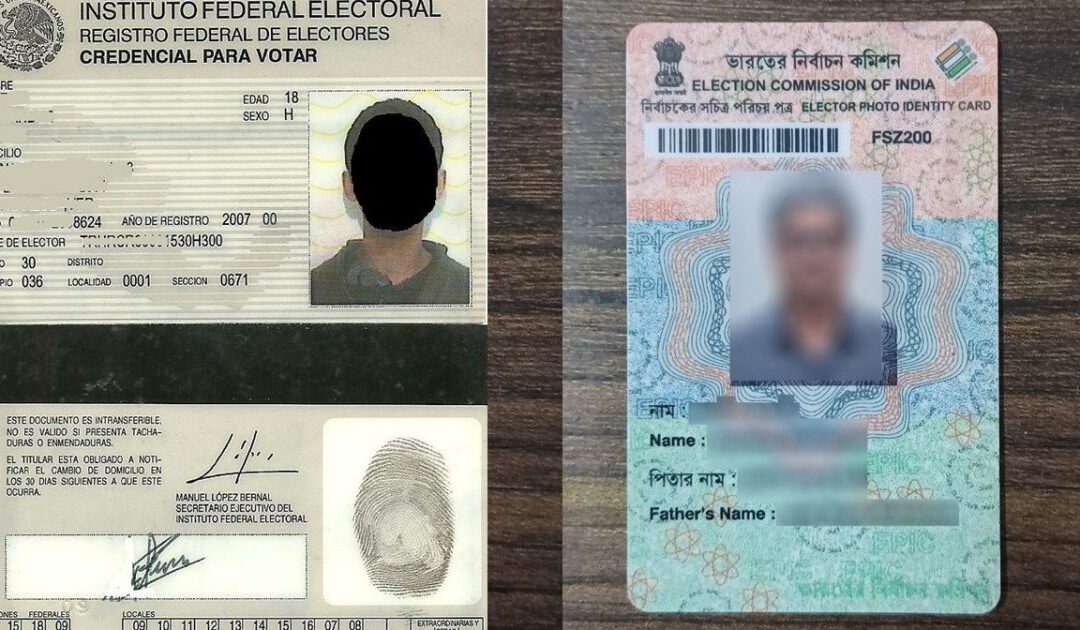
Voting Laws Around the World – Most Countries Require ID, No Illegal Aliens, and No Ballot Harvesting
March 19, 2026
All but a very small handful of countries require voter ID or preregistration with identification.
The Democrats oppose voter ID laws and are in favor of mail-in voting, while calling Republicans fascists for not agreeing with them.
However, a review of voting laws around the world shows that the overwhelming majority of countries, at least 176 nations and jurisdictions, require voter ID.
Many have no mail-in voting at all, while others allow only very limited domestic mail-in voting restricted to those who are hospitalized, and no country allows illegal aliens to vote.
While a small number of countries permit long-term legal residents to vote in local elections under strict residency conditions, even fewer allow non-citizen residents to vote in national elections.
No countries besides the United States allow jurisdictions, states, provinces, or cities to prohibit poll workers from asking voters for ID.
Most other democracies use automatic civil registration through national ID systems, making same-day walk-in voter registration an unknown concept abroad.
No nations accept ballots days or weeks after an election, regardless of postmark date. None allow ballot harvesting. Very few nations grant birthright citizenship, only around 33 countries, and most of these require at least one parent to be a citizen or permanent resident. Many also restrict passing naturalized citizenship to children if both parents are non-nationals.
According to the International Institute for Democracy and Electoral Assistance (IDEA), 34 countries or territories allow mail-in voting.
Of those, 12 allow all voters to vote by mail, while 22 permit only some voters to do so. And over 100 countries allow some form of out-of-country postal voting, though specifics vary greatly.
Countries that have banned or restricted mail-in voting due to fraud concerns include France (banned in-country postal voting in 1975), Mexico (banned in 1991, partially restored in 2006), and Belgium (banned domestic mail-in voting in 2018).
Russia does not allow mail-in voting for citizens abroad or residents.
Sweden and Italy do not permit mail-in voting. Ukraine does not permit it either. Canada, the UK, and Switzerland require application or registration before receiving a mail ballot. Switzerland mails ballots to all registered voters but requires ID and a polling card for anyone who then votes in person.
All-postal voting, in which all electors receive ballots by post without requesting them, is used in several U.S. states, and Switzerland. Outside these narrow examples, no comparable democracy routinely mails unsolicited ballots to all registered voters as standard national practice.
Only four countries in the world currently grant equal voting rights to foreigners in national elections: New Zealand, Chile, Malawi, and Uruguay. In New Zealand, permanent residents can vote after one year of residence. Chile allows legally present foreign-born adults to vote after five years, while Malawi requires seven years and Uruguay eight years.
Some countries permit noncitizen voting only in limited contexts. Ecuador allows legally present noncitizens to vote after five years, and Norway allows foreign nationals to vote in local elections after three years of residence.
Non-citizens cannot vote in national elections or referenda in Finland, Ireland, Belgium, Luxembourg, or Sweden — only in local elections under specific residency conditions.
Of the 47 nations in Europe, all but one require a government-issued photo ID to vote. Among the 38 member nations of the OECD, 33 require government-issued photo ID at the polls. The requirement spans every continent and nearly every style of government.
The four OECD member countries that did not require a photo ID were the United Kingdom, Australia, Japan, and New Zealand. Japan instead uses barcode-verified voter tickets, while Australia does not require any ID. New Zealand does not require ID for voting, but a New Zealand driver’s license, passport, or a RealMe-verified identity is required to enroll online. The United Kingdom has since introduced photo ID requirements for most elections.
No other democratic nation has a system comparable to certain U.S. states where jurisdictions are actively prohibited from asking voters for ID, and where ID-free voting is codified as a legal protection rather than an administrative default. California law prohibits poll workers from asking for voter ID for in-person voting. A Kern County elections official stated it plainly: “Poll workers should never be asking for an ID.”
Governor Newsom reinforced this at the state level. California’s Senate Bill 1174 prohibits local governments from requiring voters to present identification when casting ballots at the polls. When Huntington Beach attempted to require ID anyway, a California appeals court ruled that the measure violated state law.
In Canada, same-day registration is permitted. Since 2012, voter registration in Chile is automatic. Denmark also allows same-day corrections to voter rolls. Most other democracies do not need same-day registration because they use automatic or compulsory registration systems.
In Argentina, Chile, Hungary, Israel, the Netherlands, and elsewhere, voter registration is automatic, based on government records such as census counts. In Germany, all residents must register their address with local authorities; anyone turning 18 before an election is automatically added to voter rolls with no separate registration required.
Automatic voter registration tied to driver’s licensing is primarily an American debate; most peer democracies already register voters through population registers and have no need for a DMV trigger.
The only country other than the United States that provides automatic voter registration tied to a driver’s license is Canada. If a citizen applies for a driver’s license in a new province and checks a box allowing data sharing, provincial motor vehicle registrars can transfer their information to federal election authorities, automatically updating voter registration without any further action.
Ballot harvesting, gathering and submitting completed absentee or mail-in ballots by third-party individuals, occurs in some U.S. states where voting by mail is common, but some states have laws restricting it. As of July 2020, 26 states allow specified agents to collect and submit ballots for another voter.
There is no documented peer democracy with a system equivalent to unrestricted ballot harvesting as practiced in California. Most countries that allow absentee voting require ballots to be returned directly by the voter or a strictly defined family member. The vast majority of countries ban absentee ballots for people living in their country. While some European countries allow proxy voting, the safeguards used to prevent fraud are generally far more stringent than those used for absentee ballots in the U.S.
Regarding post-election ballot acceptance: In the U.S., five states had a receipt deadline between one and four days after the election; seven states and D.C. had a deadline between five and ten days after Election Day; two states, Illinois and Washington, had a deadline between 14 and 20 days after the election. Every state that accepts ballots after Election Day requires that the ballot carry a postmark on or before Election Day.
California accepts mail ballots received up to 22 days after Election Day, provided they are postmarked by Election Day. In Canada, roughly 99,988 special ballots in the 2021 election were not counted because they arrived after the receipt deadline of 6 p.m. on election day. No comparable democracy accepts ballots arriving 30 days after an election.
According to the CIA World Factbook, at least 33 countries provide automatic citizenship to anyone born within their borders. Virtually every nation that offers unconditional birthright citizenship is located in North or South America, a pattern traced to colonial-era European policies designed to populate New World settlements.
Australia and New Zealand formerly had unconditional birthright citizenship but both shifted to conditional systems between the 1980s and 2000s. Today, children born there qualify only if at least one parent is a citizen or permanent resident.
Most European, Asian, and African countries follow jus sanguinis principles. Germany and France offer citizenship to children born on their soil only if their parents meet certain residency or legal-status requirements.
Canada is one of the few countries outside the United States that adheres to unconditional birthright citizenship. Under Canada’s Citizenship Act, a child born in Canada is granted citizenship even if neither parent is a citizen or permanent resident, provided neither parent is a diplomat. The nationality or immigration status of the parents does not matter. However, there is active political pressure to change this, with some Conservative Party members seeking to end birthright citizenship for the children of tourists and illegal aliens.
Mexico and most Latin American nations also extend birthright citizenship with no parental-status requirement. Article 30 of Mexico’s Constitution states that persons born in Mexican territory are natural-born citizens regardless of their parents’ nationality. Outside the Americas, this unconditional extension of birthright citizenship to children of undocumented immigrants is rare to nonexistent among developed nations.
Given the restrictions imposed on voting and immigration in other countries, by liberal standards, it is not just Trump but the whole world that qualifies as Fascists.
Sen. John Kennedy Introduces Resolution to Withhold Senators’ Pay During Shutdowns — Measure Passes Committee UNANIMOUSLY, But Thune Still Dragging His Feet: ‘I Chased Him Like He Stole Thanksgiving’
March 19, 2026
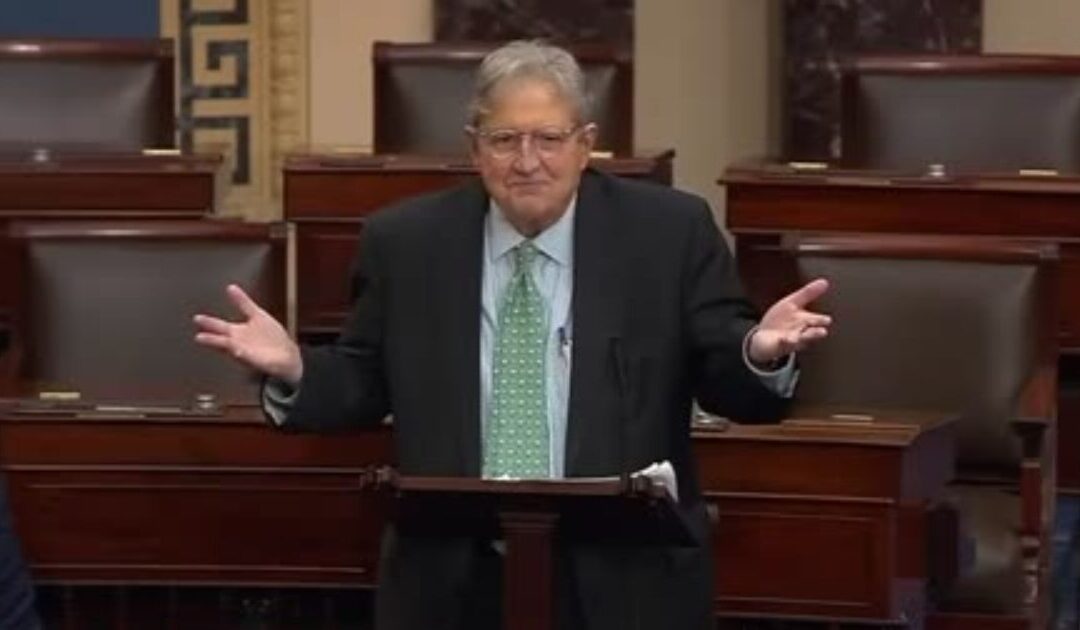
Senator John Kennedy (R-LA) is turning up the heat on Senate leadership after his resolution to withhold senators’ pay during government shutdowns sailed through committee unanimously only to stall at the hands of Senate Majority Leader John Thune (R-SD).
The resolution, S.Res.526, sailed through the Senate Rules and Administration Committee with a unanimous vote late last year, proving that even some of the most entrenched politicians recognize the basic fairness of this common-sense measure.
As Kennedy himself put it, when federal employees, troops, and border agents go without paychecks because Congress can’t do its job, why should senators keep cashing in?
Yet, despite overwhelming support and the glaring hypocrisy of Congress exempting itself from the consequences of its own failures, RINO Sen. John Thune continues to sit on the legislation.
In a recent interview, the fiery Louisiana senator didn’t mince words about his frustration with the slow-walking leadership.
Desirée Townsend: I want to ask you about your legislation to withhold senators’ pay during a shutdown. I know I’ve asked you a few times—do you think there’s any way we can move this bill forward? Unanimous consent, even, and just see who objects to it?
Sen. Kennedy: Well, my bill came out of the Rules Committee unanimously. The only thing stopping it from passing—I’m not saying everybody will vote for it, but I think most senators will—is that Senator Thune has got to bring it to the floor. And because it’s in the form of a resolution, you can’t really—it’s difficult to put it on another bill.
And so, I have chased John like he stole Thanksgiving to try to get him to do it, but so far he hasn’t agreed. But I’ll keep pounding him.
Desirée Townsend: So DHS employees could maybe reach out to Thune’s office and try to help push forward a mechanism to bring it to the floor?
Sen. Kennedy: Sure.
WATCH:
@cheerleader4changeSenator John Kennedy on his legislation to withhold senators’ pay during a government shutdown.
(VIDEO) War Secretary Pete Hegseth Says US Still “Holds the Cards” After Israel Strikes Iranian Gas Fields without US Knowledge
March 19, 2026
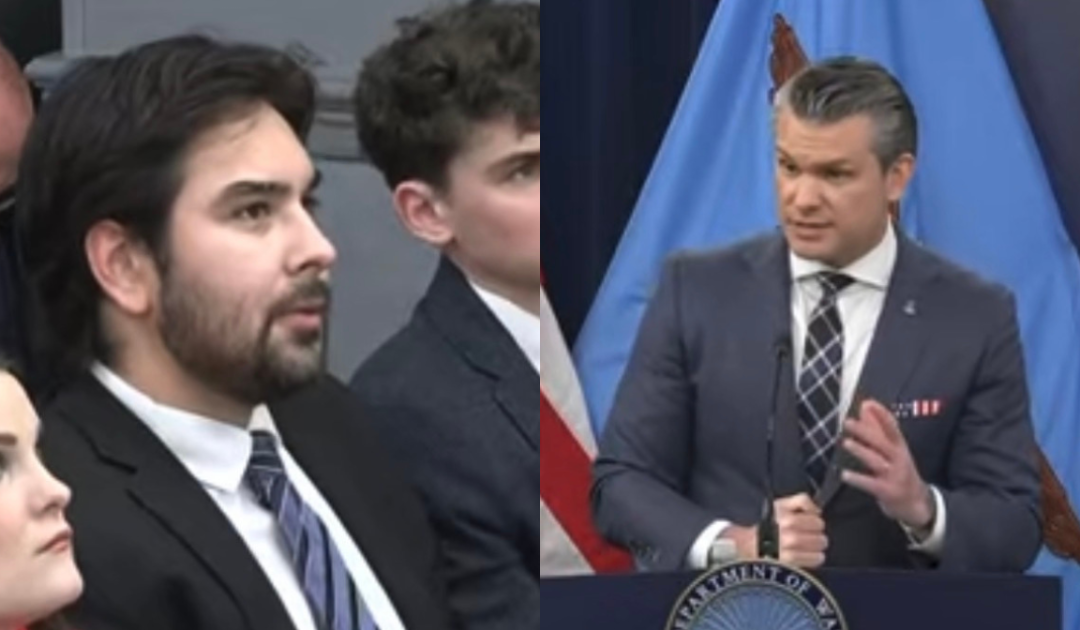
War Secretary Pete Hegseth on Thursday said that the US still “holds the cards” with the war in Iran after Israel struck Iran’s facility at the South Pars gas field, a natural gas field shared by Qatar and Iran, without US knowledge beforehand.
As The Gateway Pundit reported on Wednesday, President Trump announced that Israel had “violently lashed out at a major facility known as South Pars Gas Field in Iran,” and that the US “knew nothing about this particular attack.”
This prompted Iran to launch retaliatory attacks on Qatar’s liquid natural gas facility at Ras Laffan Industrial City.
For the second time this month, Israel has seemingly acted on their own interests, which may conflict with the United States' interests or objectives.
As The Gateway Pundit previously reported, Israel attacked Iranian oil depots, leading to shock from American officials. “The president doesn’t like the attack. He wants to save the oil. He doesn’t want to burn it. And it reminds people of higher gas prices,” a Trump advisor told Axios earlier this month. War Secretary Pete Hegseth told The Gateway Pundit last week that Israel was pursuing “different objectives” in this attack. "We’re not getting pulled in any direction. We’re leading," he added.
Likewise, Hegseth responded to the latest incident, stating, "We hold the cards. We have objectives. Those objectives are clear. We have allies pursuing objectives as well, and the truth speaks for itself," describing Israel's attacks as a "warning."
"And POTUS has made it clear, very clear, Iran knows when you hit Kharg Island, and you hit military capabilities on Kharg Island, which is the only thing we hit, we can hold anything at issue, anything," he continued.
WATCH:
Conradson: With this strike yesterday on the South Pars gas field, you know, if the US didn't know about it or didn't approve of it, it kind of seems like a trend of Israel apparently pursuing their own objectives over US objectives. I'm not sure if you agree with that, but the President has said he doesn't want to hit Iran's oil infrastructure right now. As you said, the US avoided this on Kharg Island. Oil is nearing $120. Why are we helping Israel prosecute this war if they're going to pursue their own objectives?
Hegseth: We hold the cards. We have objectives. Those objectives are clear. We have allies pursuing objectives as well, and the truth speaks for itself. I mean, President Trump is very clear about that. Iran has weaponized energy for decades. Israel clearly sent a warning, and POTUS has made it clear, very clear, Iran knows when you hit Kharg Island and you hit military capabilities on Kharg Island, which is the only thing we hit, we can hold anything at issue, anything.
The United States military controls the fate of that country. Iran has the ability to make the right choices. It should not, going forward, target Arab allies, Arab countries trying to create pain, the pain that they created themselves.
We use technologies like cookies to store and/or access device information. We do this to improve browsing experience and to show (non-) personalized ads. Consenting to these technologies will allow us to process data such as browsing behavior or unique IDs on this site. Not consenting or withdrawing consent, may adversely affect certain features and functions.
Functional
Always active
The technical storage or access is strictly necessary for the legitimate purpose of enabling the use of a specific service explicitly requested by the subscriber or user, or for the sole purpose of carrying out the transmission of a communication over an electronic communications network.
Preferences
The technical storage or access is necessary for the legitimate purpose of storing preferences that are not requested by the subscriber or user.
Statistics
The technical storage or access that is used exclusively for statistical purposes.The technical storage or access that is used exclusively for anonymous statistical purposes. Without a subpoena, voluntary compliance on the part of your Internet Service Provider, or additional records from a third party, information stored or retrieved for this purpose alone cannot usually be used to identify you.
Marketing
The technical storage or access is required to create user profiles to send advertising, or to track the user on a website or across several websites for similar marketing purposes.